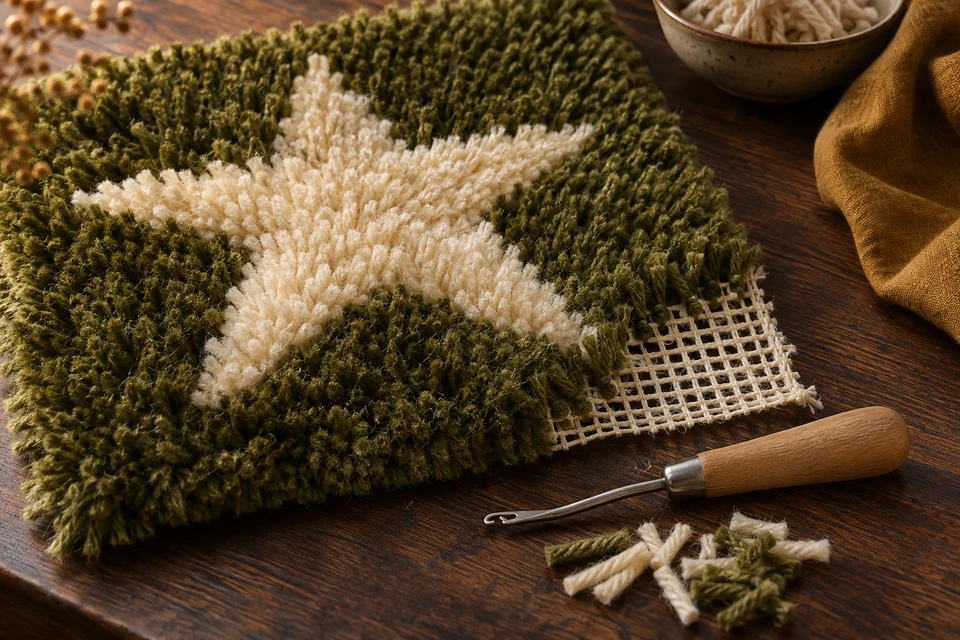
The fluffy face of a Christmas latch-hook panel can hide the structure that holds its design together. A buyer needs to identify the canvas, the individual yarn knots and the places that are meant to remain empty. Those details distinguish the proposed product from a similar-looking looped or tufted surface.
Establish what has been knotted onto what
A pile appearance is not a construction description
Yarnspirations describes latch hooking as working pieces of yarn with a special hook and canvas. That limited description helps separate individual cut-yarn knots from a continuous looped textile. Ask the supplier to show a partly worked sample and explain how the offered pile is attached to its ground. Do not infer the method merely because a photograph looks handmade or resembles a familiar craft kit.
Define the commercial unit at the same time. A finished hanging panel, a cushion front awaiting assembly and a do-it-yourself kit are different products. A kit introduces components and instructions that are outside a finished-panel quotation. For this buying brief, the focus is a completed decorative textile or an identified panel supplied for assembly. Any alternative should receive its own description and sample rather than sharing an ambiguous seasonal item code.
Turn the design into a canvas-position record
Count actual locations rather than relying on the silhouette
Ask for a working map that identifies the canvas orientation and the positions intended to carry yarn. Show deliberately bare areas separately from missed knots. A simple star can have stepped boundaries where its shape follows the grid; those boundaries should be accepted at the actual canvas scale. Avoid judging the outline from a smooth digital drawing that cannot describe the way individual knots occupy the ground.
Record the offered canvas reference and inspect a measured sample of its spacing. Do not calculate finished dimensions from an unverified retail mesh description. If the supplier changes the canvas, compare the number and spacing of occupied positions again. The same counted motif on another ground may change its physical size and the apparent density of the pile. That change needs a sample decision, not merely a revised dimension on a spreadsheet.
Define the cut-yarn proposal
Length and material belong to the worked sample
Request the yarn description, supplied colour references and the agreed preparation of the cut pieces. A loose bundle of attractive yarn does not establish how the knotted surface will appear. Compare a small worked area containing the actual foreground and background colours. Look at whether the pile hides the intended ground and whether neighbouring colours remain distinct when the panel rests naturally in its display position.
Keep the pile preparation explicit: note whether the supplier trims or shapes the worked face after knotting and what condition the buyer will receive. Do not give receiving staff an instruction to trim any uneven piece until the accepted finish is understood. An intentionally irregular textile and an unfinished panel may appear similar in a distant photograph. Retain close and ordinary viewing-distance references so the judgement does not depend solely on an extreme enlargement.
Inspect attachments from the reverse
Do not replace a knot review with a pull on every tuft
Turn over the worked sample and locate several positions from the design map, including a corner, a colour boundary and an apparently bare area. Ask the maker to demonstrate the intended knot arrangement. Look for missing positions, unexpected attachments or a change in construction between the submitted samples. Record findings without repeatedly tugging on the yarn, which may alter the very condition that the inspection is meant to document.
If the proposed product needs an attachment-retention evaluation, have the responsible technical team define an appropriate method and acceptance criteria. A quick hand pull is not a certified strength test. The reverse approval should also identify any backing, coating or lining, including its material and purpose. A hidden layer does not eliminate the need to understand the knot-and-canvas structure before the finished item is closed or mounted.
Approve the panel as it will be displayed
Assembly can obscure the edge positions
For a hanging panel, review how the ground is finished and connected to the proposed mounting arrangement. For a cushion front, show where the usable pile ends and the assembly allowance begins. Keep these interfaces away from any assumption that the visible star outline defines the entire cut piece. Ask for the completed decorative unit so the buyer can see how the edge treatment affects the surrounding pile.
Review packing and ordinary unpacking with the actual face preparation. State any supported settling or grooming step that the customer is expected to perform; do not hide a lengthy finishing operation inside the word fluff. Compare the design after that agreed procedure and after the proposed care review. The aim is an identifiable delivered appearance, not a promise of indefinite pile recovery or suitability as a floor rug, child product or protective textile.
Price a counted design and a defined finish
Preserve the distinction between panel and product
Provide each seasonal design with its canvas reference, occupied-position map, yarn proposal, face finish and edge arrangement. Ask whether changes in colour count, knot count or unit construction affect minimum quantities and development charges. A smaller external rectangle does not necessarily mean less work if its grid is more densely occupied. Compare offers on the same completed scope rather than selecting solely by the price of a superficially similar pile surface.
For an FY Bedding enquiry, include the authorised Christmas artwork, intended decorative use and an example of the reverse construction you want reviewed. Request the necessary development sample and a quotation that names the delivered unit. Confirm production and shipping milestones after that scope is agreed. The resulting approval should allow another reviewer to distinguish an intentional open canvas position from a missing knot without guessing from the product's festive appearance.
Identify the canvas and yarn knots, map filled and bare positions, approve trimming and reverse attachments, and connect the accepted panel to its actual edge finish and selling unit.
Method references: Yarnspirations: individual latch-hook yarn attachments on canvas.