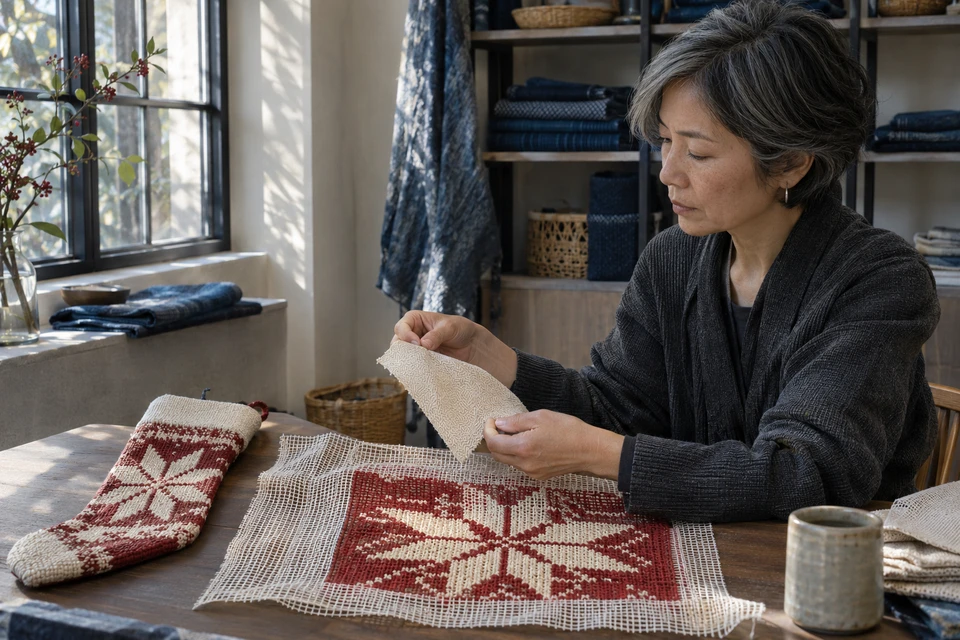
Two needlepoint stockings can show a similar Christmas star while using different canvas structures underneath. A sourcing brief should identify that substrate before it treats thread samples, embroidery quotations or finished stocking photographs as comparable evidence.
Ask what the canvas actually is
Single and paired structures need their own references
The University of Kentucky's needlepoint material guide distinguishes single-thread or mono canvas from double-thread or Penelope canvas, and also describes interlock canvas. Those names are a starting vocabulary for a supplier conversation, not proof of what a pictured stocking contains. Request the offered manufacturer's canvas reference and a labelled, unworked sample. Ask the maker to identify the structure in that sample rather than accepting a loose description such as fine needlepoint ground or premium embroidery mesh.
Keep any proposed alternative visible in the quotation. A supplier may prefer a different canvas because of its working process or available materials, but that proposal needs a buyer decision. A similar colour and nominal opening description do not establish equivalence. Obtain the declared composition and any preparation or finish relevant to the supplied substrate. Do not infer cotton content, stiffness, colour retention or suitability for the intended care route from the canvas name alone. Those attributes belong to the named material and its evidence.
Make the mesh description unambiguous
Define the counting basis before comparing numbers
A number without a basis can conceal a misunderstanding, especially when paired threads are involved. Ask the supplier to state what is being counted, the unit used and how the description relates to the offered canvas. Retain an identified close photograph with a scale and enough unworked material to show the structure. The purpose is to reconcile the buying references, not to prescribe a universal mesh size for every stocking. The maker should explain its proposed substrate and stitch plan together.
Do not approve a substitute merely because it repeats the same number found in the first quotation. Compare the unworked references side by side and ask the technical owner to resolve any difference in terminology. Keep the agreed description in the bill of materials and sampling request. If a chart or embroidery file is supplied separately, identify which canvas reference it was developed against. A change of substrate should trigger an explicit review, rather than leaving production to adjust the working interpretation without a recorded decision.
Pair the thread proposal with the substrate
A colour card cannot approve the working combination
Request a worked section made with the intended canvas and the proposed thread reference. Include a representative change of stitch direction and an area where the embroidery approaches the future cut edge. The review should expose whether the maker can produce the intended surface on that combination, not merely demonstrate an attractive colour. Record the thread composition and size description supplied by the source. Do not assume that a matching shade from another range behaves the same way during embroidery or finishing.
Review the worked and unworked samples together, with the reverse visible. Ask the maker to identify any changes it needed in order to work the sample, such as a different thread selection or substrate preparation. Procurement should record the controlled proposal rather than offer an improvised stitching correction. Keep comments specific to the observed condition: a distorted local area, an unexpectedly rigid section or a difficult transition into the edge. This is more useful than declaring one canvas family universally better or worse from a single trial.
Carry the canvas decision into the complete stocking
The embroidered face is only one component
Identify the boundary between embroidery and the allowance used to assemble the stocking. Ask for a sample that includes the toe curve, heel area, top opening and the proposed backing or lining where relevant. A flat worked rectangle cannot approve the final silhouette or the way the substrate is enclosed. The maker should show how the offered construction avoids exposing unfinished canvas in the agreed finished item. Do not assume that a lining or backing is included unless the quotation explicitly lists it.
Review the stocking from inside and outside without filling it to disguise the shape. Record whether the intended surface can be obtained with the actual assembly and preparation steps. A visually acceptable embroidered face does not establish the hanging loop's capacity or the stocking's suitability for holding particular gifts. If a filled display is part of the project, define it separately with the responsible supplier. Keep claims about function, care and intended users tied to the complete product, not to the canvas vocabulary.
Request the right sample evidence at each stage
Preserve a substrate witness through revisions
Keep a small unworked reference from the canvas used for the approved development sample, identified alongside the worked panel. It provides a useful witness when a later sample feels different but the visible embroidery looks similar. Record sample dates, substrate reference, thread reference and any maker-declared preparation. The evidence does not need to become an excessive archive: it needs to let a reviewer connect the finished appearance to the actual material combination that produced it.
When a revision arrives, ask which input changed before comparing the stockings. A change in canvas, thread or finishing is not interchangeable with a change in colour. Review the intended care route only after the material and complete construction have been identified. Any performance statement requires relevant support for that combination. A teaching guide about canvas types is not a certification, a production test or proof that a particular stocking can withstand a named treatment. Keep those evidence categories separate in the approval record.
Quote a named material combination
Resolve availability before committing a seasonal range
The request for quotation should connect canvas identity, counting basis, thread selection, completed stocking construction and the required sample stages. Ask whether the named canvas is held in stock, sourced to order or proposed as a development option, and have the supplier confirm the implications for minimum quantities. Do not assume that different Christmas colourways can share every material minimum simply because they use one outline. A change in backing, lining or canvas colour can create a different purchasing scope.
Send FY Bedding the substrate and worked references, intended quantities and destination requirements for a feasibility discussion. Ask for alternatives to be listed with their own sample and timing assumptions. Plan approval time before agreeing a dispatch proposal; neither a material name nor a finished photograph establishes a holiday delivery commitment. The useful result is a quotation that can be traced to one identified needlepoint construction, with substitutions visible before the buyer authorises production rather than discovered in the received cartons.
Confirm the actual mono, Penelope or other canvas reference, its counting basis and the worked thread combination. Retain an unworked witness and approve the complete stocking before treating an embroidery sample as a finished-product decision.
Method references: University of Kentucky: mono and Penelope needlepoint canvas.