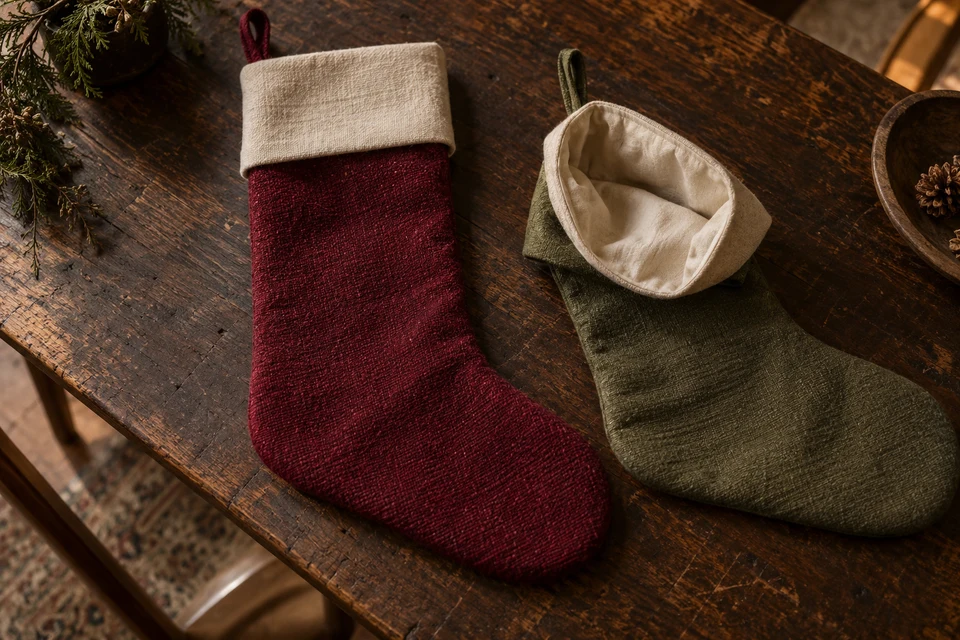
A decorative stocking can look generous in a flat photograph yet be awkward to fill. The folded cuff, lining, heel turn and hanging position all affect the space available for a gift. For a seasonal retail program, start with the intended gift presentation rather than selecting a height alone. This guide covers sewn decorative fabric stockings, not wearable hosiery or a tested load-bearing carrier. Dimensions, contents and attachment requirements need approval for the particular design; a photograph cannot establish them.
Measure the usable route
An opening dimension is not the same as outer width
Describe the largest intended gift by its wrapped dimensions and shape, including rigid corners. A narrow bottle-shaped item and a square presentation box can behave very differently inside the same stocking. Record the clear opening with the cuff in its displayed position, the internal depth to the heel and the space into the toe. Avoid stretching the shell to obtain an attractive number. Include an outline drawing and measurement landmarks in the technical pack so every supplier quotes the same interpretation.
Try inserting and removing representative empty gift boxes during sampling. Note where a corner catches or where the lining travels with the box. Do not force a box past the cuff and then describe the trial as a fit. If the intended contents are not yet selected, approve a bounded range of shapes instead of a universal capacity statement. Photograph the empty stocking and the agreed filled presentation from the same direction. These views help distinguish a naturally shaped toe from one held open by temporary styling material.
- Record clear opening with cuff folded.
- Approve specific gift shapes, not a capacity implied by height.
Treat the lining as a separate component
Resolve inside construction before decorative finishing
Identify shell, cuff, lining and any interlining separately. A wool-like appearance is not a fiber declaration, and the visible cuff need not share the shell composition. Ask whether the lining is full-length, how its bottom is closed and where it is anchored to the outer stocking. Capture those decisions in the bill of materials. An inside-out sample or unfinished construction sample can be more informative than another front photograph.
Inspect the transition from cuff to lining and the narrow heel turn. Look for an internal ridge that reduces useful space, exposed threads that catch gift wrapping, or a lining bag that pulls out during ordinary removal. Describe the observation before asking the maker to revise it; the buyer need not invent a sewing method. Recheck usable dimensions after any extra layer is added. A visually identical stocking with a stiffer backing can behave differently at the opening, so record the construction revision together with the fit result.
- Name every layer.
- Review lining movement during removal.
Approve both empty and filled hanging views
A display loop is not a performance certificate
Choose the intended display orientation: toe pointing left or right, cuff facing the viewer, and loop position visible or concealed. Hang the production-intent sample on the proposed display fixture using only a load and method approved by the responsible technical owner. Document twisting, cuff roll and the angle of the toe. If the merchandising plan uses decorative empty stockings, keep that approval separate from any filled-use proposal. A neat loop stitch does not by itself establish a safe load.
The seam specification should identify the agreed loop attachment location and construction. Ask the technical owner what evaluation is appropriate for the intended contents and market; do not turn an informal hanging photo into a strength claim. Keep the display clear of heat sources and use the property or retailer's approved installation arrangements. Decorations that are intended for children or include detachable pieces require a separate product-safety assessment, rather than assuming that a decorative name settles the intended use.
- Approve left/right orientation.
- Separate visual hanging approval from attachment evidence.
Compare motif and cuff options commercially
Separate an attractive collection from an orderable one
Build the quotation table by shell fabric, cuff material, motif technique and colorway. Ask which minimum applies to the stocking itself and which applies to a special trim or decoration. A pooled fabric quantity does not automatically mean every embroidered motif can be ordered in any quantity. Use the component MOQ discussion to identify shared inputs, while retaining a separate finished stocking quantity for each design.
Request a sample that contains the most difficult cuff-to-shell combination, then confirm whether the remaining variants need their own approvals. For personalized programs, define the permitted name area and the point at which artwork becomes fixed without promising arbitrary customization. Compare offers using the same lining coverage, finishing scope and packing state. A lower quote that omits a lining or decorative back is a different product, not simply a better price. Keep delivery assumptions tied to final artwork and sample approval dates.
- Separate fabric, trim and finished-design minima.
- Quote the back and inside, not just the display face.
Release a recoverable retail presentation
Packing should not conceal a construction compromise
Test the proposed fold with the approved stocking, including its loop and cuff. Check whether the cuff is flattened into an unintended crease or a thick decoration presses into the shell. Reopen the pack using the same routine that a store team or customer would follow. Record the presentation after unpacking without adding unapproved steaming or manual reshaping. The retail fold approval provides a useful place to document that handling sequence.
Finish with a SKU-level release sheet showing shape, orientation, layer identities, motif version, packing fold and the approved gift examples. State whether the package contains only the stocking; do not let styled gifts in photography imply included contents. Before sending a project brief to FY Bedding, select the target market, design count and intended order mix. Those inputs allow sample scope and commercial feasibility to be discussed without claiming a universal minimum, delivery date or tested carrying capacity.
- State stocking-only contents clearly.
- Retain the accepted unpacked view.
Release only when the same sewn sample satisfies opening fit, lining behavior, hanging presentation and pack recovery. Keep visual approval separate from load or safety evidence.