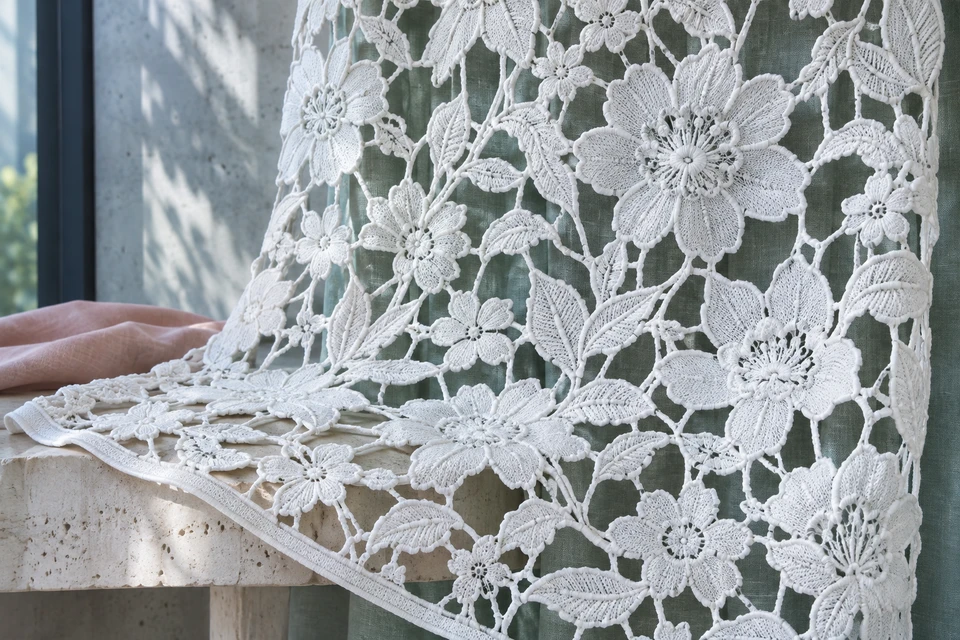
A floral lace panel can be supported by a net ground or formed as connected motifs with open space between them. Those are not interchangeable purchasing descriptions. When a buyer asks for guipure, the useful first check is whether the offered lace field is actually net-free. The next decision is how that connected field can become the proposed panel without losing the motif relationships that made the design attractive.
- 1. Look through the spaces between the flowers
- 2. Map the connected motif field before choosing panel dimensions
- 3. Decide what belongs at the panel perimeter
- 4. Plan seams around the actual lace structure
- 5. Separate construction identity from performance evidence
- 6. Buy an identified panel layout rather than an unnamed lace length
Look through the spaces between the flowers
Identify the ground rather than relying on the style name
Powerhouse's collection description of a guipure lace example identifies motifs connected by bars without a net ground. This museum reference provides terminology, not an assertion that a current commercial panel shares the object's origin, age or making method. Ask the supplier to describe the actual offered lace, its material and its manufacturing route. The visible absence of net does not establish hand production, a particular country of origin or a fibre composition.
Place a sample over a contrasting plain background and inspect several openings. Distinguish genuinely open spaces from fine mesh that is difficult to see in a pale photograph. If a net-ground alternative is offered, label it as an alternative and compare its appearance deliberately. A buyer may prefer either construction for a project; the problem is allowing a broad floral-lace description to conceal the difference after a sample or price has been approved.
Map the connected motif field before choosing panel dimensions
Usable design area is not the same as fabric width
Ask for a representative piece showing the full repeat and both boundaries where applicable. Identify the flowers, leaves and connecting elements that form the field. Mark the intended panel outline on a copy of the layout rather than immediately cutting the only approval sample. Observe where the proposed perimeter crosses a motif, a connecting bar or an open space. That map reveals which parts of the requested shape need a specific finishing solution.
Record the usable pattern area separately from any plain margin or manufacturing edge. Two fabrics sold at the same overall width can offer different practical options for the proposed panel. If several sizes are required, draw each within the actual repeat. Do not calculate finished units only by dividing nominal fabric width by panel width; the chosen motif placement and boundary treatment may be essential to the approved appearance and should be reviewed with the maker.
Decide what belongs at the panel perimeter
A cut edge and a decorative border are different offers
Specify whether the product uses an existing decorative lace edge, a newly finished cut perimeter or a plain surrounding fabric frame. Ask the supplier to demonstrate the proposed result at a corner and along more than one side. A photograph of the centre cannot approve the edge. If the design depends on an intact flower at the boundary, show its required position explicitly and compare that requirement with the supplier's actual cutting proposal.
Keep any added edging material identifiable. It may change the visual weight of a delicate floral field or introduce a new component into the care and material review. Conversely, an exposed lace boundary may be the intended effect. Neither choice should be assumed from the word guipure. The purchasing record should tell the assembly team where the connected field ends and what the finished product uses to complete that edge.
Plan seams around the actual lace structure
Do not assume a continuous cloth lies beneath every stitch line
Review how the lace is joined to another panel, backing or surrounding fabric in the intended article. Mark the seam route against the motif map and ask for a sewn trial using the actual lace. Observe whether the join catches the intended structural areas and whether the visual line is acceptable. This is a sample-development decision for the responsible maker, not a universal instruction to sew through every connecting bar in the same way.
For a cushion or decorative overlay, specify whether the background is permanently attached, removable or separate. The underlying colour may be central to the floral appearance, so identify whether it is included in the supplied unit. Inspect the completed assembly flat and in its normal display shape. A net-free sample held up against a light can be appealing while providing little information about the seam, backing and folded state the customer will receive.
Separate construction identity from performance evidence
Net-free does not mean automatically stronger or more delicate
Ask what assessments are relevant to the intended use and which actual material combination they cover. Do not infer strength, snag resistance or care suitability merely from the thickness of the motifs or the absence of mesh. A visual inspection should document unwanted breaks, missing connections or inconsistent appearance against the agreed sample, while any performance requirement needs its own defined method and acceptance criteria.
Retain the complete article after any agreed care evaluation and compare its motif field, seams and boundaries with the original. If a supplier changes the lace source or the backing, determine whether new evidence or another sewn sample is needed. This review is distinct from checking the removal of temporary embroidery support during manufacture. The buyer's focus here is the construction actually supplied: the net-free field, its usable shape and its relationship to the finished assembly.
Buy an identified panel layout rather than an unnamed lace length
Cutting and assembly scope belong in the offer
Ask the quotation to state the lace reference, declared composition, usable pattern area, selected layout, boundary finish, joining scope and included backing. Clarify whether the price is for material by length, cut panels or completed articles. A decorative lace length is not equivalent to a ready-to-use panel merely because both show the same flowers. Request project-specific minimums and sampling requirements before treating a pattern choice as an available finished product. Use FR-01 as a floral visual direction only; guipure construction, material and supply scope need separate confirmation.
Bring FY Bedding the preferred floral direction, target panel dimensions, intended background and quantity split to discuss the proposed development. Confirm the lace and assembly route separately from the displayed collection imagery. Keep an accepted full-layout sample available for the receiving review, with close views of the net-free spaces and finished boundaries. A clear offer then answers not only what the flowers look like, but what connects them and how that connected field becomes the purchased unit.
Can the offer demonstrate a genuinely net-free field, a workable cutting layout, resolved seams and boundaries, and a clearly stated supply unit with any backing identified?
Method references: Powerhouse: guipure lace without a net ground.