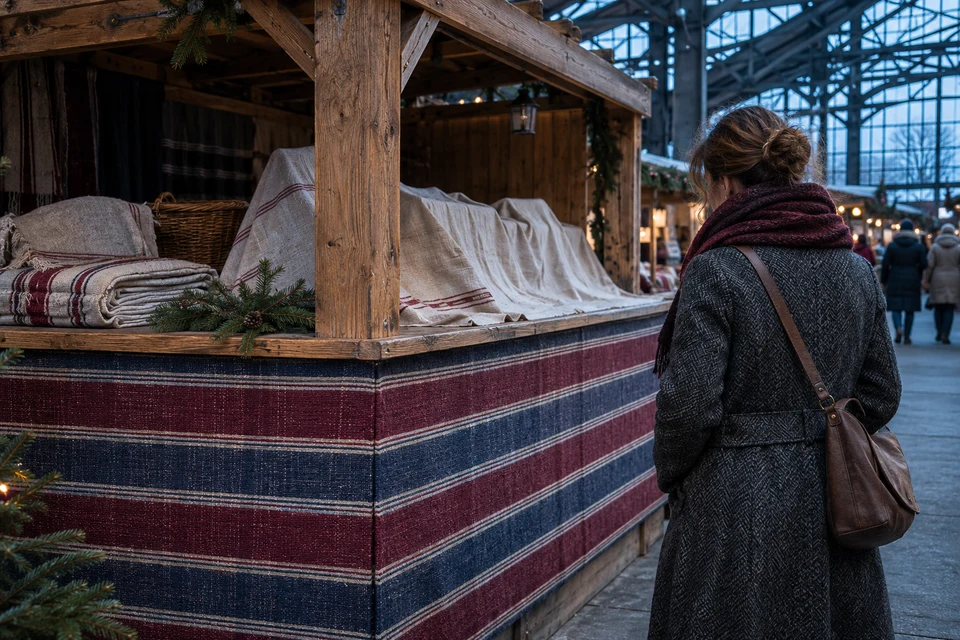
At a Christmas market, stalls that look identical from the aisle can have different working ends. One seller trades from the front only; another serves around a corner. A continuous skirt that looks tidy in the catalogue may have to be pulled away every time a box of stock comes out. Plan the working openings before placing the stripe or deciding how many panels to buy.
Sketch the stall as a route
Distinguish customer frontage from access space
Draw a plan as if looking down from above. Mark the public face, every corner post, the side where staff enter, and the place where stock is brought in. Walk the route with an empty replenishment carton. A corner used to turn into the booth is not a spare section of fascia; a hanging panel there can be caught by the carton. Ask the event operator which areas, fittings and clearances must remain untouched.
Measure along the intended attachment surface, not along the front lip of the countertop. At a projecting counter the two lines can have different lengths. Note any face where the trim cannot be attached and photograph it from beneath. Measure the drop with the counter installed on the venue floor. If the floor slopes, record both ends rather than trimming a bulk order to a measurement taken at the level end of a sample stall.
Build the corner at full scale
Compare a shared return with two separate panels
Pin a plain mock-up along one front bay and around the corner. With a one-piece return, the motif can continue naturally but one side must be detached to move the other. With two panels, a damaged side can be replaced without replacing the whole front. The price comparison should include the extra finished ends and the number of attachment points; a shorter panel is not necessarily the cheaper way to dress a bank of stalls.
Decide which panel owns the visible corner. Overlapping two bulky bound edges can lift both away from a square post. Bringing them exactly edge to edge may reveal the bare post if either is pulled during restocking. Try a narrow return behind the front face, then view it from the route customers actually use. On a striped Christmas design, compare stripe height when the corner is closed and after the panel has been opened once.
Allocate the bays by booth type
Avoid ordering by total running length alone
List the required front, left-return and right-return units for each stall type. Ten metres of fabric do not tell the installer whether the last two end panels face the right way. For instance, a row of neighbouring counters might need only two public end returns, while the same counters scattered across an aisle would expose more ends. Keep the layout identified by venue revision, especially if the operator has not yet assigned corner stalls.
Ask the supplier to quote shared front panels separately from site-specific returns. A neutral front with an interchangeable seasonal band may be worth sampling if other events use the same footprint. Check the interface on an assembled front: a removable band should not hide the opening the stock team needs. Keep spare quantities tied to the panel most likely to be changed locally rather than adding the same allowance to every component.
Rehearse installation from the packed set
Let someone else dress a bare counter
Bundle the sample panels as they will arrive and give them to a member of the venue team who did not prepare the plan. Watch which face is hung first and whether the installer has to remove an entire length to correct one reversed end. A discreet identifier on the staff side can save more time than a decorative detail on the aisle side. Check that the identifier stays hidden from ordinary customer viewpoints.
Finish by asking the operator to confirm the attachment arrangement, site restrictions and any evidence required for the selected fabric. A visual fit trial cannot approve a venue's fire, access or installation requirements. Agree who provides fixings, who removes the skirts after the event and how panels are grouped for storage. A tender can then compare like-for-like packages instead of comparing an installed front with an unmarked length of cloth.
Share the operator's counter drawing and the count of left and right end stalls. Request one assembled corner and one packed installation bundle before multiplying the quantities.