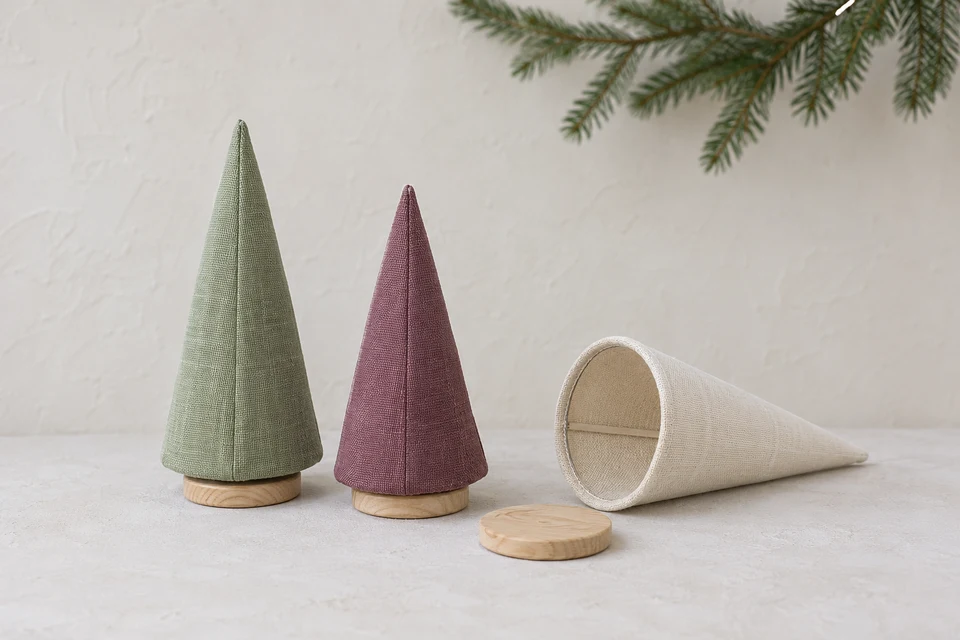
A set of textile cone trees can occupy very different storage volumes depending on what happens beneath the fabric. A hollow shell that lifts off a separate base may nest with other sizes; a fully closed construction may arrive ready to display but require separate packing positions. For a retailer buying a coordinated Christmas tabletop assortment, that choice affects assembly, missing-component risk and the appearance of the opened set. Start by deciding which parts the store or customer is expected to handle. Do not approve a photograph as evidence that the proposed construction will nest.
Define the set as separate components
Count shells and bases before comparing quotations
List every tree height, shell opening, support and base in the proposed assortment. Specify whether the visible textile is removable from its support or permanently attached. These are different products even if their room photographs look similar. A quote for three dressed shells is not directly comparable with a quote for three complete trees and a fitted storage tray. Ask the supplier to identify the components included in each selling unit and the components shared across sizes.
Use a simple assembly drawing showing the correct pairing. A base that fits two shells may simplify component control, but it can also allow an incorrect combination to look plausible. Give the packing team a way to distinguish intended pairs without relying on a subtle fabric shade. Keep component identifiers in the internal specification even when consumer-facing packaging uses only the collection name.
Trial the nesting route physically
Clearance matters at the stitched rim
Obtain one complete size set for a dry nesting trial. Lower the smaller shell into the next size without force, noting where its seam, lining or stiffened rim first contacts the outer shell. The widest point is not necessarily the opening measured flat. A turned edge or gathered seam can reduce usable clearance. Record the actual insertion depth and the portion that remains exposed; those observations determine the proposed packed height.
Repeat the trial with the agreed protective layer between shells. Tissue or a fabric separator consumes space and may catch on a projecting edge. If protection prevents the intended nesting depth, revise the pack dimensions rather than removing protection without review. Photograph the nested arrangement from above and from the side so the supplier can see whether the inner shell is centred or resting against one wall.
Compare assembly with display appearance
Approve the base in its working position
Set the assembled trees on the type of shelf or table expected in the retail presentation. View them from customer eye level as well as from above. Check whether the base remains deliberately visible, whether a gap exposes the support, and whether the lowest textile edge sits consistently around the circumference. A small variation that is hidden in a front photograph can become conspicuous when the display is viewed from several directions.
Ask someone who did not develop the sample to assemble the set using the proposed instructions. Observe hesitation, reversed parts and repeated attempts. Do not substitute a claimed assembly time for this trial. If the buyer wants a ready-to-place product, a fixed base may be preferable even when it occupies more space. If storage economy is important, document the additional assembly steps and the responsibility for checking that all parts are present.
Review the opened pack after storage
Separate creasing from structural damage
Pack the approved sample in the intended orientation and retain a second unpacked reference. Agree the storage and handling conditions with the supplier before comparing the two. After unpacking, inspect the cone tip, side seam and lower rim for distortion. Record any recovery procedure needed to restore the display shape. Avoid promising that a compressed textile construction will recover automatically unless the agreed trial supports that statement for the actual materials.
Do not treat a successful nesting demonstration as transport validation. Carton movement, concentrated contact and changes in handling can create different problems. The purchasing specification should distinguish the nesting arrangement from the distribution test plan. Ask for relevant evidence using the final support, base and packing materials, particularly if a decorative base is hard enough to mark an adjacent textile face.
Freeze the assortment before production
Make the approval cover the whole selling unit
Review colour proportions across the assembled set rather than approving each cone independently. A tall dark tree can dominate two pale companions even when individual colours match their references. Confirm the intended front seam position, the order shown in merchandising photographs and whether the customer may rearrange the pieces. Keep these presentation choices separate from dimensional acceptance criteria so a styling preference does not become an undefined manufacturing rejection.
Before releasing the order, request a revised component list, the approved assembly sequence, the nesting photographs and the final packed dimensions. Obtain written confirmation of quantities, sampling scope and delivery planning rather than assuming a seasonal photograph implies stock availability. Send FY Bedding the proposed tree sizes, base concept and intended retail pack to discuss development requirements. The decision should be based on a complete working set, not on a promise that one construction is always more economical.
Approve one assembled set, one nested pack and one component-count record together; do not combine a fixed-base sample with a nesting quotation.