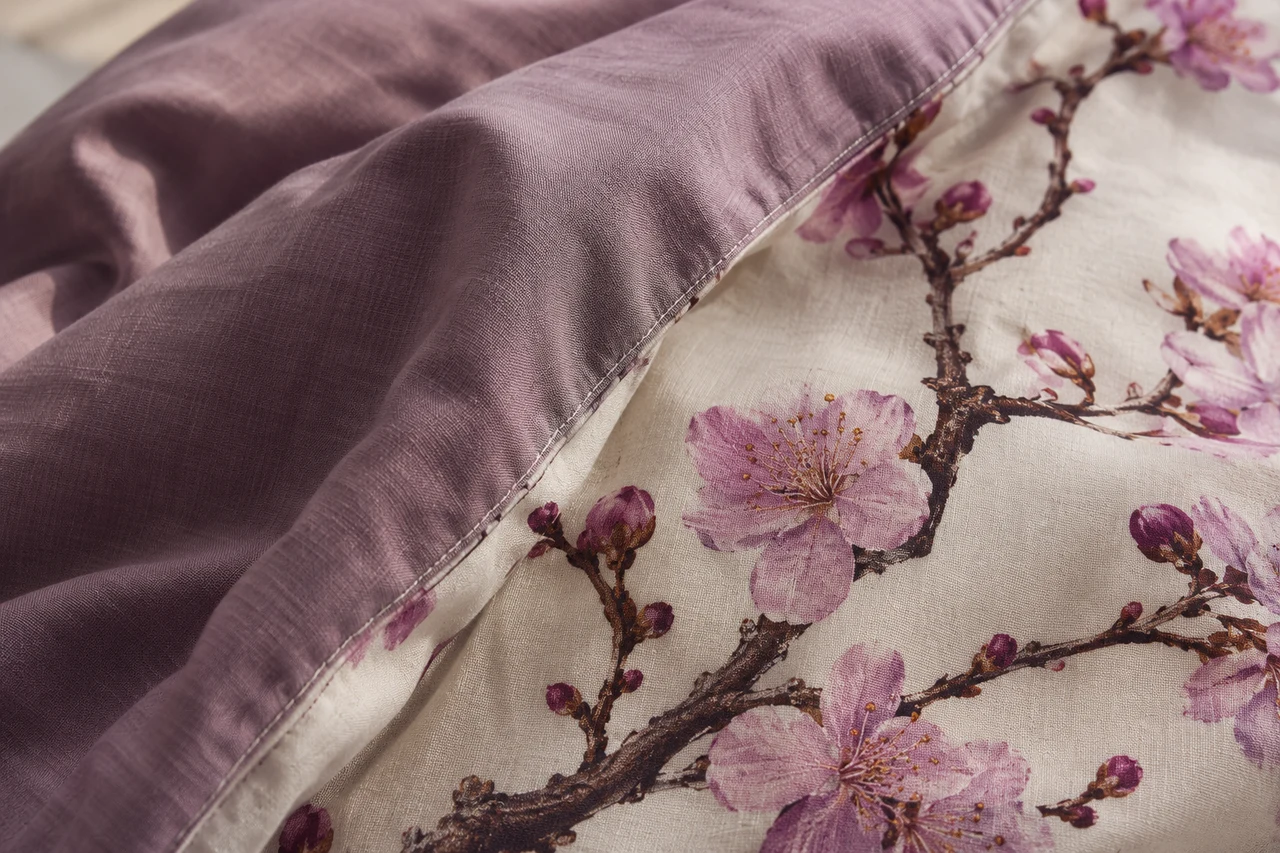
A flange can give a duvet cover a framed outline, but an attractive border on a sample table does not automatically produce the intended bed presentation. The border may fold downward at the sides, disappear beneath another layer or behave differently at the foot. Buyers need to separate decorative extension from the compartment that holds the duvet. That distinction keeps a styling choice from becoming an accidental change to insert fit, and makes quotations for different border treatments easier to compare.
- 1. Start by naming the decorative treatment precisely
- 2. Record chamber size and outside size separately
- 3. Judge the border where it falls on the bed
- 4. Inspect the corners without losing the overall line
- 5. Revisit the outline after care and finishing
- 6. Turn the approved presentation into a comparable quotation
Start by naming the decorative treatment precisely
A flange, applied band and printed frame are not interchangeable
A flange is a fabric extension beyond the seam or stitched boundary of the filled area. A contrasting band can instead lie within the main panel, while a printed frame may change no physical edge at all. Draw the intended treatment before asking for a border duvet cover. Include a simple cross-section if the sample maker could reasonably interpret the description in more than one way.
Peacock Alley's Filigree product description identifies a duvet cover with flanges on three sides, demonstrating one commercial arrangement rather than a universal rule. State which edges of your own cover receive the flange and how the remaining edge is finished. The main closure decision remains separate: a decorative border does not define how the insert enters the cover.
- Mark every edge that receives a flange.
- Separate the decorative extension from the usable insert chamber.
Record chamber size and outside size separately
Do not hide border allowance inside a nominal bed-size name
Request a drawing showing the finished chamber dimensions, visible flange width and overall outside dimensions. Identify where each measurement begins and ends. An overall width that includes two side flanges cannot be compared directly with another supplier's chamber width. A size label alone leaves this ambiguity unresolved, especially when a product is sold across markets with different naming conventions.
For illustration, a chamber with a finished decorative extension on each side has a wider outside outline; that does not make its internal compartment wider. Ask the supplier to reconcile the actual dimensions rather than using the illustration as a cutting formula. Check the intended duvet through the insert sizing review. Increasing the empty border should not be used to disguise an incorrect chamber fit.
Judge the border where it falls on the bed
Use side and foot views as well as the overhead view
Fit the proposed insert and arrange the cover on the intended mattress and bed base. Photograph the normal top view, both side drops and the foot. Notice where the filled area ends and where the unfilled flange turns or hangs. Decide whether the desired effect is a narrow line, a visible soft extension or a stronger framed silhouette; none of these requires the same width on every bed.
Review the styling with the planned sheet, pillows and any additional coverlet. A broad border may be hidden by the room's usual layering, while a small flange may visually disappear against a similar base. Use the size-set approval process to review representative sizes. One successful smaller sample should not automatically approve the outline of the largest size in the collection.
- Identify the insert and bed used for each photograph.
- Compare visible border width in the normal made-bed arrangement.
- Review the sides and foot without temporary styling aids.
Inspect the corners without losing the overall line
A close-up seam and a distant silhouette answer different questions
Examine the offered corner construction and how decorative stitching meets there. Look for the agreed alignment, turning shape and edge finish, then step back and compare the whole perimeter. Do not approve the bed only from a tightly cropped corner image. A neatly sewn detail may still produce a border that appears uneven when the cover is filled and arranged normally.
Ask the sample maker to explain any extra layer or reinforcement proposed to influence the flange's appearance. Evaluate that specific assembly rather than demanding that every flange stand rigidly upright. Connect construction notes with the seam and stitch specification. If a softer fall is the intended design, record it as an accepted characteristic so later inspections do not mistake it for a defect.
Revisit the outline after care and finishing
The border is part of the care decision, not an exception to it
Process the complete construction through the agreed care trial, including any contrast cloth, stitching or internal layer. Review whether the chamber and flange still present as intended after the documented finishing routine. Check the visible line, corner shape and the relationship between the border and main panel. Record changes without assuming a cause from appearance alone.
If the accepted result depends on pressing, make that requirement clear to the buyer and intended operator. Do not compare a carefully pressed development sample with an unpressed production item and call the difference a manufacturing failure. Keep the processed reference with the approved sample set, and identify any revision that changes border fabric, width or assembly.
- Record the care and finishing state used for approval.
- Retest changes that alter the border assembly.
Turn the approved presentation into a comparable quotation
Specify where the range is shared and where it varies
Give each supplier the same chamber dimensions, flange widths, covered edges, colors and sample expectations. Ask which design choices affect fabric use, sewing operations, minimum quantities and packing. Do not assume that a decorative extension has a standard surcharge. Establish whether border width stays constant across sizes or changes deliberately with the collection's proportions.
A FY Bedding development enquiry can include the bed photographs, dimension drawing and care-reviewed reference. Request a representative sample and a quotation tied to that scope. Product availability, construction feasibility and commercial terms should be confirmed for the project; a retail example shows a design possibility, not a guaranteed match from a different manufacturer.
Approve the insert chamber, outside outline, flange width and side-and-foot presentation as separate recorded decisions, then confirm the same assembly after its agreed care routine.
Method references: Peacock Alley: three-sided duvet flange product example.