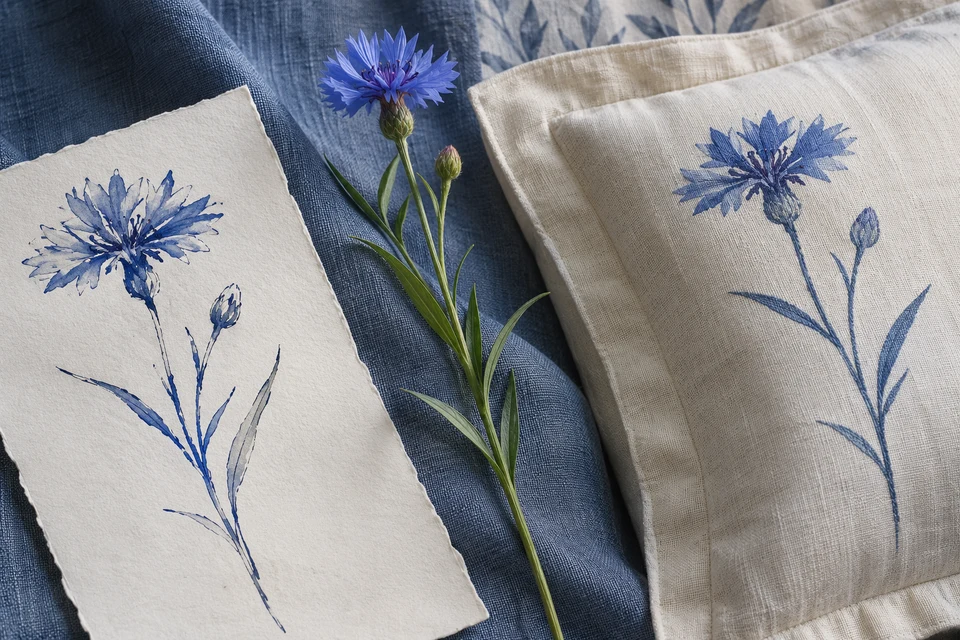
A museum shop asks for a cornflower pillow; a hotel asks for a pillow with blue meadow flowers. Those instructions may lead to similar colours but they are not the same brief. The museum buyer may reject a perfectly attractive blue bloom because the shape no longer represents the flower the collection is named after. Decide at the start whether the name is a promise about the subject or merely a working title for the palette.
Assign an owner to the flower identity
Give the illustrator one approved starting point
Ask the range owner who decides that the motif is recognisable. For a garden shop that person might be the curator responsible for the collection rather than the buyer who signs the fabric order. Have the owner supply an approved, usable reference: an original drawing, a commissioned study, or a photograph that the programme has permission to use for the agreed purpose. Keep its source and permitted use with the brief. A picture used to explain a mood is not automatically ready to trace or publish.
Use the floral collection to discuss how prominent a single flower should be on a bed. The FR-01 reference can anchor a conversation about the overall floral look without identifying the plant in a new drawing or proving a construction method. Keep the visual direction in one part of the file and the approved subject reference in another. Mixing the two is how an attractive background flower ends up as the named hero by mistake.
Agree which cues must remain
Mark the features the artist may simplify
On a copy of the approved study, ask the owner to circle the features that identify this particular motif. These might be an irregular petal edge, the relation of the bud to the open head, a leaf silhouette or the way smaller blooms branch off the stem. Use the actual drawing, not a general list of rules about the species. Limit the marks to features that genuinely matter; if everything is mandatory the illustrator has no useful guidance.
Next identify what may disappear when the motif is translated to cloth. A fine vein that contributes little to recognition can be easier to sacrifice than a distinctive gap between two large petals. Make two reduced drawings, each simplifying a different feature, and ask the owner which still reads correctly. Record why the other one fails. A marked rejected example often communicates the boundary better than the instruction to keep the design close to the original.
Judge recognition on the proposed textile
Diagnose a missing cue before changing the whole drawing
Put the chosen drawing beside a sample made in the proposed process. If print and embroidery are both being considered, request separate samples or mark one route as untested. A narrow negative space that remains clear in a paper proof can close up in a stitched version. Inspect the finished surface from the distance at which the pillow or cover will be seen. Then come closer to decide whether the lost detail is part of the artwork or part of its translation.
Try masking the flower name in the presentation and ask the collection owner to point to the identifying feature on the cloth. The goal is not to demonstrate that every shopper can name a plant. It is to confirm that what the owner approved has survived. If a gap has closed, the artist can widen that gap, change the surrounding shapes or propose a different interpretation. Obtain a new approval of the affected motif; matching the old blue colour does not settle the question.
Keep the product name with its evidence
Separate the core flower from later colourways
Save a small identity sheet showing the authorised starting reference, marked essential cues, approved drawing revision and a photograph of the accepted textile sample. Identify which item and process the sample represents. A new ground colour may not change the drawing but can reduce the contrast of the cue that mattered most. Give the range owner a simple trigger for a repeat review, such as a lost bud outline, a different stitch scale or the addition of another dominant flower.
Before ordering a series, compare the proposed retail names with the signed identity sheets. If the buyer chose a deliberately loose interpretation, a descriptive meadow-floral name can be more accurate than the name of a specific plant. Ask separately about the minimums associated with a new drawing and with a new colour only; do not pay to remake a motif when the change is simply to a ground shade. The approved reference remains a project decision, not a botanical certification.
Send one cleared subject reference and mark the cues the finished textile must retain. Request a motif sample and have the named range owner approve it before artwork is extended across the collection.