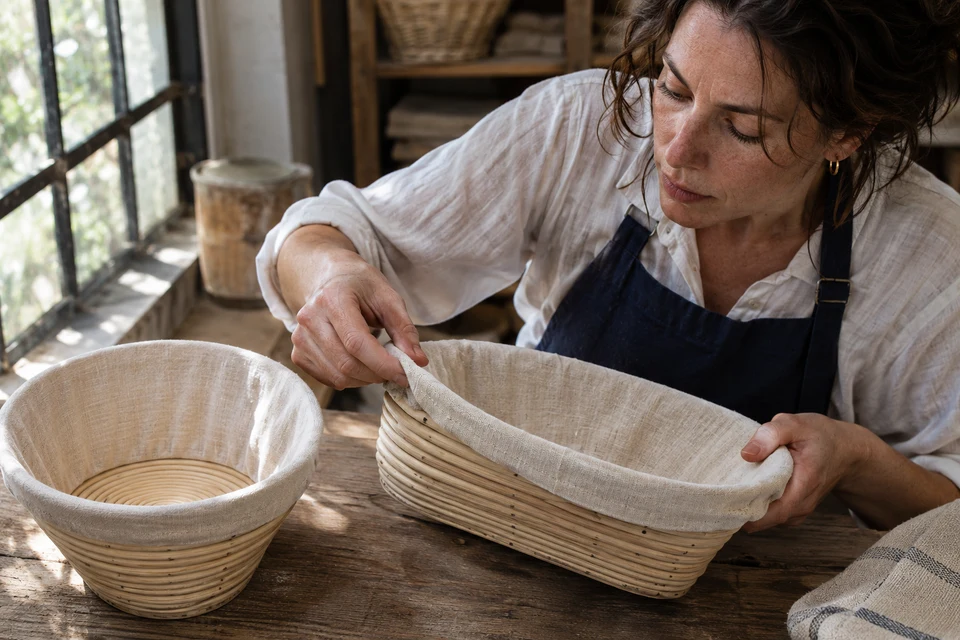
A round basket and an oval basket can accept the same length of tape around the rim and still need quite different cloth liners. Fabric that distributes evenly around a circle can bunch at the tight ends of an oval. The order should identify where the cloth sits inside the basket and how much turns over its lip. A single circumference on a quotation is not a finished fit specification.
Draw the basket the liner must follow
Use the inside well as well as the outer lip
Place an empty production basket on paper and trace the outer lip without flattening the basket. Mark its orientation and measure the usable internal opening, the depth to the bottom and the base shape. On an oval, note the width near the ends as well as at the centre. The outer measurement governs how a turnback comes over the rim. It says very little about the volume of cloth needed to settle into the well.
Look at baskets already in service if the buyer wants replacement liners. Even baskets sold under one name may come from different purchases. Choose representative examples and note the range actually seen rather than inventing a universal tolerance. A deep liner in a shallow basket can leave a ridge of spare cloth under the working surface. A shallow liner may look neat at the lip while hanging above the base like a hammock.
Seat the base before folding the rim
Read the folds at the tight ends of an oval
Put the unfilled sample into the dry empty basket and press it gently into the bottom. Smooth the side walls without pulling the rim upwards. Now turn the edge over the lip, moving around the basket. For an oval, alternate between the two ends so that spare fabric is not all pushed towards the final end. If the liner only stays in place when the base lifts, stop and compare the depth profile again.
Ask a second person to fit a fresh sample without watching the first. A complex sequence that relies on one experienced baker may not suit a programme used across several sites. Observe whether the second person naturally aligns a seam with the end or with the long side. A discreet orientation cue outside the working surface may help. A cue cannot correct a shape that has to be stretched out of position every time.
Separate the retention choice from the care choice
Compare a plain turnback with a gathered edge
A plain turnback leaves the operator free to redistribute fullness. A gathered or elasticated edge can hold the cloth during movement but may concentrate gathers at the ends of a narrow oval. Try the two samples side by side. Lift out the empty liner and lay it open. Note how easily the bakery team can inspect and clean the folded edge, and whether the agreed care method is compatible with every component of the finished article.
Measure and refit the sample after the proposed care cycle under the buyer's own conditions. Record both the inside seating and the amount of rim coverage left at the most demanding point. A liner can retain its overall width yet lose the turnback at one end. If the programme includes both shapes, repeat the care check for each. Do not use the result for a round basket as automatic approval for the oval pattern.
Distinguish shape approval from suitability for use
Request evidence for the actual supplied liner
A successful dry fit settles a geometrical question. It does not establish food-contact suitability, hygiene performance or release behaviour with a particular dough. Before any food trial or public claim, ask the supplier for documentation covering the actual cloth, sewing components and finish for the buyer's intended use and market. Have the purchaser's responsible team review its scope. Keep this decision separate from the pattern maker's signed basket trace.
Request pricing by shape and basket family, including how minimums apply if the two liners share a cloth but require different cutting patterns. Specify whether the order includes liners only or the baskets as well. For replacements, retain one washed sample, the corresponding basket identifier and a photograph of its rim with the turnback in place. That record gives a new buyer something reproducible to compare when the next carton comes in.
Send the basket outlines and care routine with your enquiry. Request separate round and oval samples, and treat food-use documentation as a separate approval before putting either into production use.