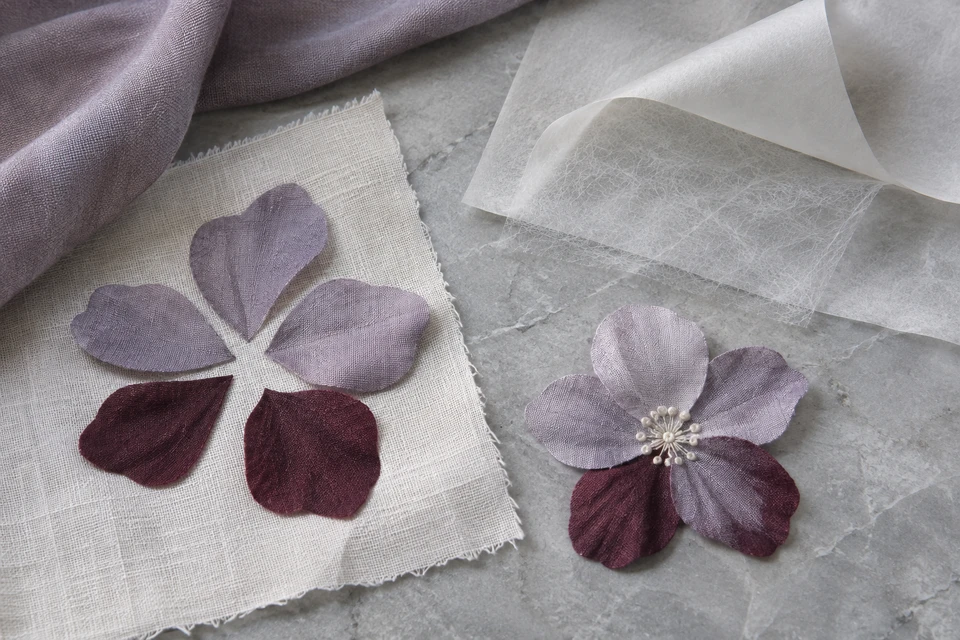
A floral appliqué panel may contain an important material that disappears from view after assembly: adhesive. The release paper can be removed while the bonding web remains between the flower and its ground. Buyers should record that retained layer as part of the proposed product, rather than approving only the two visible fabrics.
- 1. Separate the temporary carrier from the retained layer
- 2. Make the flower shape part of the bonding decision
- 3. Decide whether stitching is part of the design
- 4. Approve the complete fabric stack for care
- 5. Include hidden materials in the purchasing file
- 6. Give the approval team a panel they can identify
Separate the temporary carrier from the retained layer
Ask what stays in the finished panel
Manufacturer instructions for Pellon Wonder-Under describe a paper-backed fusible web and removal of the backing paper during application. This is a useful example of the distinction between carrier and adhesive; other products may have different constructions and instructions. Do not transfer one manufacturer's material description or application method to every fusible product offered by a supplier.
Ask the developer to identify the exact adhesive product, its supplier documentation and the layers that remain in the finished sample. Request a simple layer record: floral face fabric, retained bonding material, ground fabric and any additional backing. If the developer changes the adhesive during sampling, update the record. A sheet that looks equally thin on the worktable is not enough evidence of equivalence.
Make the flower shape part of the bonding decision
Review large petals and narrow stems separately
A broad petal and a narrow stem present different areas of contact in the same design. Show the proposed adhesive arrangement on the actual motif rather than asking for a generic square of bonded cloth. Where the design includes overlapping petals, identify which layers are bonded to one another. The buyer should be able to distinguish an intentional loose decorative edge from a missed or incomplete bond.
Review the actual assembled motif from the face, at the edges and through ordinary handling appropriate to its use. Record any visible adhesive, uneven surface, stiffness or change in colour that would be unacceptable in that project. Do not prescribe a universal bonding pressure, temperature or time. Those settings need to follow the identified adhesive and fabric combination, the equipment and the supplier's validated process.
Decide whether stitching is part of the design
Do not let fusible become a no-sew promise
The fact that a web is fusible does not by itself establish that a finished home-textile panel can omit stitching. Ask whether the proposed product is intended for temporary positioning, permanent bonding or a combination of bonding and sewing. Obtain documentation for the exact adhesive and review the construction against the intended item. A decorative display panel and a frequently handled cushion cover are not interchangeable use cases.
If stitching is included, specify its role and visible appearance in the approved sample. It may form part of the decorative outline or be intended to secure a particular area. If the proposal omits stitching, require suitable finished-product evidence for that choice before adopting it in retail copy. Avoid replacing a construction decision with the vague statement that the adhesive is strong enough.
Approve the complete fabric stack for care
A single-layer swatch cannot represent the assembly
The flower fabric, adhesive and ground are reviewed together in the finished panel. Ask the supplier which care proposal applies to that complete combination and what evidence supports it. Where further evaluation is needed, define the intended care method and acceptance observations with the appropriate technical party. Record the sample revision used so that later adhesive substitutions cannot inherit an earlier result automatically.
Examine the areas most likely to reveal a change in the assembled appearance: overlapping petals, fine stems, the perimeter and large uninterrupted bonded areas. Keep the review focused on the product being purchased. A claim made for adhesive on one demonstration fabric does not prove an identical outcome on a different woven ground, a coated textile or a layered decorative panel. Request evidence, not an assumed transfer of performance.
Include hidden materials in the purchasing file
Keep sample and production revisions connected
Create a bill-of-materials entry for the retained web even when it is invisible and small in quantity. Ask the supplier to identify how the approved product will be controlled during production and how a proposed replacement will be communicated. The public fibre or care information for the finished item must be assessed on the correct product basis; do not assume a marketing label for the face cloth answers every material question.
For quotation comparison, distinguish a loose cut-motif kit from a bonded panel and from a bonded-and-stitched finished component. State who supplies the adhesive, who performs assembly and which sample approval is included. This keeps apparently similar prices attached to comparable work. Ask for minimum quantities, development costs and the delivery plan for the exact proposal without assuming that any named adhesive or fabric is already in stock.
Give the approval team a panel they can identify
Retain the layer record as well as the attractive face
Photograph the accepted floral arrangement and keep a separate technical record of the concealed layers. Where practical, retain a small labelled development specimen that demonstrates the layer sequence without relying on the saleable panel being taken apart. Identify the adhesive and fabric revisions in the approval notes. A receiving team can then trace an appearance concern to a defined construction instead of starting from an unlabelled sample. The FR-01 collection reference communicates a floral mood, not an adhesive or appliqué construction.
Share the proposed motif, product use, care expectation and target quantities with FY Bedding when requesting floral appliqué development. Ask which materials and assembly routes can be evaluated for that project. The visible collection direction is a starting point, not proof that an existing style contains fusible web or can be supplied without sewing. Confirm the construction before using those descriptions in a purchase order or product listing.
The release decision should identify the retained adhesive, removed carrier, exact fabric layers, stitching arrangement and evidence supporting the finished panel's proposed care.
Method references: Pellon: paper-backed fusible web product description; Pellon: release paper removal in a specific fusible-web application.