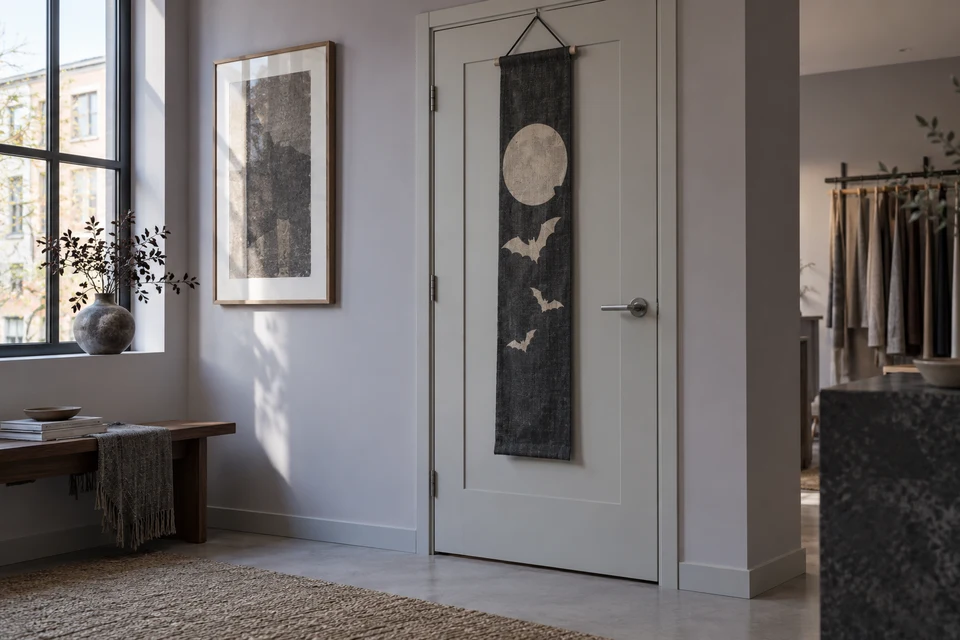
A Halloween banner shown on a wall has not yet been approved for a door. The door moves, its hardware occupies useful space, and people approach it from both sides. For buyers developing a seasonal textile banner, the important decision is how the decoration fits a specific door arrangement without becoming an obstacle. Treat the following review as a product-development brief, not as installation certification or permission to decorate a regulated entrance.
Draw the door before drawing the banner
Keep the useful viewing area separate from hardware
Obtain a dimensioned view of the intended door, including the handle, glazing, hinges and any notices that must remain visible. Ask the property or retail operator which areas may be decorated. Mark the textile outline on that view before adjusting the artwork. A narrow moon-and-bat design may suit the remaining area better than a wide scene cropped around a handle. Use the product-program brief to describe the proposed textile, not to imply that every door is compatible.
Record whether people mainly see the door closed, open or while passing along a corridor. Choose the primary viewing distance and photograph the marked area from there. Close-up artwork can appear clear while the complete silhouette is lost against dark paint. Resolve that viewing problem through size and contrast before adding more decorative detail.
- Record door and hardware dimensions.
- Identify the permitted decoration area with the operator.
Separate the textile from its mounting parts
Name what is supplied and what is not
List the banner body, top support, loops, ties and any proposed removable fixing as distinct parts. The wall-hanging support guide covers the fabric-to-support interface; a moving door adds a separate installation problem. Ask the mounting supplier and responsible site reviewer to assess the actual surface and arrangement. Do not infer paint compatibility or secure retention from the word removable.
For sample comparison, use the proposed mounting parts rather than tape added by a stylist. Record their position on the door and their relationship to the banner. If a rod or hanger is excluded from the offer, make that exclusion visible in the quotation and instructions. A photograph of an assembled display should not silently expand a textile-only purchase.
- Identify every supplied support and fixing.
- Keep mounting approval separate from fabric appearance.
Observe ordinary door movement
A closed-door photograph misses the controlling condition
Have the authorized operator review the proposed sample through the door movements relevant to that location. Observe the textile near the handle, frame and floor, including what happens as the door changes position. Keep access, notices and the operator's required clearance unobstructed. If the design interferes, stop the trial and revise the installation rather than asking users to hold the banner aside.
Capture both faces and the ordinary resting position in the buyer review record. Do not convert a short demonstration into a general performance claim. A different closer, door thickness or hanging part may change the result. Define which changes require another site review, and avoid describing a banner as suitable for all entrances merely because one interior mock-up looked satisfactory.
- Review the moving arrangement with the responsible operator.
- Record conditions that require a new installation review.
Place Halloween artwork within the usable rectangle
Keep motifs readable without covering the function
Position the moon, bat group or border within the approved textile outline. Show the visible face when the banner hangs naturally, not stretched on a studio wall. Compare the full design with seasonal collection references, but approve its actual size and orientation independently. The bottom motif should not rely on extra length that conflicts with the door layout.
Review the reverse if it can be seen when the door opens. Specify whether print show-through, seams or a plain backing are acceptable in that view. Keep the artwork revision linked to the physical pattern: shortening the banner can remove a motif or change the spacing. Require a revised full-size view rather than letting the factory crop artwork at packing time.
- Approve front and any visible reverse.
- Reissue artwork when the physical outline changes.
Release an honest retail installation offer
Pack the parts in the order a customer needs them
Trial unpacking, identifying the components and following the proposed instructions with an unprepared reviewer. Note any missing explanation, hidden styling step or ambiguous fixing location. Confirm care and storage information for the whole assembly, including supports that must be removed before cleaning. Do not promise outdoor exposure performance unless that separate use and its evidence have been agreed.
Compare quotations for the same textile dimensions, decoration, supplied hardware and pack quantities. Include the installation limitations accepted by the buyer in the retail information. For a door-banner development discussion, share the door reference, permitted display zone, mounting responsibility and design quantities. Sample feasibility and production timing need confirmation; a seasonal image is not evidence of available stock or arrival before Halloween.
- Trial the actual retail pack and instruction sequence.
- Quote the same textile and mounting scope across offers.
Approve a door banner as a specific moving installation, with a clear textile outline and named mounting responsibility. A static decoration photograph cannot approve door access or hardware clearance.