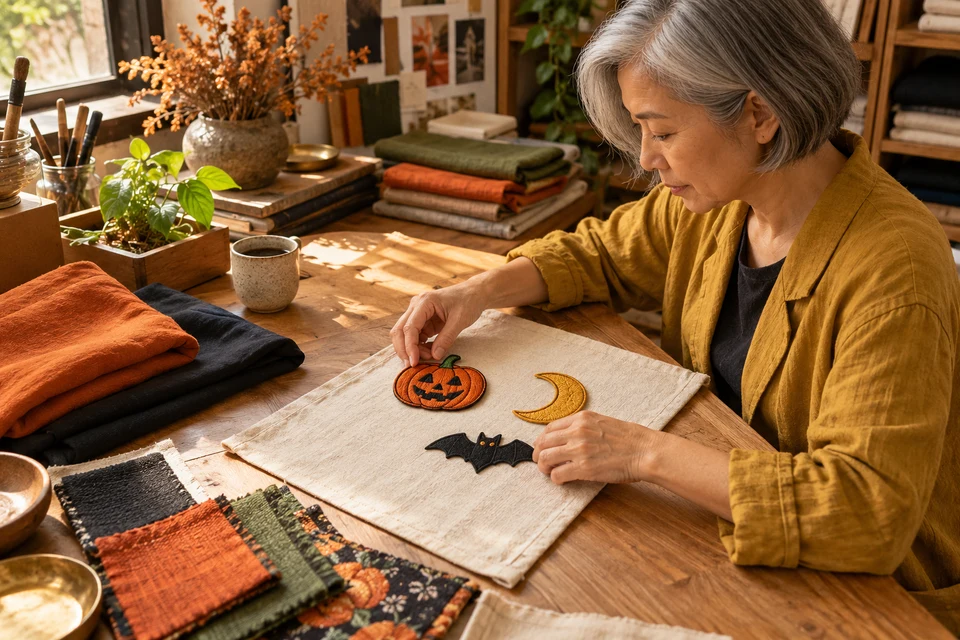
A set of pumpkin, moon and bat patches can let a brand develop seasonal textiles without ordering a completely printed fabric. That flexibility is useful only if the patches work with the intended base materials. A patch approved on firm canvas may behave differently on a loose knit or a soft cushion face. Purchase the patch kit as a controlled component assortment, with attachment responsibility and intended substrates clearly recorded.
Name the host textiles before approving the kit
One decorative component does not fit every material
List the textiles on which the brand intends to use the patches: for example, a canvas cushion cover and a woven storage bag. Identify each actual fabric reference rather than writing suitable for all textiles. Note whether the patch is attached during manufacturing or later by another party. This changes what sample can realistically be approved and which instructions must accompany the supplied kit.
The component bill of materials guide helps link patch references to host products. Keep any unsupported application out of the initial offer. If the project later adds a stretch knit or a coated substrate, request another attachment trial instead of assuming a successful canvas sample proves compatibility.
- Name each proposed substrate and the attachment party.
- Treat a new host material as a new review condition.
Approve the patch as a physical component
Edge finish and backing belong in the reference
Review the full patch outline, embroidery density, reverse and finished edge. A bat wing tip or a narrow crescent point may be visually important but awkward to attach cleanly. Compare the actual component with its artwork at the finished size. Decide which small details must remain readable and which simplified details are intentional design choices rather than production defects.
Refer to the reverse-side embroidery review for questions about backing and exposed material. A sew-on patch should not silently acquire an adhesive layer because a supplier normally stocks an iron-on version. Record the proposed backing composition and attachment route, and keep any heat-application claim separate until the exact construction has been assessed.
- Inspect front, reverse and narrow outline points.
- State sew-on supply explicitly rather than implying iron-on compatibility.
Review the attached sample without hiding the reverse
The host fabric is part of the result
Ask for an attachment sample using the proposed patch, thread, stitch route and actual host fabric. Inspect the surrounding fabric laid flat and in its normal product shape. Look for unwanted gathering, local stiffness or exposed sharp-looking corners. Record which observations are acceptable for the design and which require a change to the patch or attachment construction.
The seam puckering review offers a way to separate flat appearance from changes after an agreed care trial. It does not establish a ready-made pass limit for this kit. Keep the reverse visible during approval, especially where stitching could interfere with a closure, lining or pocket on the host textile.
- Check the completed attachment on the actual host fabric.
- Review the reverse and nearby closures or linings.
Make the design count unmistakable
A kit is an assortment rather than a loose total
Specify how many of each motif belong in one kit. A pack containing three pumpkins is not equivalent to a pumpkin, moon and bat simply because the total piece count is three. Define left- and right-facing variants where they matter. Show the size of each patch and avoid a group image that makes unequal pieces appear identical in scale.
Use the set completeness checklist to build a visual packing reference. Keep labels, any placement guide and the patches tied to the same kit revision. If the offer includes needles, thread or other tools, scope and assess them separately; an embroidery component approval does not automatically cover a broader craft kit.
- Count each motif and orientation separately.
- Declare additional tools or instructions rather than implying inclusion.
Separate development, minimums and release decisions
Small components still need a clear commercial basis
Ask which minimums apply to each embroidered design, size and backing. Request sampling and setup charges as distinct quotation items if applicable, without assuming a particular cost structure. Discuss whether a mixed kit is assembled from standard components or newly developed motifs. Record acceptable substitutions explicitly; a similar orange pumpkin from another source is not automatically the approved patch.
The component MOQ planning guide can support the discussion. Keep artwork permission evidence separate from physical approval, and obtain the relevant rights documentation for supplied motifs. Confirm production and packing readiness before committing the kit to a Halloween campaign schedule.
- Identify minimums by motif and component specification.
- Keep artwork rights and attached-sample approval as separate records.
Share the patch motifs, exact host fabrics and kit counts with FY Bedding. Ask for component samples and a defined attachment trial, then approve the assembled result and packout reference before treating the kit as ready for a seasonal range.