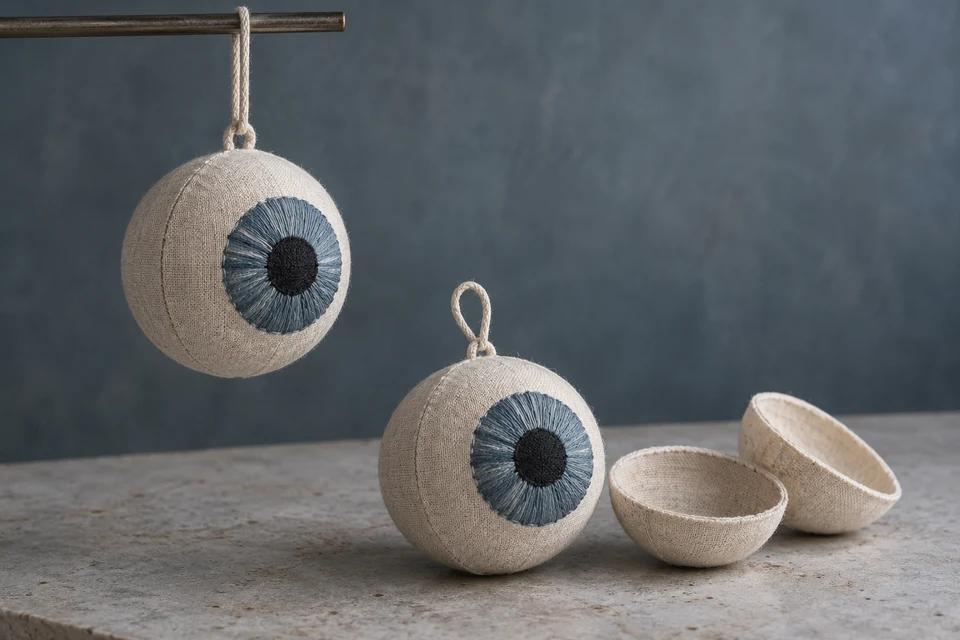
A round fabric eye needs a defined front: a correctly sewn pupil can still point toward the floor after the ornament is hung. Halloween textile eyeball decorations therefore need an orientation record linking the iris, the sphere seam and the hanging point. This is a procurement brief for decorative textile objects, not biological imagery or a statement that the item is a toy. Approve the complete soft assembly rather than an isolated embroidery swatch.
Choose the front axis before placing the artwork
A sphere has no automatic top
Draw the intended pupil direction relative to the loop and the seam joining the body sections. Mark the center of the iris, its visible diameter and the desired amount of surrounding ground. Decide whether the hanging view should look straight outward or deliberately downward. The technical brief should show that relationship in front and side views so the maker is not left to orient a flat circle on an undefined ball.
Where two ornaments are sold as a pair, specify whether they are identical or form a coordinated left and right gaze. Do not assume that turning one finished sphere creates a mirrored design: the loop and seam will also move. Keep pupil position separate from sphere diameter so a size change triggers an artwork review rather than automatic enlargement of every component.
- Map the iris center to the loop and body seam.
- Identify identical pairs versus deliberate mirrored gazes.
Name the actual soft-body construction
A round appearance can come from different panels
Ask whether the body uses two shaped shells, several curved panels or another offered construction. Record the shell material, lining and filling separately in the component list. A photograph of a soft white sphere does not establish its fiber composition or internal material. Request an accessible development sample if the finished seam conceals the arrangement.
View the assembled body from several directions without squeezing it into a better shape. Compare intended roundness with obvious flattening, uneven panel tension or a projecting closure. Decide which softness belongs to the design and which departure requires revision. The sample record should describe observable appearance, not invent a universal roundness tolerance or assign a durability claim from the amount of filling.
- Identify panels, layers and filling explicitly.
- Review the unstressed body from more than one angle.
Approve decoration on the curved face
Flat artwork does not show the final expression
Apply the proposed iris and pupil to a production-intent body and inspect their outline at the normal viewing distance. Embroidery, applique and print should remain named alternatives, since they can create different relief and edge behavior. Check whether a circular motif appears displaced by seam tension or whether the pupil sits unintentionally off-center. Keep the selected version in the artwork revision record.
Inspect the reverse of an accessible decorated shell to understand the offered assembly, then compare its finished surface with the approved sphere. Avoid covering a join problem with a larger pupil unless the designer agrees to the changed proportions. Record any deliberate irregularity that makes the expression playful. Otherwise a later inspector may reject an intended eccentric gaze while accepting an accidental rotational error.
- Review the decoration after the body is formed.
- Keep deliberate expression differences in the approved drawing.
Suspend and unpack the same identified sample
Orientation should survive the customer presentation route
Hang the sample from its supplied loop and observe its settled orientation before touching the face. Record front, side and seam views together. An assistant holding the sphere in the desired position should not be mistaken for free-hanging approval. Any required attachment or product-use assessment belongs with the responsible technical owner; ordinary visual review does not establish suitability for children or a public installation.
Pack and reopen that same identified sample using the proposed retail arrangement. The unpacking observation guide helps separate immediate condition from a styled result. Check whether the loop is trapped beneath the body, the iris is creased or the two pieces of a pair are mixed. If gentle arrangement is permitted, record it rather than presenting a retouched image as the opening experience.
- Observe the pupil direction without hand support.
- Keep immediate and arranged unpacking views separate.
Release the ordered eyes and their pack identity
Counting spheres is not enough for a gaze assortment
List each sphere size, iris color and gaze version with its corresponding loop position. For mixed packs, state the count of each variant rather than a total number of eyeballs. Use the assortment check to reconcile physical contents with the intended retail set. Confirm whether the display rail, tray or other photography prop is excluded.
Compare offers using the same decorated body and pair composition. Ask which materials or embroidery setups create minimum quantities and which details remain subject to sampling. Agree shipment planning after construction and artwork are accepted; seasonal styling does not confirm available stock. Keep the release reference accessible to packing staff so they can distinguish two similar iris colors or a deliberately different gaze without improvising from the product title.
- Count each gaze and iris variant within the selling pack.
- Keep the complete sample linked to artwork and loop position.
Share the intended front view, sphere construction and pair composition with FY Bedding. Request a decorated three-dimensional sample that hangs by its own loop, then approve the same piece after the proposed pack is opened.