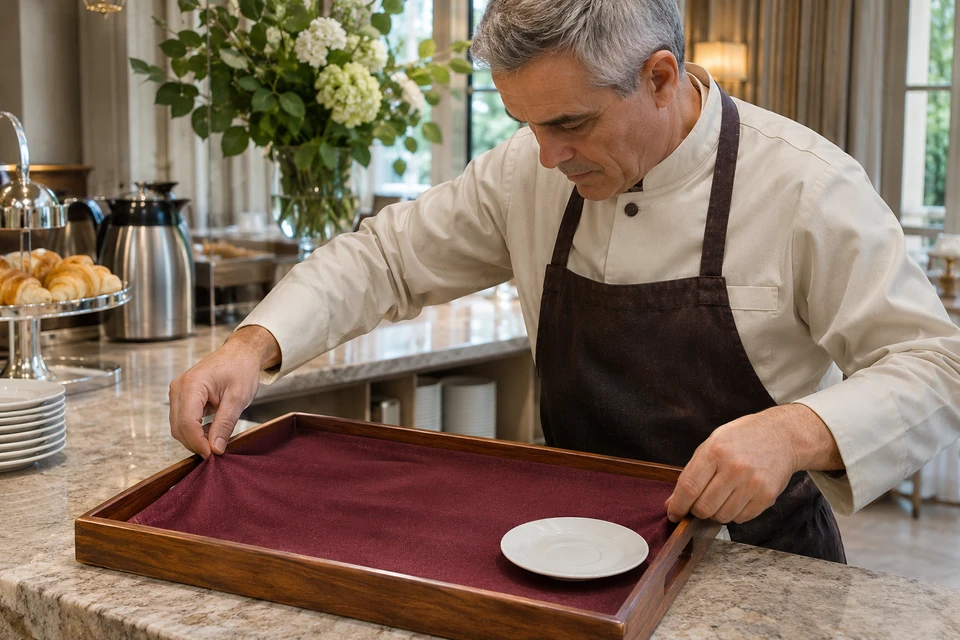
A breakfast tray cloth has a smaller working area than the outer dimensions of the tray suggest. Rounded corners, a sloping rim and handles can all reduce the space available to the textile. A hotel buyer therefore needs a sample inside the actual tray, not simply a rectangular cloth whose dimensions match the supplier's tray catalogue.
Record the usable inset
The outer tray measurement is the wrong starting point
Identify the tray models used in room service and measure the flat internal area on which the cloth is intended to rest. Note the corner shape, rim slope and any feature that interrupts that area. If trays differ by outlet or room category, record those groups separately before deciding whether one cloth size can serve them all. A universal size is useful only if its fit is acceptable in every agreed group.
Decide whether the textile should finish just inside the rim, turn up slightly or follow another documented arrangement. Do not leave that decision to staff at each service. Include photographs taken directly above the empty tray and from rim level. The photographs help explain the geometry, but a sample tray or accurate physical template is preferable when a supplier must develop a shaped corner or a close-fitting edge.
Review corner bulk before selecting the hem
A neat flat rectangle may bunch in the tray
Place the proposed cloth in the tray without stretching or forcing its corners into position. Observe how the hem behaves where two edges meet. A thick corner can sit above the working surface even when the overall width and length are correct. Compare a revised hem or corner treatment on otherwise identical fabric so that the review isolates the cause of the bulk rather than changing several variables at once.
Lift and replace the cloth using the routine movement expected from service staff. If it requires careful folding every time, record that extra step and decide whether it is acceptable for the operation. An attractive styled photograph can hide repeated adjustments. The buying team should approve a repeatable placement method, not a presentation that only the sample developer can reproduce consistently.
Set up a representative breakfast service
Check the arrangement without making unsupported performance claims
Use the hotel's actual service items or documented equivalents. Position the plate, cup and other pieces in the intended arrangement while the tray remains on a stable work surface. Check whether the cloth's raised edges intrude into the usable area or catch when an item is removed. Any practical handling trial should follow the property's established service procedures and avoid unnecessary exposure to hot liquids.
Do not describe the cloth as non-slip, heat-protective, food-safe or hygienically superior without appropriate evidence for the finished article and intended use. An informal placement trial answers a fit question; it does not establish those properties. If one of them is a purchase requirement, add it explicitly to the evidence request and involve the relevant technical reviewer before comparing products on that claim.
Test the fit after the proposed care cycle
The tray does not change when the cloth does
Send identified cloth samples through the intended care trial with the laundry team. Record the agreed process and compare the returned cloths with their original measurements after the agreed conditioning and handling. Then place them inside the same tray again. A cloth can remain within a general size tolerance yet no longer fit the rim arrangement that the hotel approved.
Observe edge curl, corner lifting and visible distortion as well as overall dimensions. Keep the assessment separate from the effect of different folding or pressing methods. If the housekeeping or food-service team intends to press the cloth before use, include that step in the reviewed workflow. Do not assume that an unpressed trial proves the presentation of a pressed service cloth, or that careful pressing will reliably correct a construction problem.
Standardise only after the tray groups are checked
A simpler stock list can create a harder service task
Compare the approved fit on each tray group and document any compromise needed for a shared size. A slightly smaller cloth may simplify stockholding but expose more of one tray surface; a larger cloth may fit another model only after folding. Let the operational team decide whether that compromise is acceptable. Avoid approving a nominal standard while leaving different outlets to invent their own placement instructions.
The purchase brief should identify the tray group, cloth dimensions and shape, hem or corner treatment, colour, care reference and packing quantity. Include a clean physical approval sample and a photograph of the agreed empty-tray fit. Discuss these details and the required trial quantity with FY Bedding before confirming a bulk specification. No particular material, performance result or stock availability is implied by the illustrative service image in this guide.
Approve the cloth inside each actual tray group, before and after the agreed care trial. Use the internal working area as the datum and make any required folding step explicit to the service team.