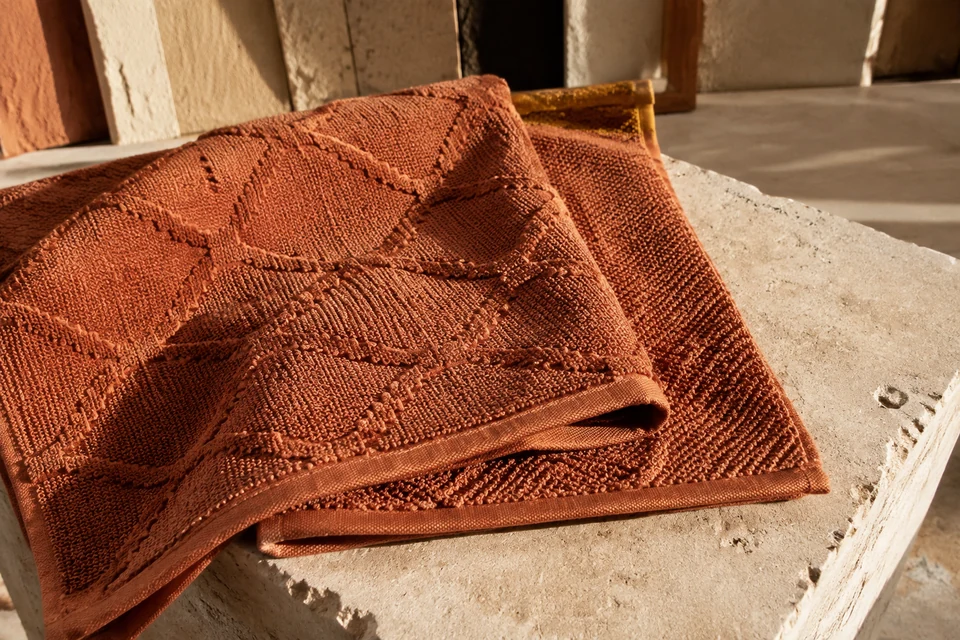
A woven motif on a terry towel must remain understandable through a much more complex surface than the artwork file suggests. Pile loops, ground areas, borders, folding and care all affect what the buyer actually sees. A successful screen proof can therefore lead to a disappointing towel if the approval process stops too early. This guide helps private-label and hospitality buyers judge the woven design on a representative product, including the reverse face and folded presentation. The objective is an agreed visual standard that production and inspection can apply consistently.
Translate the motif into a textile brief
Define the viewing context and design priorities
Begin with the approved artwork version and a clear statement of where the motif must be visible: hanging on a rail, folded on a shelf, presented on a bed or used flat. Identify details that carry recognition, such as a narrow gap between shapes or the outline of a symbol. The artwork version guide supports file control, but the woven trial must establish whether those details remain distinguishable in the proposed towel construction.
State the intended dimensions, motif position, border arrangement and acceptable relationship between design and usable terry area. A design that looks balanced on one towel size may crowd the border on another. Supply a placement drawing for each relevant size or explain how scaling should work. Avoid simply enlarging the complete artwork without reviewing the resulting pile areas and gaps. The supplier should flag details that require a construction or artwork adjustment before development work is approved.
- Identify the real display and use position.
- Mark the motif details that must remain clear.
- Control artwork and placement revisions together.
- Review scaling across the requested sizes.
Assess a representative woven trial
Inspect front, reverse and transitions
Ask for a woven sample made with the proposed yarn, colour and pile arrangement, and record any differences from the intended bulk process. Examine motif edges, small gaps, loop consistency and transitions into the ground or border. The towel construction guide helps describe these inputs. A swatch can answer an early feasibility question, while a full towel is needed to approve overall placement, proportions and finished presentation.
Turn the sample over and review the reverse deliberately. Differences between the two faces may be inherent to the selected design, but the buyer still needs to approve what is acceptable. Check whether the reverse appearance suits a product that guests or retail customers may display either way. Record front and back photographs under consistent light. A visually appealing face should not conceal an unresolved reverse-side issue that will later appear in returns or inspection disagreements.
- Record the trial's material and process differences.
- Inspect small gaps and motif-edge definition.
- Approve the reverse face explicitly.
- Use a full towel for final placement decisions.
Judge legibility under ordinary viewing
Use the same conditions for approval and inspection
Agree a practical viewing distance, lighting arrangement and presentation position. Review the towel both close up and at the distance relevant to its display. A tiny irregularity visible under magnification may not affect the intended motif, whereas a broad loss of contrast may be obvious across a hotel bathroom. The multi-light colour review is useful when colour contrast contributes to recognition, especially if samples are discussed through photographs.
Keep the physical sample as the primary visual reference and use photographs to document specific observations. Phone exposure and sharpening can exaggerate texture or hide low contrast. Mark the exact area that is acceptable or needs revision, and describe the reason in ordinary terms. If the buyer accepts a softened outline or a less detailed small motif, retain that decision with the approved version. Inspection then has a shared boundary instead of an instruction to make it look premium.
- Agree distance, light and presentation position.
- Judge both overall recognition and local detail.
- Keep a physical reference alongside photographs.
- Record accepted simplifications and their locations.
Check folding and care effects
Approve the towel as the customer receives it
Fold the towel using the proposed retail or housekeeping sequence and inspect what part of the motif remains visible. A central design can disappear inside a compact fold, while a border motif may sit awkwardly across a crease. Use the folding approval process to connect the towel presentation to the pack or shelf. Test the complete set if hand towels, bath towels and other pieces must read as one coordinated range.
Run the agreed laundering trial and reassess the same visual points after the specified preparation. Record changes in dimensions, pile presentation and motif definition without attributing every change to one cause. The border distortion guide helps investigate a motif that appears uneven because the surrounding towel has changed shape. Use the buyer's intended care route and retain the actual trial conditions; a one-off sample check cannot support an unlimited durability statement.
- Validate the approved fold and visible motif area.
- Review coordinated pieces as a set.
- Compare the same locations after laundering.
- Record care conditions with the visual decision.
Freeze the design for bulk approval
Connect the motif, construction and commercial scope
Release the artwork, woven trial, full-size placement, colour reference and care observations as one controlled package. Changes to yarn, pile arrangement, colour or motif scale should trigger review of the affected visual features. Use the bill of materials to connect those inputs. Agree whether a production sample is required before the full quantity proceeds, and identify who signs off when the factory proposes a small adjustment to improve weaving or finishing.
For the commercial discussion, distinguish development work from the quantity and colour assumptions behind bulk pricing. A simplified motif or a shared construction may alter the proposed route, but the supplier must confirm any MOQ or schedule effect. Send FY Bedding a woven towel design brief with artwork, size range, display method and expected care. Request a sample route that shows the front, reverse, folded presentation and post-care appearance before final approval.
- Freeze artwork and textile construction together.
- Review changes affecting motif recognition.
- Specify the bulk-sample approval point.
- Confirm MOQ and timing against the approved design.
Does the approved motif remain recognisable on both relevant faces, in the intended fold and after the agreed care trial, with a physical reference for inspection?