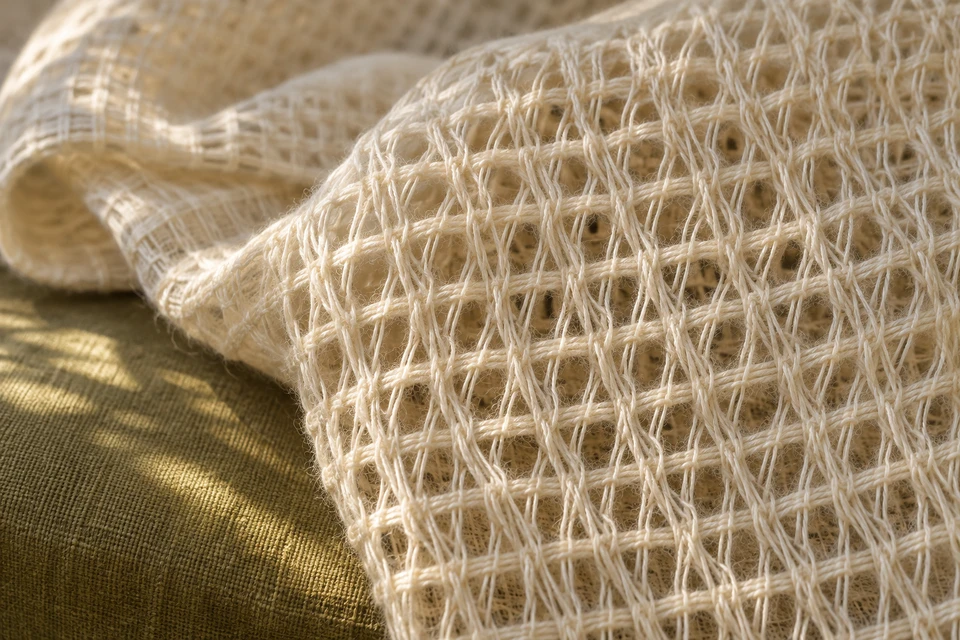
A loosely woven throw can look like leno from across a room even when its yarns do not form the expected crossings. If leno construction matters to the buying brief, openness alone is not enough to identify it. The buyer should ask to see how paired warp yarns cross in relation to the weft and how that structure appears in the proposed finished textile. This is a construction-identification question, separate from whether an open-looking throw suits a particular display or feels pleasant in a hand sample.
Identify the crossing structure
Use a close specimen rather than a marketing name
Craft Hub's record of its leno-weaving residency describes paired warp yarns interacting around the weft and shows that leno can be combined with denser plain-weave areas. This supports a practical first question: where are the crossings in the offered fabric? Ask the maker to identify them in a magnified sample or clear construction view. The reference explains a technique; it does not establish which route or equipment a supplier has available.
Compare the proposed cloth with the intended structure, not with a generic photograph of gauze. A plain open weave may be an acceptable alternative for some projects, but it should be named and approved as an alternative. Do not allow the description to slide between leno, mesh and airy fabric without explaining the actual construction. Those words alone do not prove that the same textile is being offered in two quotations.
Mark the open and dense areas
A throw may contain more than one construction region
Request a whole-width reference showing where the crossed-warp structure is used and where another weave or finishing arrangement appears. Identify bands, borders, corners and any transition into a denser area. A close-up of the most attractive open section does not describe the complete throw. The purchasing file should make clear whether the entire field or only selected regions use the proposed leno structure.
Review the design at the intended finished size. The proportion of open areas to dense bands can change the visual effect even if the local crossing remains the same. Ask the maker to show how each proposed size is arranged. Do not assume a larger throw is simply a wider version of the sample if the supplier plans to add bands, change spacing or alter the border to obtain the required dimensions.
Describe the yarns independently of the weave
Construction identity does not establish material identity
Ask for the proposed yarn materials and the relevant yarn descriptions for the warp and weft. Keep any different yarn roles visible in the specification. A confirmed leno crossing is not evidence that the cloth is cotton, linen or a particular blend. Obtain the appropriate material information for the actual offer, and keep any sustainability or certification claim tied to its specific supporting evidence.
Compare samples made with the proposed yarns rather than using one material as a stand-in for all later options. Record the finished hand and visible structure without turning those observations into unsupported performance claims. Two constructions may share the leno name while differing in yarn size, twist, spacing and finishing. The buyer needs to know which combination is represented by the accepted sample before comparing unit quotations.
Examine the crossings in a relaxed state
Handling can change the view you are trying to compare
Place the samples under matched conditions and avoid stretching one more than another for photography. Inspect the crossing arrangement and open spaces with the cloth supported naturally. If a handling or recovery comparison is relevant, agree the method with the technical owner and record the before and after states. Do not mistake a tensioned photograph for the relaxed geometry of the finished throw.
Look at the transition from the open field into the border and at any location where the arrangement appears to change. Describe yarn displacement, spacing or a missed-looking crossing as an observation requiring review. Do not diagnose a loom fault from the image alone. Ask the maker to explain the intended structure at that location and compare it with the approved reference before deciding whether the sample is correct.
Review the finished edges and intended use separately
A correct weave is only one part of the article
Request the proposed completed throw, including its edges, joins and any fringe. The supplier should explain how those features relate to the body construction. Compare the full article with the accepted weave sample and layout. A piece of open fabric with unfinished edges is a development reference, not proof of the condition in which the retail item will be delivered.
Have the responsible team define any handling, care and performance evaluation required for the intended decorative use. Openness does not establish breathability, thermal comfort, snag resistance or suitability for infants. Avoid borrowing such claims from a different product made with a similarly named weave. The accepted evidence must address the actual finished construction and the use for which the buyer intends to offer it.
Make the quotation describe the same textile
Preserve the structural reference through alternatives
For an FY Bedding enquiry, send the desired crossed-warp appearance, a reference you are authorised to use, finished dimensions and planned quantities. Ask whether a suitable development route can be evaluated and which yarn and construction options are proposed. If a supplier suggests a plain-weave or other open-texture alternative, request a separate description and comparison rather than treating it as an invisible substitution under the original leno name.
At release, identify the accepted local weave view, whole-throw layout, material proposal and completed sample. State which regions must contain the agreed crossings and which may use a different construction. Keep the physical reference available to receiving and replenishment teams. This lets a future quotation be compared against a recognisable textile, while minimum quantities, stock, lead times and any performance claims remain subject to their own project-specific confirmation.
For a leno brief, verify the paired warp crossings, map open and dense regions and retain the accepted yarn proposal and completed throw; openness by itself is not construction evidence.
Method references: Craft Hub: leno-weaving residency and crossed-warp structure.