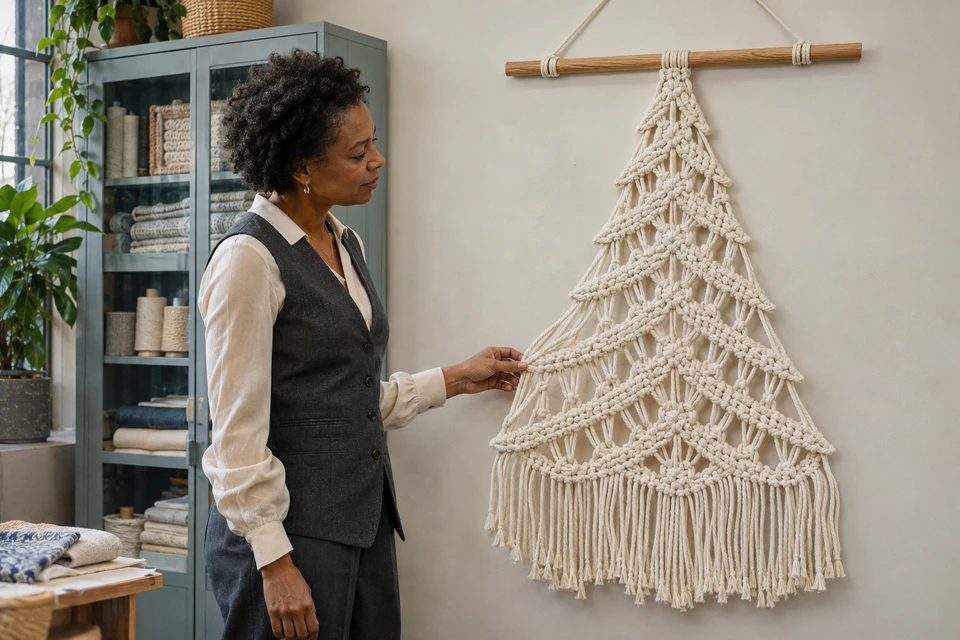
The open areas in a macrame Christmas tree are part of the design, not empty space that can be ignored when buying the finished hanging. A different knot sequence or cord arrangement can turn a narrow, airy tree into a dense triangle while preserving its outside dimensions. For retail development, the useful approval reference connects the knotted structure, its gaps and the support from which it hangs.
Read the tree as a sequence of rows
An outer triangle is not a construction drawing
Start with the full hanging shown without seasonal props obscuring its outline. Identify the apex, each branch-like diagonal, any horizontal joining row and the transition into fringe. Give these areas clear names in the sample record. A supplier should be able to point to the same row that the buyer is discussing, rather than interpreting instructions such as make the middle less busy differently on each revision.
Ask the maker to describe the proposed knot construction and show a representative close view. Procurement need not prescribe the maker's working technique, but it must distinguish an actual knotted textile from a superficially similar braid, woven panel or attached cord decoration. Record whether rows are repeated exactly or intentionally varied. A design change that removes one row can change the open spaces as well as the finished length, so approve the resulting structure rather than only the revised measurement.
Measure spaces as well as cords
The background will remain visible through the product
Choose a few recognisable openings at the top, middle and lower section. Record their location and ordinary suspended appearance alongside the overall width and height. Avoid pulling the cords apart to achieve an attractive photograph. The review should show how the piece settles under its own weight on the proposed support, with the fringe free and the wall visible behind it.
Compare the hanging on light and dark backgrounds if both are relevant to the intended retail presentation. A narrow gap can disappear visually against one surface even when it is physically present. This is a design and display observation, not proof that the material has changed. Decide which openings must remain readable and where softer variation is acceptable. Retain those decisions with a full-size sample or a controlled reference that conveys the actual scale.
Treat cord and knot layout as one proposal
A substituted cord can change the same pattern
Request the proposed cord composition, construction, colour reference and diameter or other agreed size description. A smooth braided cord and a loosely twisted cord should not be treated as equivalent merely because both are called natural. Ask which parts are intended to be brushed into fringe and which must retain their twist. The supplier should confirm what it can provide; an editorial image does not identify an available FY material.
When a cord changes, request a section that includes both a dense knot row and an open area. Compare the row thickness, gap shape and the way adjacent lengths lie against one another. A new cord may look satisfactory in a straight length yet alter the whole hanging. Do not transfer the earlier sample approval automatically. Keep each accepted cord-and-layout combination under its own revision so the quotation describes a reproducible item rather than a flexible visual suggestion.
Define the support and hanging interface
The dowel is part of the supplied unit when included
Specify whether the purchase includes the horizontal support, suspension cord and any separately supplied fitting. Record the support's overall span, the area occupied by the textile and the exposed ends. Identify how the textile attaches and whether it is intended to be removed. A wide display dowel used only for photography must not be confused with a shorter support supplied in the retail pack.
Review the complete assembly from the front and side. Check whether the support remains in the intended position and whether the hanging naturally twists away from the wall. Return construction or attachment questions to the responsible maker instead of improvising extra ties during the photo review. Installation suitability and any required evidence depend on the actual assembly and destination; neither an attractive wall image nor a generic hanging cord establishes a universal fixing or load claim.
Agree what the customer must do after unpacking
Fringe arrangement should be a defined step
Open the proposed retail pack and hang the unit using only the supplied components and stated instructions. Record tangled cords, trapped fringe, altered openings and the time or actions needed to reach the approved presentation. Distinguish simple arrangement from substantial reworking. If the buyer expects the customer to comb or separate fringe, agree the instruction and trial it with a reviewer who did not make the sample.
Check the packaging length against the included support and the proposed fold route against the densest knot rows. Do not assume the textile can be folded anywhere because it is flexible. Compare the unpacked piece with the original suspended reference, noting whether temporary bends remain visible. Where the pack changes, repeat the presentation check on that pack rather than approving a photograph of a loose hanging and treating all later packaging as interchangeable.
Release a defined Christmas assortment
Keep variation intentional and countable
List the offered sizes and colour combinations as separate variants, including the support and fringe in each measurement basis. State whether the assortment contains identical trees or a planned mixture. Ask for minimum quantities, sample stages and lead times on that exact combination. Avoid deriving a Christmas arrival promise from a successful design review; production and dispatch commitments need separate confirmation.
Send FY Bedding the full hanging reference, named knot rows, important open spaces and intended selling pack for a scoped development enquiry. Request confirmation of construction feasibility and component sourcing before finalising the range. The order is ready for release when the maker, buyer and receiving reviewer can recognise the same tree from its structure, not merely from a triangular outline or a festive colour description.
Approve the freely hanging tree with its actual cord, named knot rows, key openings, included support and repeatable unpacking steps.