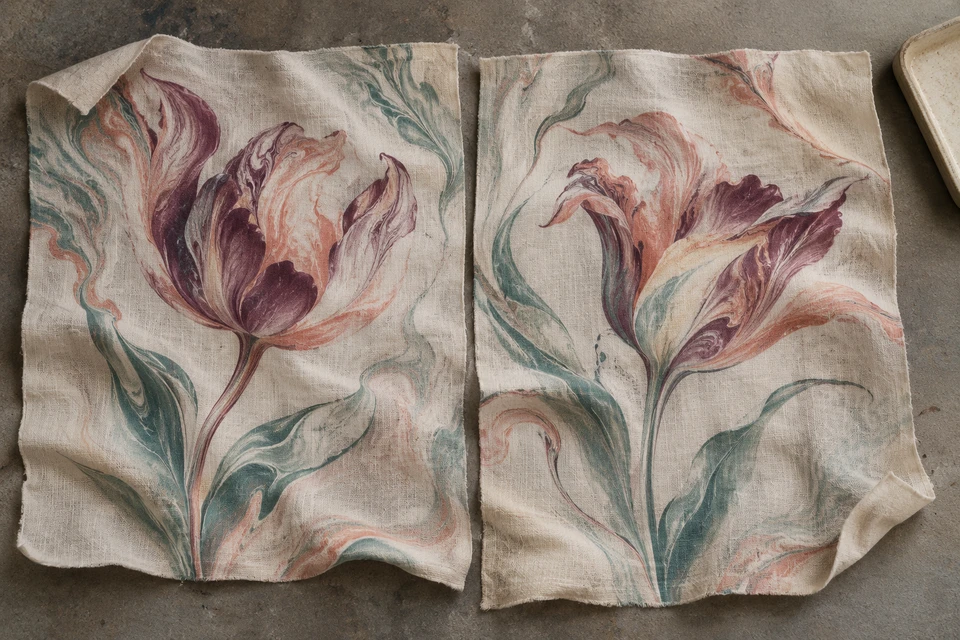
Two marbled flowers can belong to the same collection without being identical. The buying challenge is deciding which differences are part of the product and which mean the supplier has moved away from the agreed floral direction.
- 1. Decide whether the transfer itself is the product
- 2. Define the floral relationship before demanding uniformity
- 3. Review consecutive samples rather than a chosen favourite
- 4. Control colour relationships as well as individual shades
- 5. Merchandise the variation honestly
- 6. Turn the range into an orderable brief
Decide whether the transfer itself is the product
Separate a marbling process from a reproduced image
Jacquard describes a marbling system in which colours float on a thickened water surface before a design is transferred to fabric or another suitable surface. A textile can also carry a printed reproduction of a marbled image. These are different proposals, even if a photograph makes them look similar. State whether the buyer wants individually transferred pieces, a repeatable printed image, or a comparison of both. Do not leave the manufacturing route to be inferred from the word marbled in a collection title.
A printed reproduction may support a tightly repeated layout, while an individually developed transfer calls for a different conversation about variation. Neither route is inherently the correct commercial choice. The decision depends on what customers are promised and what the buyer can approve and manage. Ask the supplier to identify the actual proposed materials and process. A colour-system manufacturer's examples do not prove the suitability, care performance or availability of a particular FY Bedding textile construction.
Define the floral relationship before demanding uniformity
Choose the features that must remain recognisable
Describe the elements that make the design floral for this project. It might be a tulip-like silhouette rising from flowing stems, a cluster of petal shapes, or a loose botanical rhythm without literal flowers. Then distinguish those defining features from incidental swirls. If every small contour must match, the brief may be asking for a reproduction rather than accepting the nature of separate transfers. Resolve that expectation before the supplier creates a collection of samples that will later be judged against incompatible criteria.
Use a small selection of approved physical examples to discuss the range. Point out which changes are acceptable in flower position, stem movement, petal size and background flow. Also show a boundary example that no longer communicates the intended direction, if one is available. The aim is not to reward random differences. It is to establish a recognisable collection with a documented range that purchasing, merchandising and receiving teams can interpret consistently without relying on a single person's memory of the first sample.
Review consecutive samples rather than a chosen favourite
Understand what the proposed route actually delivers
Ask the maker for an identified sequence of development samples, not only the most successful piece from a much larger trial. Discuss how the sequence was selected and whether it represents the proposed production approach. This gives the buyer a more useful basis for deciding how much variation to accept. It does not establish a statistical production capability by itself. If the project needs quantified consistency or performance evidence, agree a suitable evaluation with the supplier and a competent testing party where appropriate.
Keep the sample orientation and intended cutting area visible during review. A pleasing flower in the middle of a large cloth may be lost when the fabric is cut into a small cushion face. Compare the finished-panel outline with the design actually available, not just the full uncut transfer. Where selective cutting is proposed, ask how that affects the quantity basis and whether the quotation assumes usable yield. Do not assume that every transfer can supply the same number of visually equivalent panels.
Control colour relationships as well as individual shades
A matching palette can still produce a different balance
An assortment can use the same teal, coral and plum yet feel inconsistent if one piece is predominantly dark and another is mostly pale ground. Discuss the balance of colours and the visibility of the floral form together. Physical samples are essential because screen images and lighting can change the apparent contrast. Agree the viewing conditions used for approval and retain the selected samples. A list of colour names alone cannot express how much of each colour should be present in the finished design.
Ask the supplier to identify any change in colour materials or substrate during development. A revised fabric can alter the appearance even when the intended palette remains unchanged. Review the completed textile after the proposed processing steps, not only an intermediate wet-looking or freshly transferred surface. Do not borrow a manufacturer's washability statement for the assembled product. Product care, colourfastness and destination-specific claims require evidence tied to the actual materials, process and finished article being supplied.
Merchandise the variation honestly
Plan sets and product photography around the chosen promise
Decide whether retail units are sold as individually variable pieces, closely coordinated pairs or a deliberately assorted set. A pair of cushions may need a shared visual balance even if each flower differs. Define how pairs will be selected and what happens when one piece falls outside the approved range. Do not let a broad tolerance for individual variation silently replace a requirement that a set looks coherent. Review a proposed retail grouping using real samples before approving the assortment description.
Product photography and wording should reflect the promise the buyer has chosen. If images show a particular transfer but customers receive related variations, the presentation should not imply exact duplication. Conversely, a printed repeat should not be marketed as individually hand-marbled without evidence. Confirm the manufacturing description with the supplier and avoid unsupported artisan, origin or sustainability claims. Packaging can help preserve the agreed grouping, but it cannot resolve an unclear product promise after the order has already been packed.
Turn the range into an orderable brief
Retain examples, boundaries and the selection responsibility
The final brief should identify the route, substrate, authorised floral direction, colour relationships, finished cutting area and approved variation range. Record who selects or groups finished pieces and how exceptions are handled. Ask for minimum quantities, sample charges and timing against that specific brief. A quotation for a printed reproduction should not be compared directly with an individually transferred option unless the differences in appearance promise, grouping and usable output are visible in the comparison. A reference such as FR-01 helps communicate botanical mood, not a claim that the displayed textile is marbled.
FY Bedding's floral collection can support a discussion of botanical mood, but a displayed style is not evidence that it uses marbling or any particular colour system. Send the intended product, quantity split and sample expectations with the enquiry, and request a project-specific proposal. Keep the approved physical range available for receiving. If a new production approach or material is introduced later, review it against that range before treating the change as a routine replenishment of an unchanged design.
Choose the transfer or reproduction route first. Then approve consecutive samples, the defining floral features, colour balance, cutting area and retail grouping, with clear responsibility for selecting pieces that fall within the agreed range.
Method references: Jacquard: floating-colour marbling and transfer to fabric.