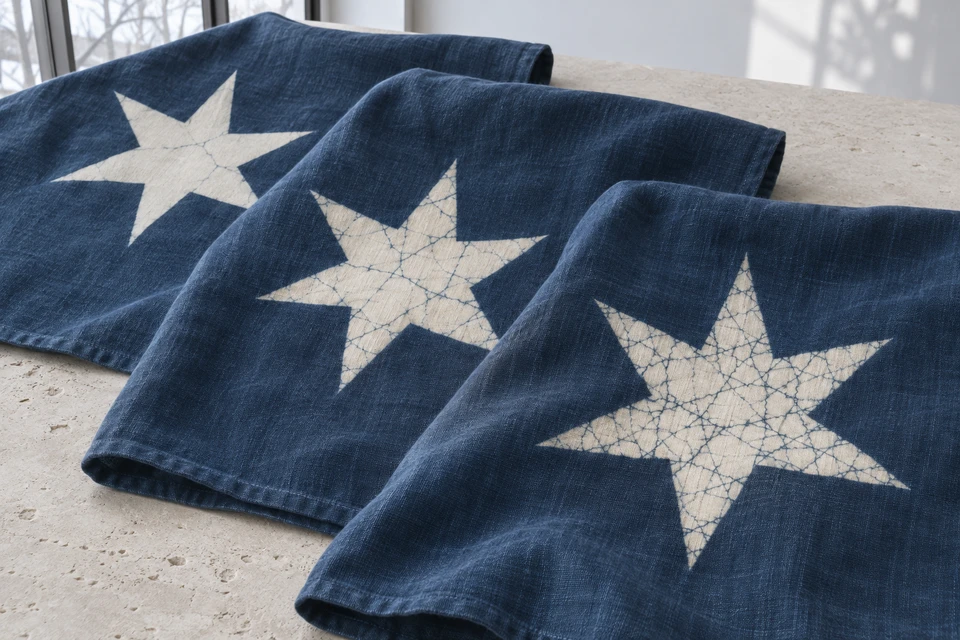
A fine network of coloured lines inside an ivory Christmas star may be an intended batik effect, not a damaged print. But calling every unexpected mark part of the craft is equally unhelpful. Buyers need an agreed crackle range that preserves the seasonal design, alongside a clear description of how the offered textile is made. One unusually attractive swatch cannot explain either the acceptable variation across an order or the difference between wax-resist work and a printed imitation.
- 1. Establish what the word batik describes
- 2. Approve a range rather than one perfect star
- 3. Separate crackle from other visible findings
- 4. Judge coordinated pieces together
- 5. Request the finished textile, not an intermediate treatment sample
- 6. Make the commercial offer reflect the approved variation
Establish what the word batik describes
Process and appearance are separate purchasing fields
Dharma Trading's batik guidance explains that wax resists dye and that cracks in some wax applications allow fine lines of colour into reserved areas. This describes the source of a characteristic effect, not a guarantee that every textile sold with a batik-style image uses that process. Ask the proposed maker to identify its actual route. A digitally printed crackle drawing can be a deliberate design choice, but it should not silently inherit a claim of wax-resist production or handwork.
Record the declared fabric, colour application and finishing route with the sample identifier. Keep any craft or origin description limited to evidence for the actual supply. Do not infer a particular country, workshop tradition or manual method from irregular lines alone. If the buyer's priority is repeatable visual appearance rather than a specified technique, say that openly so alternative routes can be quoted. If the process itself is essential to the range, confirm it before selecting from attractive but technically unrelated samples.
Approve a range rather than one perfect star
Choose boundaries with the complete motif visible
Ask for several representative finished samples of the proposed Christmas motif. Compare sparse, middle and denser crackle appearances where the supplier can demonstrate that range. Keep the entire star, tree or other seasonal element visible; a tiny crop can make fine lines look acceptable while hiding how they affect recognition across the motif. The sample set should reflect the proposed route, not unrelated fabrics collected merely to fill a comparison board. Ask what each reference represents and how it was selected.
Choose the acceptable boundaries through a documented design review. Describe why an example is accepted or held: perhaps a star remains clear, perhaps an isolated dark patch interrupts its outline, or perhaps the intended light ground has become visually crowded. Avoid imposing a universal crackle percentage or accepting every mark as natural variation. Where measurements help, agree them with the technical owner and connect them to the physical examples. The resulting range should be understandable to production and receiving staff without requiring them to share the designer's intuition.
Separate crackle from other visible findings
A process explanation does not approve unrelated defects
Review the samples for different kinds of marks instead of recording a single overall rustic appearance. Fine branching lines inside reserved areas, a broad isolated stain, an uncoloured patch and a distorted motif boundary are not automatically equivalent. Record the location and appearance of each concern, then ask the maker to investigate anything outside the agreed range. Do not diagnose every line from a photograph or use the technique name to excuse an unexplained condition that the accepted references do not contain.
Inspect both faces in the supplied finished state. The buyer should understand whether the intended appearance changes through the fabric and which face is presented in the retail image. A visible reverse is a useful construction reference, but it does not independently prove a dyeing method. Retain observations and the supplier's explanation separately. If the proposed material is revised to improve the effect, request new range references rather than transferring the old visual approval automatically to a different weave, finish or colour combination.
Judge coordinated pieces together
Variation must still produce a coherent table setting
Lay out the intended selling unit: one runner, a pair of placemats, or the actual napkin quantity. Compare motifs across the group under ordinary table-setting conditions. A single piece may sit within the accepted range while a pack assembled from its most extreme ends looks inconsistent. Decide whether sets need a narrower visual grouping and ask how that grouping would be identified during packing. Do not assume that a shared colour name is enough to deliver the coordination the merchandising team expects.
Review the arrangement with the proposed plain or patterned companion textiles. Crackle that looks restrained on an isolated swatch can become busy when repeated across an entire table. Keep this assortment decision separate from technical rejection: an acceptable fabric may simply be unsuitable beside another selected design. Photograph the accepted grouping and record its component references. If individual replacement items are planned, discuss how their permitted variation will be communicated rather than promising an exact match to every previously supplied piece.
Request the finished textile, not an intermediate treatment sample
Care and residue questions need their own evidence
Specify that the approval samples must represent the offered finished state, with the intended processing complete. Ask the maker how that state is identified and which checks are relevant to any retained material or finishing concern. Do not include a hot-wax or chemical-handling recipe in the purchasing brief, and do not assume a room-temperature photograph establishes that a textile has been adequately processed. Technical questions about treatment and suitability belong with the responsible supplier and qualified reviewers.
Where care evaluation is required, compare identified samples before and after the agreed procedure. Record motif clarity, colour appearance, handfeel observations and any other specified findings without converting one visual comparison into a general performance claim. The chosen process name does not prove colourfastness, suitability for commercial laundry or a sustainability benefit. Keep the relevant requirements and any supporting reports tied to the actual construction. A supplier's evidence for another fabric or colour route is not automatically evidence for this seasonal programme.
Make the commercial offer reflect the approved variation
Plan repeatability before extending the range
Ask the supplier which pattern scale, colour combinations and finished sizes can be sampled, and how minimum quantities apply to those choices. Confirm what is included in the quotation: the defined production route, finishing, piece count, grouping and packaging. If the design is switched to a printed crackle effect for another price or schedule, issue a new identity and approval. That alternative can be legitimate without being presented as the same product under unchanged process wording.
Send FY Bedding the authorised seasonal motif, proposed table-linen unit and the selected crackle-range references for a scoped development discussion. Request actual feasibility and timing information; a concept image does not establish stock or Christmas arrival. Retain the accepted low and high visual examples with the finished set and its description. The aim is an offer whose intended variation is recognisable and bounded, so buyers can appreciate the surface character without making either impossible uniformity demands or unlimited allowances for unexplained differences.
Confirm the actual process, approve a representative crackle range on complete motifs, and check that the pieces grouped into one retail set still look intentionally coordinated.
Method references: Dharma Trading: wax-resist batik and crackle background.