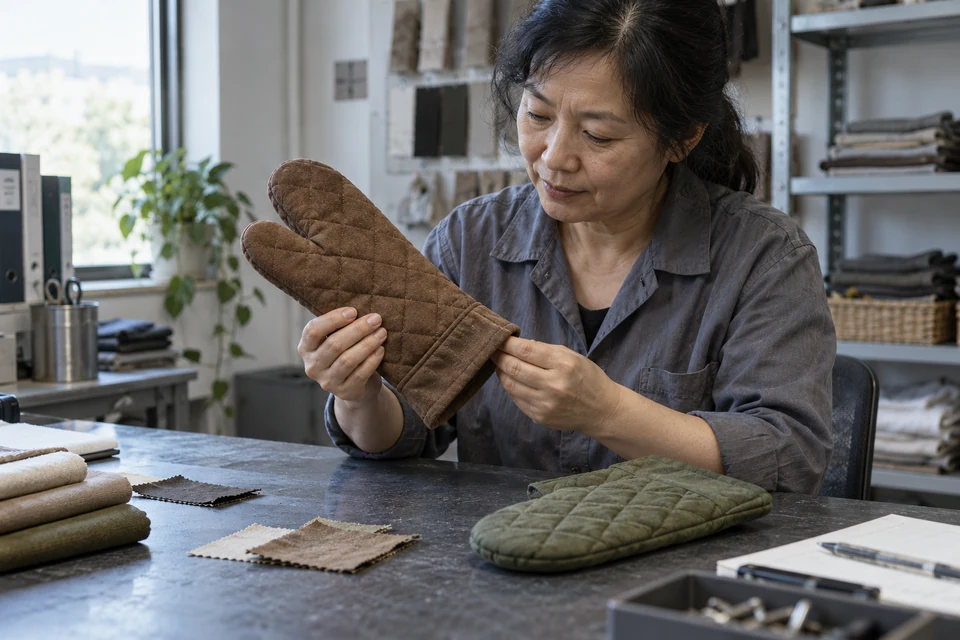
An oven mitt can look convincingly thick, quilted and well finished without its appearance establishing a safe level of heat protection. For a retail buyer, that makes the evidence brief a central purchasing decision rather than a document collected after an attractive sample has been selected. Construction, usable fit and the intended product claim must be reviewed separately and then connected to the actual offered assembly. This guide describes procurement questions only. It is not a home testing method, a protection rating or a promise of compliance; samples should not be tried against hot objects in an informal buying review.
Define the proposed product claim
The intended use must be explicit before comparisons
Ask the brand's responsible product-safety owner to define the proposed use, destination and claims. Identify whether the item is being marketed as a protective oven mitt, a different kitchen accessory or part of a mixed gift set. A protective function cannot be dismissed as decorative merely because the textile carries a pattern. Use the claim-substantiation matrix to connect each proposed statement with the evidence and review that must support it.
The need for care is real rather than theoretical: the CPSC oven-glove recall notice linked below describes inadequate heat protection as a burn hazard. That notice concerns identified recalled products; it neither condemns all textile mitts nor proves another supplier's item safe. Its relevance to a new procurement is the boundary between appealing construction and demonstrated protection, not a transferable result or certification.
- Give claims and intended use a responsible owner.
- Name the market and complete purchased product.
- Do not infer protection from visual thickness.
- Keep recalled-product findings separate from a new product assessment.
Document the complete layered assembly
A fabric certificate does not describe the whole mitt
Request the material and construction description for the entire offered assembly: outer textile, intervening layers, lining, seams, binding, closure if present and any decorative components. Identify their positions and the approved version. The bill-of-materials guide supports this record. A changed lining, omitted layer or different seam construction should be a visible revision, not an undocumented equivalent accepted because the finished color still matches the photograph.
Ask how the maker controls layer identity and assembly consistency during production. Keep the answer factual and request relevant records; do not invent factory capabilities from a sewing-room image. A certificate for the outer cotton or a supplier's general management system is not evidence for the mitt's claimed protection. The certificate scope matrix helps distinguish material, process and finished-product evidence without overstating what any one document proves.
- List every layer and its approved position.
- Control seam, binding and decorative components.
- Ask for assembly-consistency evidence without inventing capability.
- Separate material certificates from finished-product protection.
Review fit without exposure to heat
An unheated usability check has limited meaning
Under the agreed safe review method, examine opening access, internal seams, left-right presentation and the fit range the supplier proposes. Use clean, unheated sample props if the responsible owner permits a handling demonstration. Record the participants and conditions rather than extrapolate to every consumer. Check whether the offered pack contains one mitt, a matched pair or a set with other items. An easy-fitting sample establishes only the observed usability in those conditions, not safe gripping of a hot vessel.
Record visible defects, loose sewing ends, uncomfortable internal seams and misaligned layers for correction. Review each revised complete sample rather than only the repaired area. The sample scorecard can separate usability observations from documentary assessment. Do not let a high appearance score compensate for missing protection evidence, and do not invite the buying team to fill that gap with a quick kitchen heat demonstration.
- Keep all informal sample reviews unheated.
- Record fit observations without a universal comfort claim.
- Identify one-piece, pair and bundled units.
- Treat missing evidence as outstanding, not a low score that can be averaged away.
Commission the evidence plan
Let qualified specialists define applicable assessment
Have the appropriate qualified product-safety specialist or laboratory determine the evidence relevant to the actual intended use, claims and destination. Ask it to identify the assembly, sample condition, method, results and limitations in the assessment record. This article does not select a universal standard or legal classification. The testing-plan guide supplies a procurement structure for agreeing what is assessed and when, but it must not replace specialist instructions for a protective kitchen product.
Review whether the documents correspond to the offered mitt rather than a different sample, material alone or earlier construction. The report identity and scope guide is particularly useful here. Obtain clarification when identification or scope is incomplete; do not rewrite the report in marketing language to make it appear broader. Keep an explicit hold on unsupported protection claims and release only within the responsible owner's approved assessment and evidence boundaries.
- Use qualified assessment for the relevant product and market.
- Check sample identity, condition and report scope.
- Do not invent a universal test or legal category.
- Keep unsupported claims on hold until the required review is complete.
Connect care and production to approval
A substitute construction needs a new decision
The responsible owner should confirm what care instructions and any conditioned-state assessment are required for the proposed product. Keep the offered care information consistent with the actual reviewed assembly and evidence. Avoid copying instructions from a towel or ordinary quilt because both use similar textiles. A change in dimensional behavior, layer arrangement or seam condition after care belongs in the technical review, not merely in a cosmetic comment on the sample's appearance.
At bulk release, verify approved components, assembly references, labeling and the agreed inspection and evidence requirements. The supplier change-control guide helps prevent an undocumented substitute from inheriting approval. If the supplier cannot maintain an approved component, obtain a revised proposal and route it back to the responsible technical owner. Lower unit cost or faster delivery should not silently remove a layer, change a seam or broaden the supported claim.
- Keep care instructions tied to the assessed assembly.
- Route component substitutions through technical review.
- Verify the release requirements during production and packing.
- Do not trade an undocumented construction change for speed or price.
Compare evidence-ready offers
Quoted scope must include the necessary review work
Ask suppliers to separate sample development, proposed materials, finished-unit quantities, packaging and any evidence or assessment costs that are included or excluded. Determine who commissions the specialist work and what remains outstanding. The quotation comparison guide provides a related commercial structure, but the decision must not reduce this product's evidence requirement to the cheapest optional add-on. A low initial quote may simply omit work another offer has included.
Before placing an order, confirm the exact sold unit, approved artwork, care information, evidence version and owner of the final product-release decision. Buyers discussing a kitchen textile project can submit the proposed scope and evidence questions for review. The suitability and availability of a supply route must be established specifically; an editorial article does not claim that FY Bedding supplies a certified mitt or provides product-safety approval. Keep the procurement conditional wherever required evidence has not yet been accepted.
- Compare offers on the same assessment and packaging scope.
- Identify included and excluded development costs.
- Freeze the sold unit and documentary version.
- Do not treat an editorial sourcing discussion as product approval.
Approve appearance and unheated usability separately from protection. Obtain qualified, assembly-specific evidence and keep unsupported claims or component substitutions out of the released retail offer.
Method references: CPSC: Identified oven-glove recall and burn hazard.