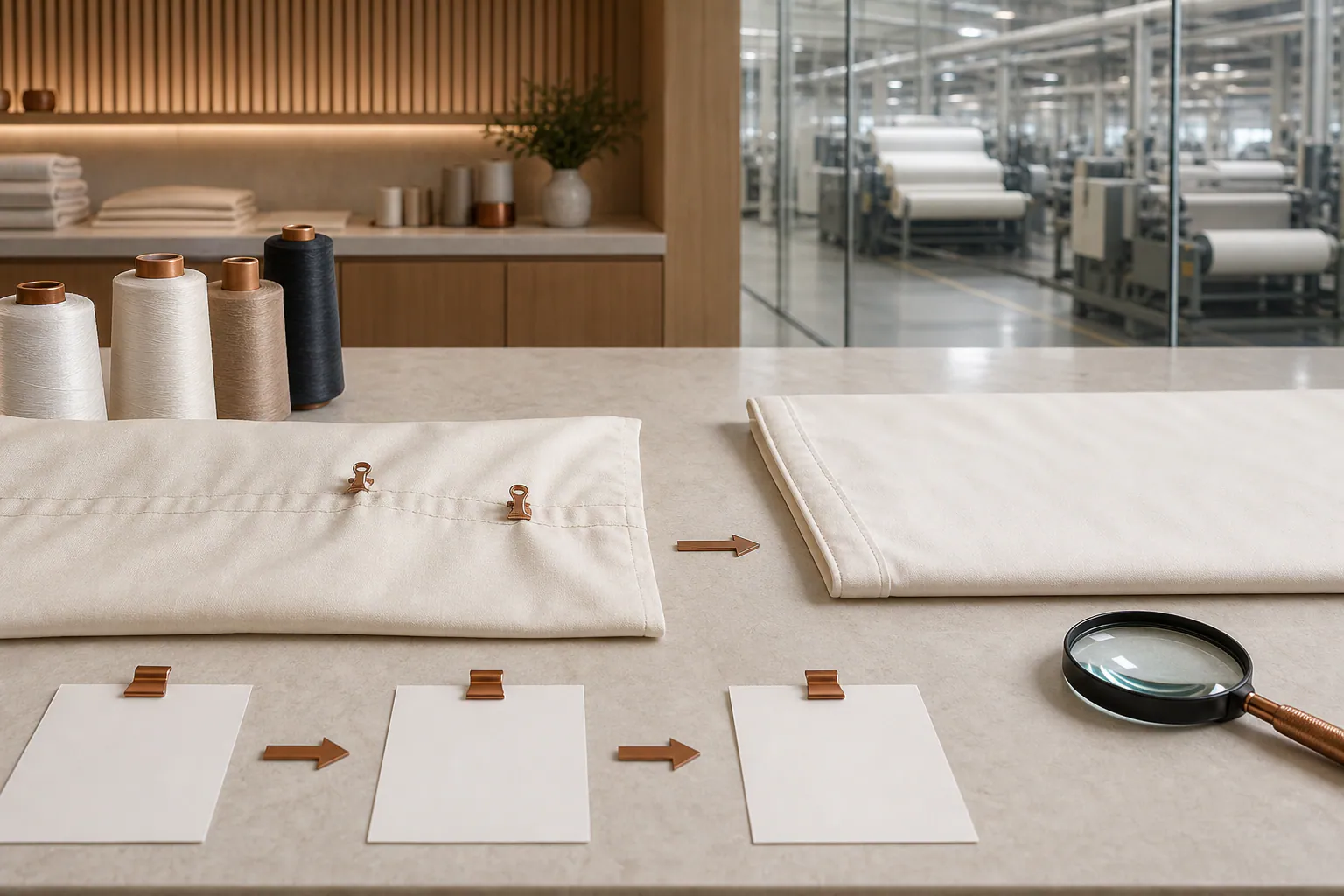
An approved sample is useful only when later changes remain visible and controlled. Material availability, production learning or artwork revisions may create legitimate reasons to change a home-textile order, but the response should be a documented review—not an unrecorded substitution. A simple change-control workflow protects repeatability and gives both buyer and supplier a shared decision trail.
1. Define what counts as a controlled change
A change is any deviation from the approved specification, sample, bill of materials, color reference, artwork, pack-out or agreed process that could affect fit, appearance, function, claim, evidence, cost or timing. Include both supplier-proposed changes and buyer-requested revisions.
Typical examples include a fiber or yarn source, fabric weight, dye lot or shade direction, finish, stitch or seam, dimensions, fill, trim, sewn label, barcode, insert, carton, testing route or production location. The trigger list should sit beside the golden-sample record.
2. Require a written change request
The request should state what changes, why it is needed, which purchase orders/SKUs/lots are affected, when it would enter production and whether unchanged alternatives remain available. Attach the previous and proposed specifications, photographs, supplier data or test evidence as applicable.
A verbal discussion can start the review but should not release production. Give the request an identifier and status so the sourcing, quality, product and logistics teams can see whether it is under review, approved, rejected or superseded.
3. Review impact across the entire product
| Change | Potential impact | Evidence to review |
|---|---|---|
| Fabric or fill | Hand, weight, shrinkage, function, claim | New material data, sample and relevant test |
| Color or finish | Shade, feel, care behavior, coordination | Lab dip, shade band or finished sample |
| Construction | Dimensions, durability, appearance, output | Revised tech pack and sample |
| Label or pack | Information, barcode, presentation, carton fit | Artwork proof and pack-out review |
| Production route | Capability, traceability, lead time, evidence scope | Route review and quality plan |
Also assess commercial and schedule consequences. Approval of a technical change does not automatically approve a price or delivery change unless those are explicitly included.
4. Match approval evidence to the risk
A typo correction may need an artwork proof; a material change may require a new physical sample and targeted testing. Define the approval level from the possible effect rather than treating every change identically.
- Document-only review for a non-product administrative correction.
- Component or strike-off approval for a localized material/artwork change.
- Revised finished sample for construction, fit, appearance or hand changes.
- Testing or pilot production where function, durability or claim could change.
Use the testing-plan guide to select relevant evidence instead of repeating unrelated tests.
5. Close the change and keep lots traceable
After approval, update the controlling specification, bill of materials, artwork and inspection checklist. Mark the old version as superseded without deleting the history. State the effective purchase order, work order, lot or date and identify any remaining stock made to the previous standard.
Final inspection should verify the approved change and confirm that no mixed execution entered the shipment. The final inspection checklist provides the closing control point.
No substitution should enter bulk only because it appears “equivalent.” Review effect, evidence, sample level, commercial impact and effective lot, then update every controlling document after approval.