The phrase silk-filled duvet names a proposed filling material but leaves important construction questions unanswered. Is the filling supplied as extended layers, as loose material, or in another declared form? How is it held within the shell, and what evidence links that explanation to the finished sample? A buyer should ask these questions before comparing quotations. Neither a luxurious cover photograph nor a stated filling mass shows how the material is arranged inside the article.
- 1. Obtain the filling description in the supplier's own terms
- 2. Request a representative view inside the article
- 3. Examine how the proposed filling is held
- 4. Separate shell, interlayer and filling mass
- 5. Treat care as a construction-specific decision
- 6. Put unresolved construction questions into the enquiry
Obtain the filling description in the supplier's own terms
Material identity and physical form are different fields
Ask the proposer to describe both the declared filling composition and its physical form. If it uses terms such as layered, long-strand or hand-pulled, request an explanation of what those words mean for the offered construction. MANITO, for example, describes a particular duvet using hand-pulled silk filling and separately identifies shell components. That is a manufacturer-specific example of a fuller description, not evidence that another duvet shares its materials, process or performance.
Do not infer silk species, origin, purity or processing route from colour, softness or a generic silk label. Ask what documentation or testing is available for the exact proposed material and define any verification required by the buyer. Keep a material declaration distinct from a construction demonstration. Seeing layers in a cutaway may help explain arrangement, but does not independently prove fibre composition. Equally, a composition report does not reveal how the duvet has been assembled.
Request a representative view inside the article
Connect the cutaway to the finished sample
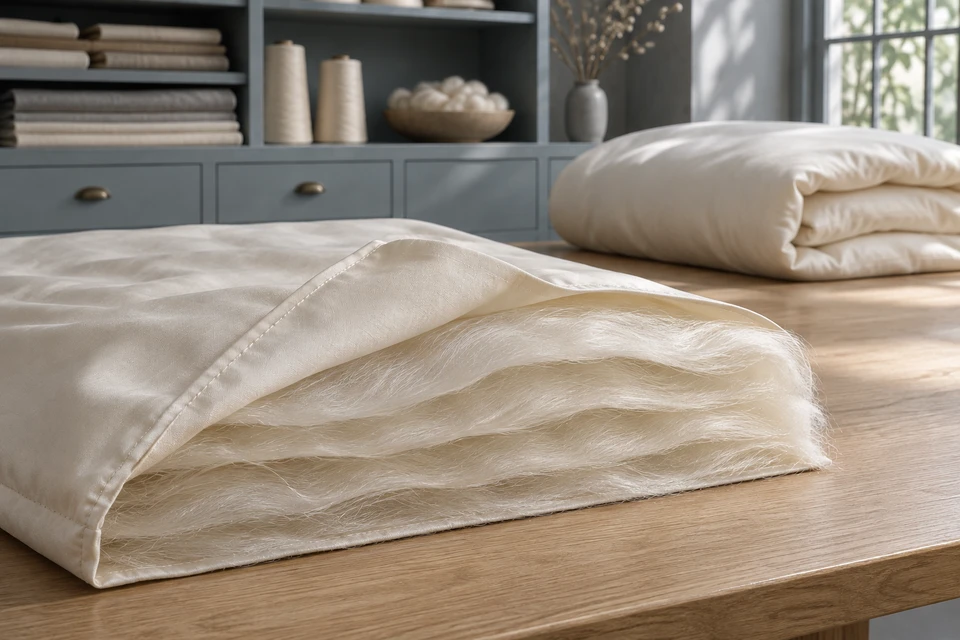
A purpose-made cutaway can make the filling arrangement easier to discuss. Ask the supplier to identify the sample revision, shell construction and filling specification it represents. The exposed area should be large enough to show the proposed form without presenting a separate decorative handful of fibre as if it were the interior of the duvet. Keep a complete finished sample for handling and a distinct demonstration piece where opening the shell would change the article being evaluated.
Photograph the cutaway before moving its contents. Record which layers or components the supplier identifies and how they sit relative to the shell. If the demonstration has been prepared differently from production, ask for that difference to be stated. A staged loose pile beside a duvet is not evidence of what is inside it. Where a supplier cannot provide a cutaway, request another proportionate form of construction evidence and keep the interior arrangement unconfirmed until it is satisfactorily explained.
Examine how the proposed filling is held
Follow the arrangement to edges and attachment points
Ask the supplier to show how the filling is anchored or otherwise contained in the offered design. Locate the relevant attachment points, edge treatment or internal components in the sample record. Do not prescribe an arbitrary stitch pattern without considering the proposed filling form. The purchasing decision is whether the supplier's declared construction has been represented and evaluated, not whether its internal layout resembles a familiar duvet made with a different filling.
Compare the explanation with the complete sample under agreed handling. Observe the distribution and any local changes without claiming that one brief demonstration establishes long-term stability. If an issue is observed, record where it occurs and the handling that preceded it. Request a technical response tied to that location. Avoid turning a visual observation into an unsupported claim that all layered filling stays in place or all loose filling migrates; the actual construction and evidence must determine the decision.
Separate shell, interlayer and filling mass
Ask what each quoted figure includes
A quotation may describe a shell, a supporting interlayer and the main filling separately, or combine several components in a single weight figure. Ask for a component breakdown sufficient to understand the offered article. Confirm whether the quoted mass is filling only or complete-piece mass, and identify the finished dimensions to which it applies. If more than one internal material is proposed, make its role and declared composition explicit rather than assuming every hidden component is silk.
Compare alternatives on the same basis. A heavier complete duvet is not necessarily one with more of the named filling; a different shell or additional internal layer can change its mass. Use the supplier's component records and agreed measurements to resolve the distinction. Do not derive thermal, breathability or comfort claims from a filling weight alone. If the buyer requires performance evidence, specify the relevant evaluation and confirm which complete construction the result covers.
Treat care as a construction-specific decision
Do not borrow instructions from another silk product
Ask for the proposed care instructions and the evidence supporting them for the complete article, including shell, filling and attachment method. A care statement from a fibre supplier or a different duvet cannot automatically be transferred to this design. Identify who is responsible for validating and approving the instructions intended for the finished product. Keep unsupported assumptions out of both the purchase specification and any customer-facing description.
Where care evaluation is part of development, record the starting sample, procedure and observed outcome. Compare the interior distribution and external appearance using an agreed method appropriate to the proposed construction. If a sample is opened after evaluation, identify it separately from the untouched reference. A changed shell, anchoring arrangement or filling form may require the relevant evidence to be reviewed again. The goal is a traceable decision for this duvet, not a general claim about every article containing silk.
Put unresolved construction questions into the enquiry
Approve evidence before promotional language
Send FY Bedding the intended duvet dimensions, requested filling description, shell requirements and the construction evidence needed for review. Ask whether an appropriate proposal can be developed, which sample stages are feasible and what quantities and schedule can be confirmed. Keep any species, origin, certification or specialist processing requirement explicit and conditional on evidence. Do not imply current availability or a manufacturing capability merely because the project has been discussed.
At final approval, retain the complete sample, representative cutaway record, component description and accepted care basis under one revision. Ensure that the quotation and proposed product copy use the same confirmed terms. If the filling form remains unclear, leave that point open rather than choosing the most attractive marketing description. A clear interior explanation enables a more defensible comparison of duvet proposals and gives receiving teams something concrete to check beyond the appearance of the cover.
Confirm material identity and filling form separately, then link a representative interior view, anchoring explanation and care evidence to the actual finished duvet sample.
Method references: MANITO: one manufacturer-specific filling and shell description.