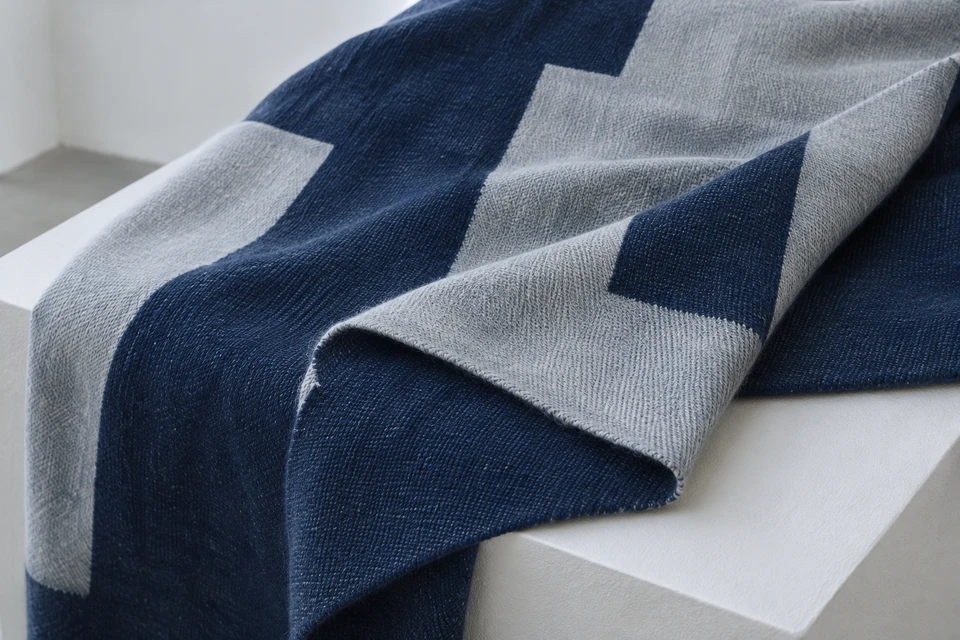
Two attractive faces do not fully describe a block double-cloth throw. The important construction question sits at the boundary between the blocks, where the layers change their visible role and the woven design connects the cloth.
- 1. Confirm the structural meaning of the offer
- 2. Examine a boundary sample before the whole throw
- 3. Separate the block map from the quality judgement
- 4. Feel the transitions in a relaxed drape
- 5. Repeat the observations after the proposed care route
- 6. Quote the approved construction and define change control
Confirm the structural meaning of the offer
Reversible appearance is not a complete weave description
Handwoven's explanation by weaver Madelyn van der Hoogt distinguishes cloth woven doublewidth from block doubleweave, in which two woven structures remain connected through exchanging faces. This distinction helps buyers ask a more precise question: is the proposed throw a structural double-cloth design, a different reversible weave, two fabrics joined later, or a printed interpretation? Request the maker's actual construction description rather than inferring it from opposite colours in a photograph.
Identify the proposed yarns, composition, finishing and edge treatment separately. The structural term alone does not establish warmth, weight, softness, origin or suitability for a particular care process. If a quotation uses a broad commercial name, ask for clarification before comparing it with a more detailed offer. Two suppliers can use similar marketing language while proposing materially different products, and those differences belong in the purchasing record.
Examine a boundary sample before the whole throw
Compare the two faces at the same location
Ask for a sample that includes a complete transition between light and dark blocks, plus a representative interior area on either side. Mark the location privately so the same boundary can be found on the reverse. Examine both faces under consistent light. The relationship between the sides matters more than a photograph of one especially neat square selected from elsewhere in the sample.
Discuss any small stepped or saw-tooth appearance with the maker. The cited weaving reference describes such edge character in common block-doubleweave constructions; it should not automatically be classified as damage. Equally, a general explanation of structure should not excuse an unintended broken boundary. Agree the accepted appearance for the specific proposal and retain a physical example. If the buyer requires a smoother outline, ask for a confirmed alternative rather than demanding an unspecified cosmetic repair.
Separate the block map from the quality judgement
A clean boundary can still be in the wrong place
Provide a complete face map showing the arrangement, proportions and colour roles of the blocks. Include the reverse relationship and the intended orientation on the finished throw. Compare the sample with that map before discussing small workmanship details. An accurately woven but incorrect sequence is an artwork or setup issue, not simply a variation in the texture of the cloth.
Review the map at the actual finished scale. A block that looks balanced in a small swatch may dominate a throw, while a narrow border can disappear in the fold used for retail display. Decide which dimensions and relationships are controlled and where variation is acceptable. Keep the construction approval connected to the full product dimensions so a larger size is not produced by extending an arbitrary edge without a reviewed layout.
Feel the transitions in a relaxed drape
Do not judge a soft product only under tension
Lay the throw flat without stretching it, then fold and drape it as it will be presented. Observe the boundaries for unwanted ridges, local separation or distortions that affect the agreed appearance and handle. Ask the maker to explain any concern using the actual sample. Do not pull the layers apart as an improvised strength test; where performance evidence is needed, the responsible technical owner should define an appropriate method and acceptance criteria.
Inspect the outer edges and corners in relation to the internal blocks. A binding, turned edge or fringe may change how the layers are contained at the perimeter. Confirm the selected finish and whether it is the same on every offered size. A close woven sample can establish the intended structure, but it cannot approve the complete throw's border, corner behaviour or finished presentation on its own.
Repeat the observations after the proposed care route
Keep the baseline and the treated sample linked
Use the agreed care procedure on an identified sample and record the actual conditions. Compare relaxed dimensions, block relationships, surface appearance and boundary handle with the original condition. Note whether any change is uniform across the throw or concentrated near a particular interchange. Keep the physical references and photographs together so a difference in folding or lighting is not mistaken for a material change.
Ask for further technical assessment if the observed change falls outside the project's agreed criteria. Avoid claiming universal durability or wash life from a limited development trial. A different yarn, finishing treatment or care instruction can alter the proposal and may require renewed approval. The useful record states exactly what was tested or observed on which construction, rather than attaching a general positive conclusion to every double-cloth product.
Quote the approved construction and define change control
Preserve the structural decision in the bulk order
The order brief should identify the face map, yarn and material references, dimensions, edge finish and approved sample. Ask which block layouts or colour combinations create separate setup or minimum-quantity requirements. Compare quotations against the same construction and sample stage; a colourway mock-up is not necessarily a production-representative woven approval. Confirm sampling and delivery milestones only after the supplier has reviewed the actual proposal.
Send FY Bedding the desired block layout, both-side appearance references, intended use and quantity split through the custom textile enquiry. Ask for a construction-specific response without assuming a particular loom capability or material is already available. For bulk inspection, retain the accepted boundary sample alongside the complete throw so staff can assess both the local weave relationship and the overall product that the buyer approved.
Approve both faces at the same block boundary, then inspect the complete relaxed throw. Keep structural edge character distinct from damage, incorrect block layout and unsupported performance claims.
Method references: Madelyn van der Hoogt: Block doubleweave and Finnweave.