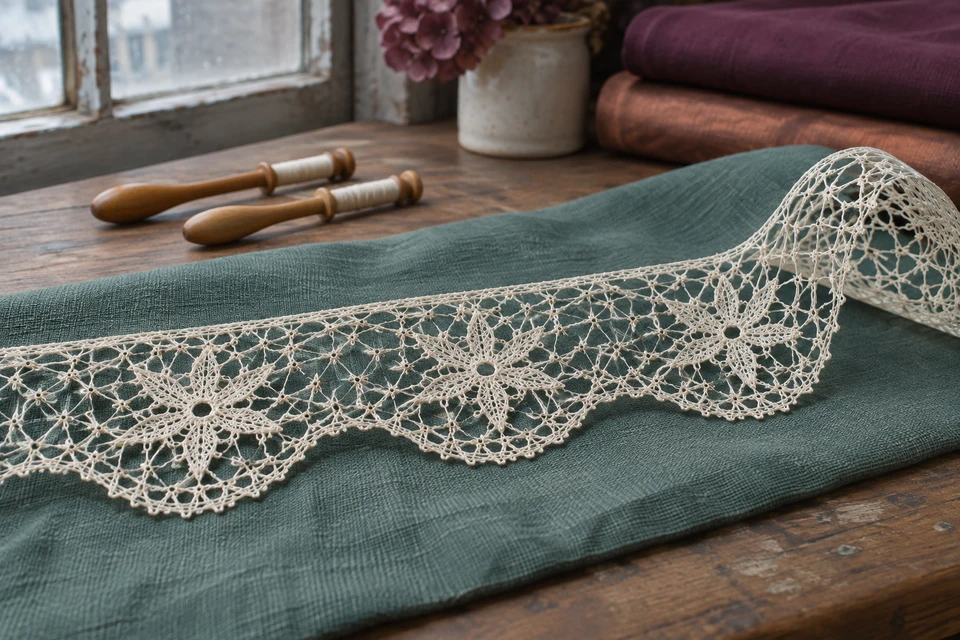
A festive lace border needs more than one attractive star to become an orderable table-linen detail. Buyers should review how the pattern is worked, how successive repeats relate, and how the finished edging meets the table textile before treating a lace photograph as a production reference.
Establish which lace process is being offered
Separate bobbin work from a similar-looking surface
Heritage Crafts describes bobbin lace as work built through crossing and twisting threads carried on bobbins. Other methods can produce open decorative structures too, including crochet and machine embroidery. Ask which process the supplier is proposing rather than inferring it from the presence of holes or a traditional-looking motif. If a machine-made interpretation is offered instead, compare and describe it honestly as its own option. A visually similar edging does not establish the same manufacturing route.
Record the proposed thread information and the role of the lace in the finished item. A narrow decorative edge on a runner is a different brief from a free-standing ornament or a dense insert in a cushion. Ask for a representative length produced by the proposed method, not only a historic reference photograph. Any statement about hand production, geographic origin or a particular maker requires evidence for the supplied item. The name of a craft technique is not evidence of a commercial relationship or production location.
Use the pricking as a design reference
Connect the pattern guide to the sample actually worked
The Portuguese Saber Fazer programme explains the use of a pricked pattern guide in bobbin lacework. For procurement, the useful question is which approved guide or revision the maker used for the submitted sample. The buyer need not direct every thread movement, but should be able to connect the physical result to a controlled design. If the maker adapts a pattern for the chosen thread or size, record the adapted version rather than continuing to reference an unrelated original drawing.
Ask for an annotated view or other agreed identification that makes this connection clear without demanding disclosure of unrelated proprietary work. Clarify permissions for the design supplied by either party. A reference image found online is not automatically permission to reproduce its pattern. Where the buyer provides an authorised seasonal motif, agree how the development interpretation will be reviewed. The artwork, working guide and finished lace should have related revision identifiers so that later changes cannot slip between them unnoticed.
Compare more than a single repeat
Look for drift in spacing and the open ground
Request enough worked length to see several complete motifs and the connections between them. One well-shaped snowflake or star does not show whether the spacing stays coherent along a runner. Lay the sample in its natural, agreed condition without stretching it into the desired dimensions for a photograph. Examine the motif outlines, connecting ground and edge line together. Where dimensions matter, agree how the lace will be conditioned and measured rather than taking an arbitrary ruler reading from a pulled sample.
Pay particular attention to transitions between dense and open areas. A buyer may appreciate deliberate changes in density while still needing the edging to sit consistently. Mark a questionable repeat and compare it with its neighbours before deciding whether the difference is intentional. Keep photographs of the full sample length and the specific detail. Avoid a requirement that every thread look identical in magnified photographs if the commercial brief accepts visible craft variation, but do not use that variation as a reason to ignore clear design drift.
Approve the lace on the table textile
Attachment can change a successful loose edging
Have the maker attach the proposed lace to the intended runner or a representative section of its final ground fabric. Review the relationship between the lace's attachment edge and the fabric edge. A loose lace sample that lies neatly by itself may behave differently once stitched to a finished hem. Ask for both face and reverse views and an actual handled sample. The relevant decision is whether the completed assembly matches the approved presentation, not whether either component looked satisfactory in isolation.
Corners and ends need their own treatment where the product includes them. A continuous straight edging cannot demonstrate how a corner will turn or how the final repeat will terminate. Decide whether the motif should finish complete, whether a deliberate cut-off is acceptable, or whether a separate end solution is needed. Request the maker's proposal before fixing final dimensions. If the chosen repeat conflicts with the runner length, resolve that relationship in development instead of discovering it after the quantity order is placed.
Define handling and packing around the open structure
Do not infer care from the lace's appearance
An open edging deserves a practical review of the handling it will encounter. Discuss product care, folding, retail removal and repacking with the supplier, then agree the relevant checks and evidence for the complete textile. A delicate appearance does not establish that an item must be dry-cleaned, and a sturdy-looking thread does not establish machine washability. Use the actual declared materials and construction when determining what evidence is required; keep unverified care claims off the final product description.
Review a packed sample with the lace positioned as intended. Confirm that the display exposes enough of the seasonal motif without repeatedly bending the same fragile-looking feature or catching it on another packaging component. This is a packaging-development observation, not a claim that a particular fold prevents all damage. If a buyer changes the retail format, revisit the packed sample. Include the agreed packing presentation with the order so that an approved lace design is not undermined by an unreviewed display arrangement.
Keep quotation and receiving decisions tied to the revision
Approve a construction, not a generic festive border
The quotation should identify the lace method, thread proposal, worked design, attached configuration and quantity basis. Ask how changes in width, thread or motif affect sample work, minimum quantities and timing. Avoid assuming that a narrow lace consumes less development time or that a finished prototype guarantees available seasonal capacity. Confirm any production and delivery plan for the actual order. A Christmas motif is an intended market position, not a promise of arrival before a holiday.
At receiving, compare the worked repeat and assembled edge with the retained sample and revision record. Separate a motif discrepancy from an attachment discrepancy so the supplier can investigate the correct part of the process. FY Bedding enquiries can include the authorised design direction, runner size, intended use and sample evidence required. The next step is to discuss a feasible proposal, not to infer that an existing seasonal photograph confirms a bobbin-lace technique, material specification or stock position.
Connect the approved pricking revision to several worked repeats and an attached runner sample. Resolve corners, endings, care evidence and packing before accepting a quotation for a generic Christmas lace border.
Method references: Heritage Crafts: bobbin-lace thread construction; Saber Fazer: the pricked pattern guide in bobbin lacework.