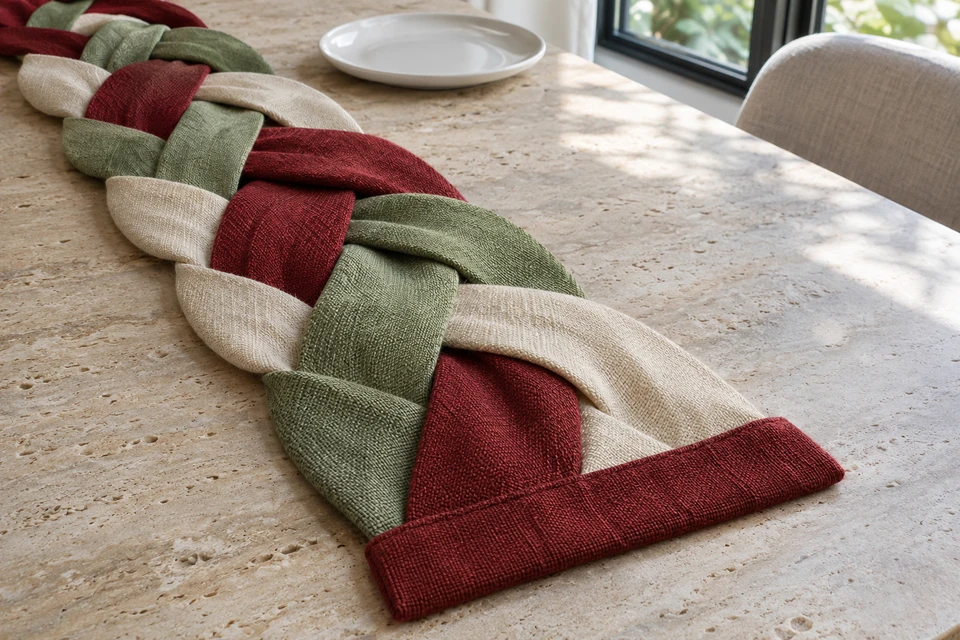
A braided Christmas runner is not a conventional flat cloth with a decorative stripe. Its width, relief and edges come from interlaced strands. That makes a short, attractive braid sample insufficient for a purchase decision: the buyer also needs to see whether a full runner lies steadily on the intended table and how the last crossing is finished.
Start with a placement plan
Decide what may sit on the braid
Mark where the runner will lie relative to plates, serving pieces and decorative objects. If its purpose is a narrow visual line down the centre of a table, state that clearly. Do not automatically photograph drinks or unstable ornaments balanced across raised crossings. The sample should demonstrate the intended display arrangement rather than encourage an untested use simply because a festive setting looks appealing.
Measure the available flat tabletop length and decide whether the runner ends remain on that surface or extend beyond it. A soft braided end can hang differently from a bound flat runner. Mock up both arrangements if the range is intended for several table sizes. Keep the chosen arrangement in the buying brief so that the finished length is not judged against a different styling convention at inspection.
Define the strand and the assembled braid separately
One material width does not describe the runner
Ask whether each strand is a folded strip, a sewn tube or another agreed construction. Record its relaxed width, edge treatment and face presentation. Then record the overall runner width and the approximate length occupied by a complete repeating crossing sequence. The braid can become narrower and thicker if it is pulled more tightly, even though the starting strips remain unchanged.
Review a full-width sample under normal room light and from a low angle. Look for twists that expose the wrong face, abrupt changes in strand width or a crossing that sits visibly higher than its neighbours. In a wine, ivory and green Christmas palette, also check the colour sequence from both ends. A deliberate repeating sequence should not be replaced by an accidental concentration of one shade near the binding.
Inspect the last crossing before the binding
The end should not conceal an unfinished assembly
Request a construction sample of the end before it is permanently enclosed. Confirm which strand ends are captured and where their cut edges finish. A neat outer binding may cover loose material underneath; the review needs to establish the intended containment rather than infer it from a tidy front photograph. Record the finished binding width separately from the length of the braided body.
Lay two completed ends next to one another. Check whether the termination looks balanced, whether one end flares outward and whether the binding pushes the final crossing into a lump. If the project intentionally uses a tapered end, retain its outline as part of the approved sample. Do not let the inspection team alternate between a squared and tapered reference when classifying the same delivered design.
Run the dining-surface trial without styling tricks
Flatness needs an observable method
Use the proposed table surface, or a documented representative surface, and lay the runner down without tape, pins or hidden weights. Photograph its natural position from above and at tabletop level. Turn the runner around and repeat the placement. If a raised section moves with the runner, record that location; if it stays with the table, investigate the support surface before rejecting the textile.
Place only the agreed display objects on their intended stable areas. Observe contact and rocking without treating this informal trial as a safety certificate. If the design is intended as decorative textile only, make that limitation consistent in retail photography and product copy. Any heat-protection or other functional claim requires separate evidence for the particular finished assembly, not an assumption based on the thickness of the braid.
Approve packing on the full-length sample
Folding can alter the first impression
Compare a loose roll with the proposed folded packing method using the actual runner, including its bound ends. Unpack it using the steps that a retail customer would receive. Record any crossing that stays distorted or needs more adjustment than the approved presentation allows. Agree an observation period and handling method with the supplier rather than claiming that every crease will disappear on its own.
For quotation comparison, keep the strand construction, braid width, total length, end treatment and individual pack constant. Request changes as clearly identified alternatives. Discuss the Christmas display quantity and required sample date with FY Bedding through the project enquiry route; a confirmed supply plan must come from the completed brief and supplier response. A seasonal colour combination alone does not establish stock availability or delivery before a particular event.
The acceptance sample should include a full crossing sequence, both finished ends and the unpacked full-length runner. Record the intended placement so that decorative relief is not confused with an approved support surface.