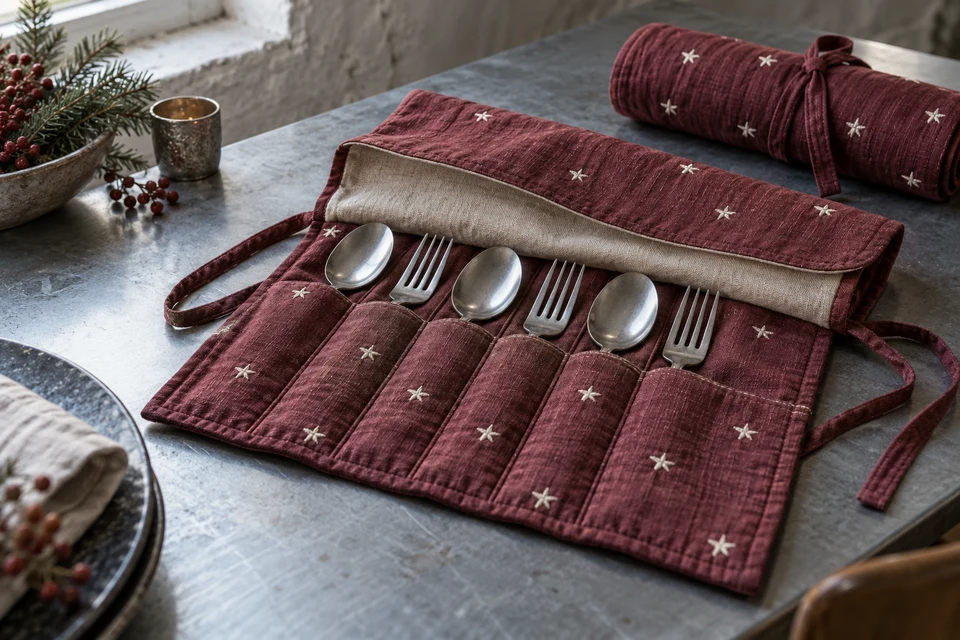
A textile cutlery storage roll is a different purchase from individual dining sleeves. It must organize a defined collection, close around that collection and reopen without losing the sequence. For a Christmas gift program, the attractive outer fabric is only one part of the specification. Start with the intended blunt table utensils and build the pocket map, flap and ties around them; knife cases require a separate development brief.
Count the contents before drawing pockets
Name the intended storage set
List each utensil type, its quantity and its dimensions. A six-piece assortment of mixed forks and spoons is not the same as six complete place settings. Decide whether one pocket holds one item or an agreed group, and show the loading sequence on a simple numbered drawing kept in the technical file. Do not rely on the supplier's phrase 'six pockets' to define the capacity.
Use representative utensils or dimensionally faithful samples during development. Check the widest spoon bowl, longest handle and highest stacked section rather than an average size. State clearly whether the quoted product is an empty textile roll or a set containing utensils. The quotation comparison checklist helps make such inclusions explicit before the buyer compares unit costs.
- Specify each pocket's intended contents.
- Exclude sharp knives from this blunt-tableware brief.
Lay out the loaded row
Measure between finished seams
Specify usable pocket width and depth after sewing, not only the cut-panel dimensions. A seam allowance consumes space, and a thick item may occupy width differently from a flat template. Load every pocket together and check that the row remains manageable. An isolated pocket test can miss the cumulative bulk that appears when the entire collection is packed.
Inspect pocket bottoms and dividing seams for visible distortion and unfinished thread ends. Confirm whether the pocket face is one continuous panel or separately assembled pieces. Use the seam specification guide to document the approved construction. A change in pocket count, fabric thickness or lining should trigger another loaded sample review, not just an edited artwork proof.
- Measure usable depth from the finished pocket opening.
- Inspect both the loaded face and reverse seam lines.
Separate the protective flap from the closure ties
Follow the complete folding sequence
Define which part of the utensil is covered when the flap folds down. The flap should be reviewed with the tallest intended item, not with empty pockets. Check how it meets the pocket row and whether the fold pushes items sideways. Do not claim complete protection from an image showing only the roll tied shut; inspect the loaded arrangement before and after folding.
Agree which end is rolled first and photograph the sequence. Then specify tie attachment position and usable length around the fully loaded roll. A tie that looks generous on an empty sample may be too short on the gift set. Keep the approved loaded roll with the reference sample record, including the precise contents used to establish the closure.
- Photograph the open, flap-down and closed states.
- Confirm that ties remain reachable when fully loaded.
Approve the contact face and Christmas exterior separately
Do not infer special protective properties
Record the outer textile, lining, quilting layer and thread. Inspect the inner face for loose fibres, bulky seams and exposed decoration backing. If the roll is intended to store cleaned tableware, the buyer's product reviewer should assess the intended contact, care and destination requirements. A decorative textile report does not automatically establish suitability for every storage use. Avoid unsupported tarnish-prevention or hygiene claims.
Review the motif orientation when the roll is closed: a large Christmas image can disappear beneath the ties or be split across the outer overlap. Keep the exact material references in the bill of materials. Any proposed material or finish substitution should be reviewed for both the internal contact face and the external appearance before it enters the order.
Make washing, drying and packing part of approval
Retain the actual loaded dimensions
Agree care instructions for the textile component and review a complete finished sample after that route. Check whether the pocket row, lining and flap still align and whether the roll can be folded in the approved sequence. Storage instructions should be reviewed by the responsible product team rather than inferred from a seasonal photograph. Do not market the roll as a substitute for cleaning the contents.
Record the packed dimensions and the number of rolls per retail unit and carton. If utensils are excluded, use clear wording so the styled image does not create a different expectation. The pack approval checklist provides a useful recording framework. Send FY Bedding the utensil list, pocket map, intended care route and Christmas artwork direction to scope sampling, packaging and delivery milestones without an unconfirmed holiday-arrival promise.
- Keep the loaded sample and the empty retail pack reference.
- Freeze the pocket map before final packing artwork.
A storage roll is approved only when the complete intended set fits, the flap folds correctly and the ties close around the loaded form without changing the agreed sequence.