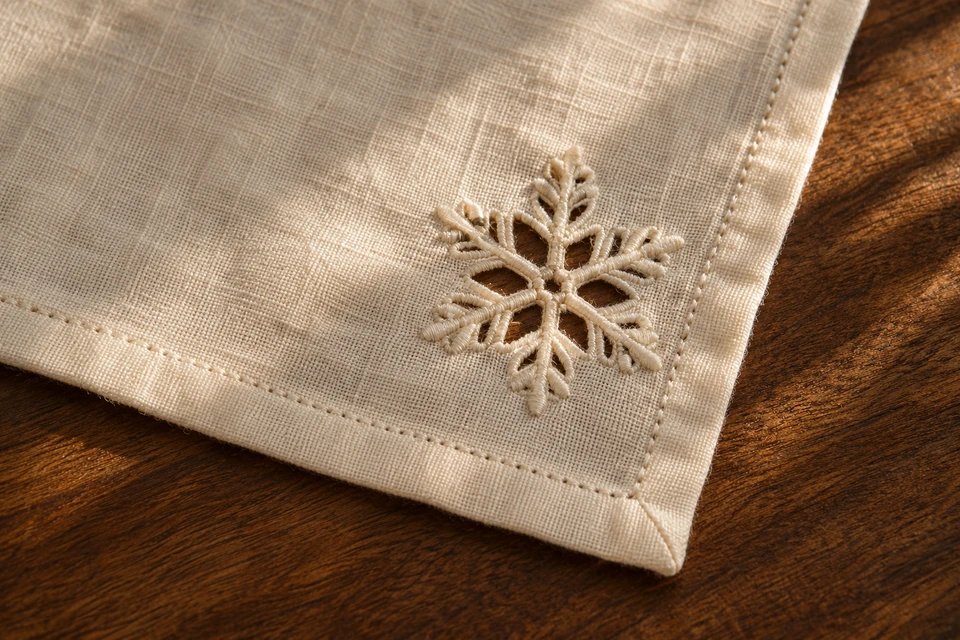
A snowflake can look delicate on a screen yet become disconnected when its light areas are cut out of cloth. For Christmas cutwork napkins, the buying decision is not simply whether the outline resembles the approved artwork. It is whether the intended openings, embroidered edges and connecting bars form a coherent finished corner. Establish that construction on a physical sample before extending the motif to several napkin sizes or committing a retail pack to production. A photograph alone cannot establish the strength or care performance of the openwork.
Mark what stays and what is removed
Create an opening map before discussing stitch appearance
Give the technical team an artwork version in which retained cloth, removed cloth and stitched connections are distinguishable. Number the openings on the working drawing, not on the finished product. A white area in a digital illustration might mean background fabric, thread or a hole; leaving that distinction unresolved invites incompatible samples. Confirm whether the snowflake sits inside an intact corner or intersects the outer edge, because those are materially different constructions and should not share one ambiguous approval.
The design review should show the entire motif and a close view of the smallest connecting junction. Identify the links whose absence would isolate a central area or merge adjacent apertures. BERNINA describes cutwork as fabric removal with embroidered edge finishing; that explains the construction category, not a performance guarantee. The buyer still needs a supplier proposal for this cloth, scale and use. Do not approve a printed white snowflake as evidence that the same shape can be produced as openwork.
Compare bridges at the intended scale
Avoid approving an enlarged demonstration sample
Request a trial at the actual finished motif dimensions using the proposed base fabric and thread. View it flat over both a light and a dark surface so missing connections are not hidden by a matching background. Look for uneven bar widths, exposed cut edges, loose thread loops and points where several bars crowd into a bulky junction. Record observations against the numbered opening map so the supplier knows which part requires revision instead of receiving a general instruction to make it neater.
If a narrow gap repeatedly closes or a connecting bar becomes visually dominant, ask for a redesigned local junction. Enlarging the whole motif may solve one technical problem while changing the desired corner proportion. Compare the original and revised versions at the same scale before choosing. Keep the rejected map visibly superseded. A sample with broader links should not be approved while a purchase order still refers to the earlier drawing with finer openings; both documents need to describe the same deliverable.
Review the napkin as a usable textile
Separate appearance handling from performance evidence
Open and refold the complete napkin in the intended presentation, noting whether a fold repeatedly lands across a dense junction or catches an exposed loop. Compare both faces. A tidy front can coexist with bulky backing residue or unfinished thread on the reverse. Inspect these areas without stretching the openings to make them look larger. Agree how the napkin should be laid out for routine appearance inspection and retain photographs showing the accepted relaxed state, including its relationship to the hem.
Define a care trial appropriate to the intended project with the supplier or relevant specialist. Record the actual care process, sample identity and observations, including any changed opening shape or puckering. Do not claim that a visual sample has passed a wash standard or is suitable for commercial laundry. If formal test evidence is required, request documentation tied to the same material and construction. Appearance approval, care instructions and substantiated performance requirements belong in separate fields rather than one blanket statement of quality.
Build a pack that presents the corner honestly
Check folded visibility and inter-item contact
Trial the proposed selling quantity in the actual folded format. Decide whether the cutwork corner is visible on the top item and whether the other napkins are oriented consistently. Inspect the stack after removal from its pack before smoothing it. Openwork can be difficult to judge if a fold or another item's hem sits directly behind it. The pack review should make the design understandable without relying on excessive tissue, special lighting or a styling routine that the recipient will not reproduce.
Ask the packing team to demonstrate how adjacent openwork areas are separated during the proposed handling sequence. Record any snags or displaced threads as observations rather than assuming a particular wrapping material will prevent them. Compare the pack dimensions and component quantities used for the quotation with the reviewed sample. An attractive loose napkin and an attractive closed box are not enough if the agreed pack cannot be assembled consistently or the decorative corner is distorted when the lid is closed.
Release one controlled openwork version
Link feasibility, quantities and acceptance criteria
Before ordering, bring together the opening map, actual-size sample, base-fabric identity, thread proposal, finished napkin dimensions and packing arrangement. State which measurements describe the whole napkin and which describe the motif. Ask the supplier to confirm development feasibility, minimum quantities and sampling sequence for that specific version. A change of fabric weight, snowflake size or edge position should trigger review of the affected connections rather than be treated as an equivalent cosmetic change.
Send FY Bedding the marked motif and intended table-linen programme when requesting a development review. Include market, quantity by size, desired care route and any evidence requirements so the response can separate confirmed options from open questions. No delivery date, certification or available production method is established by this guide's illustration. Release bulk only after the parties agree how to identify an unacceptable missing connection and how a revised sample will be signed off, retained and communicated to inspection.
Approve the real-size opening map and finished napkin together: every intended bridge must remain identifiable before and after the agreed care and packing review.
Method references: BERNINA: Digitizing cutwork.