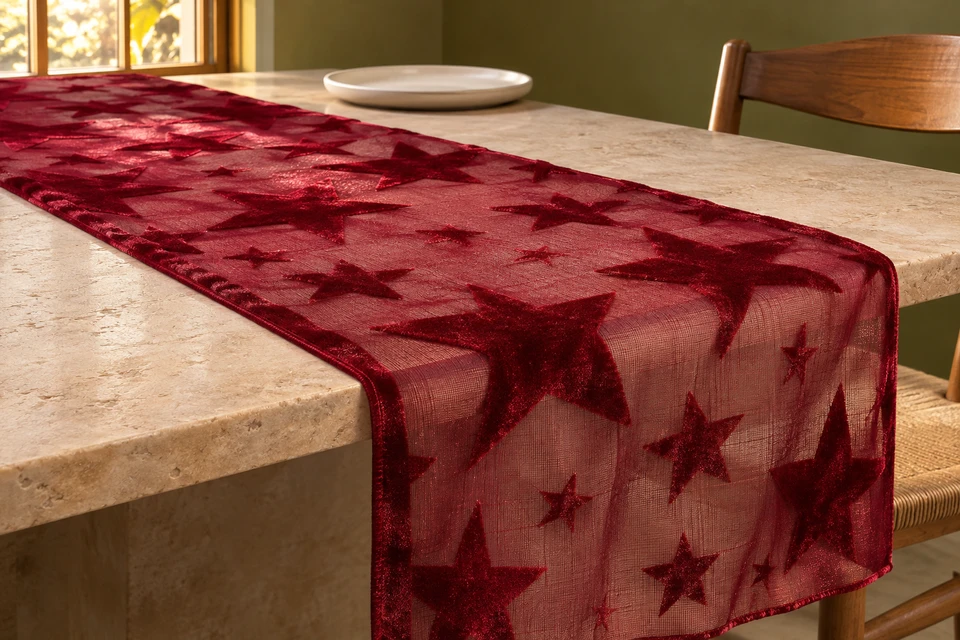
A Christmas runner with velvet stars floating on a sheer ground can be visually striking, but its specification cannot stop at the word devore. The buyer needs to understand what the starting fabric contains, which component the proposed process removes and what structure remains in the open-looking areas. This is a construction decision as well as a pattern decision. A printed imitation, an openwork textile and a selectively treated pile fabric may look related in a photograph while requiring different sample questions.
- 1. Ask what remains beneath the design
- 2. Specify the fabric components independently
- 3. Read the boundary between velvet and sheer areas
- 4. Check the runner on the table surface it will reveal
- 5. Examine the transitions into seams and edges
- 6. Purchase a described construction with a visible approval trail
Ask what remains beneath the design
Distinguish a sheer ground from a hole through the textile
Dharma Trading's Fiber Etch description gives an example of selective fibre removal in a blend, leaving other fibres to form sheer areas. It illustrates the principle rather than defining every commercial devore fabric. Ask the actual supplier to explain the proposed starting construction and the remaining ground in its own sample. Do not assume that a velvet-looking surface is silk, that every sheer area is a hole or that all burnout routes use the same materials.
Request a face and reverse view with the sample placed over contrasting backgrounds. Then examine a physical specimen. Identify the pile areas, the remaining supporting structure and any area intended to be fully open. Keep those categories separate on the artwork. A photograph on a dark table can conceal a fine ground, while backlighting can make the same area appear more open than it is under ordinary tabletop conditions.
Specify the fabric components independently
A single blend percentage may not explain the construction
Ask for the composition information relevant to the pile and ground, along with the description intended for the complete product. The supplier should explain how that information was established and which evidence applies to the finished proposal. Do not calculate a finished composition merely by subtracting an imagined amount of removed pile from a starting blend. The buying team needs a supported description of the article it will actually receive.
Keep decorative effect and performance separate. A remaining ground may be fine, dense, soft or relatively firm, but those observations alone do not prove tear resistance, laundering performance or compliance. If a market or customer requires evidence, specify the relevant finished construction and obtain an appropriate evaluation plan. This article is a purchasing brief, not a chemical-processing recipe or a substitute for the maker's technical and safety controls.
Read the boundary between velvet and sheer areas
Small seasonal details need a full-size trial
Review the proposed pattern at the scale intended for the runner. A snowflake arm, star point or narrow stem can produce a difficult boundary between retained pile and exposed ground. Ask the maker to show representative fine and broad features on the actual fabric. Compare the sample with the authorised design, marking any simplification that needs a design decision. A large demonstration motif does not approve every small detail in a separate Christmas file.
Observe the outline from both sides and note whether the accepted design requires a crisp edge or a deliberately softened transition. Do not classify every fuzzy boundary as a defect without a reference, or accept every incomplete-looking area as a normal feature. Preserve an identified physical master that makes the agreed distinction visible. If the technique cannot reproduce a critical detail on the proposed base, revise the artwork or the route before pricing the final order.
Check the runner on the table surface it will reveal
The background becomes part of the visual proposal
Choose a small set of representative tabletop backgrounds for the buyer's review. A cranberry pile over a light ground may read differently on pale stone, dark wood and a coloured tablecloth. Photograph the same runner in those contexts without changing the pattern sample. The purpose is to make the intended retail presentation clear, not to claim that the textile changes colour or to use a favourable background to hide an unresolved construction issue.
Decide whether the product is sold as an unlined sheer runner or with another layer beneath it. An added backing changes what is visible through the treated areas and creates a different finished assembly. Record that choice in the quotation and product description. If a collection offers both versions, obtain the appropriate samples for each rather than showing one styled version while supplying an unspecified alternative.
Examine the transitions into seams and edges
The surface technique does not finish the article
Request a finished corner and edge section containing both pile and sheer areas. Check how the proposed seam, binding or hem relates to the changing surface. Ask the maker to explain any reinforcement or retained material at the perimeter. Keep that explanation connected to the approved sample so a later substitution does not introduce a visibly different strip through a sheer part of the design.
Review the complete runner after the agreed finishing and care assessment for the intended use. Record observations at the motif boundaries, ground, corners and seams separately. A change in the pile does not automatically establish damage to the ground, and an apparently intact face does not prove the supporting structure is unchanged. Unresolved findings should go back to the technical owner with the actual specimen and its processing history, not a guessed cause.
Purchase a described construction with a visible approval trail
Keep the sample's limitations explicit
For an FY Bedding enquiry, provide the authorised Christmas artwork, desired finished dimensions, the intended sheer or lined presentation and a description of the visual effect. Ask whether the construction can be evaluated, which materials are proposed and what evidence would accompany the samples. Confirm quantities, development steps and delivery planning independently. A reference image does not establish an available devore capability, a confirmed material source or inventory ready for the season.
Before release, connect the accepted fabric proposal to the pattern revision, component information, full-size trial and finished runner. State which sample controls the pile-to-ground boundary and which controls the table presentation. Keep any outstanding performance or market requirements visible rather than treating a successful visual review as a blanket approval. The useful purchasing outcome is a clearly described textile with an agreed evidence path, not an attractive effect supported only by a technique name.
For a devore runner, identify the retained ground and pile separately, approve the actual pattern boundaries at full size and review the complete sheer or lined assembly before release.
Method references: Dharma Trading: a specific selective-fibre-removal example.