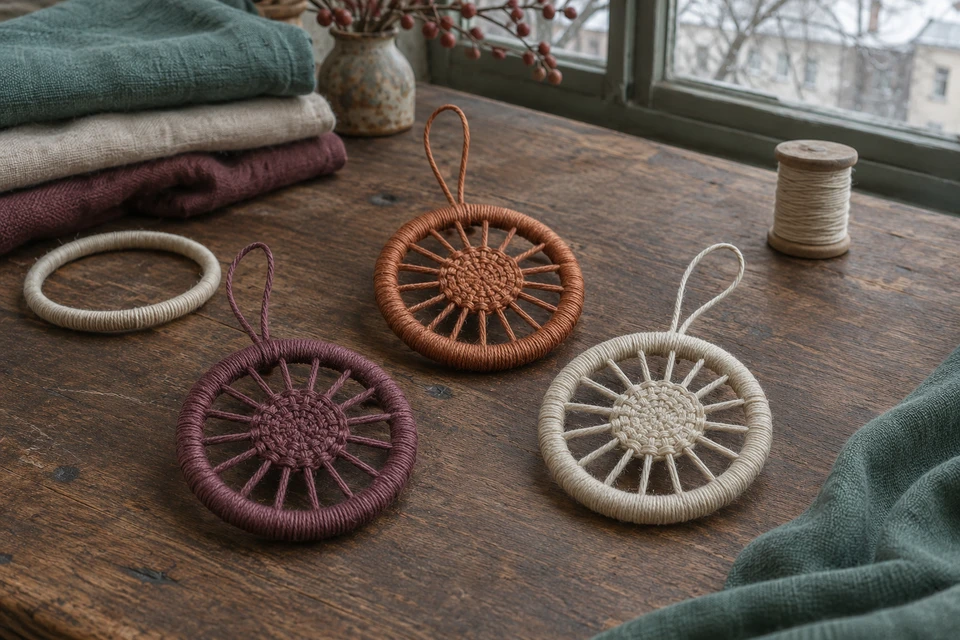
A thread-wrapped wheel can become a distinctive Christmas ornament, but its name alone leaves several buying decisions unresolved. The ring, spoke arrangement, centre and hanging loop need to work as one approved object rather than four attractive details sourced independently.
Define the ornament rather than a closure button
State the intended use and construction family
Heritage Crafts describes button making that includes threads wrapped, woven or stitched over supporting forms, with Dorset buttons among the traditions discussed. That history helps identify a construction direction; it does not authenticate a supplier, establish a place of manufacture or prove hand production. In a purchasing brief, state that the proposed item is a hanging decoration based on a thread-worked ring. Do not describe it as a garment fastening unless that separate use has actually been developed and assessed.
Ask the maker to identify the supporting ring, thread materials and attachment method for any additional parts. These are specification questions even when the finished ornament looks entirely textile. A covered ring may conceal a material that matters for handling, storage or the destination market's requirements. Obtain the relevant information and evidence for the actual product rather than guessing from its weight or appearance. If details are not yet settled, keep them open on the development record and avoid definitive product-page claims.
Approve the wrapped ring as the frame
Inspect coverage and shape before adding decoration
Review an unfinished wrapped ring as well as the finished wheel. The unfinished example exposes whether the coverage and ring shape are already consistent before the spokes and centre distract the eye. Look around the full circumference, including the area where thread starts or finishes. A bulky finishing point can change the silhouette or make the ornament hang unevenly. Ask for the proposed treatment to be shown, not simply described as concealed.
Decide whether a small amount of the supporting form may be visible anywhere in the finished design. An intentionally exposed detail should be documented separately from an accidental gap. Compare the ring under the lighting likely to be used for product inspection, then view it at normal display distance. The buyer may accept natural thread texture while rejecting an obvious discontinuity in colour coverage. Those are different decisions; a blanket requirement for perfect smoothness can erase the very material character the collection is intended to show.
Read the spoke arrangement from the centre out
Distinguish deliberate asymmetry from drift
The number, spacing and route of the spokes determine the wheel's visual rhythm. Request a sample showing the intended arrangement clearly enough to compare successive pieces. An irregular design can be valid, but it still needs a defined reference and an explanation of which variations are deliberate. Without that distinction, a supplier may treat any imbalance as craft character while a receiving team treats every difference as unacceptable. Neither interpretation is a reliable basis for a retail order.
Inspect the centre where thread paths converge. A dense centre, a visible opening and a woven rosette each produce a different appearance and thickness. Agree which is intended before approving the colour assortment. If a contrast thread is used at the centre, check its transition into the spokes and how it reads on the reverse. Ask the maker to show any revised structure with the same ring and thread combination so that a construction improvement is not confused with a colour or material change.
Hang the sample in both directions
The reverse and loop are part of the displayed product
Suspend the ornament by its proposed loop and let it settle naturally. Record which side faces forward and whether the wheel tends to rotate. A Christmas tree ornament may be seen from more than one direction, so the buyer should decide how finished the reverse needs to appear. A single carefully positioned front photograph cannot approve the full object. Include a reverse view and a side view showing the centre's depth and the loop attachment.
Keep a clear distinction between a display check and a safety or durability assessment. Observing that one sample hangs neatly does not establish the strength of its loop, the suitability of small components or compliance for a particular audience. Define the intended market and use with the supplier, then determine the evidence and testing required for that product. Avoid describing a decorative wheel as a toy or suitable for children merely because it is soft-looking and sold during a family holiday.
Plan the assortment around real sample differences
Colour combinations are not only a shade-card exercise
A plum ring with chalk spokes may reveal gaps differently from a chalk ring with plum spokes. Copper-coloured thread may also have a different construction from the other colours proposed. Ask for material identification and physical samples of the combinations that create the highest contrast or a different surface effect. A colour card is useful for direction, but it does not show the finished coverage at a wrapped edge or the appearance of a densely woven centre.
For mixed retail packs, specify the count of each approved design and decide whether small individual variation is acceptable within the set. Review the actual pack arrangement so loops do not obscure the wheel faces or become entangled during ordinary removal. Ask the supplier to price the agreed assortment and explain any minimum quantities by thread or design. Do not assume that a mixed pack can absorb unlimited colour variation or that an available sample represents confirmed stock for a seasonal launch.
Keep the approval small enough to use
Document the wheel's defining features and change route
A practical record includes the ring dimensions and declared material, thread references, spoke arrangement, centre treatment, reverse appearance and loop configuration. Attach photographs of the approved complete ornament and the intermediate wrapped ring. If an intentional variation is accepted, show examples of its range. Agree how the buyer will review a change in ring supplier or thread construction, because a visually similar substitute can alter coverage, thickness and the way the wheel hangs.
Use that record when discussing sample timing, inspection and packing, rather than repeating a general request for handmade-looking Christmas ornaments. FY Bedding can review a project brief with the intended display context, quantity split and target market. Feasibility, manufacturing method and commercial terms must be confirmed for the proposed design. Any heritage story, geographic attribution or hand-production statement should have its own support; the visual resemblance to a Dorset-style wheel is not evidence of those claims.
Approve one complete wheel, its wrapped-ring reference, spoke layout, centre, reverse and loop together. Keep the ornament's intended use and supporting material information explicit before moving from a decorative concept to a retail order.
Method references: Heritage Crafts: thread-worked button traditions and supporting forms.