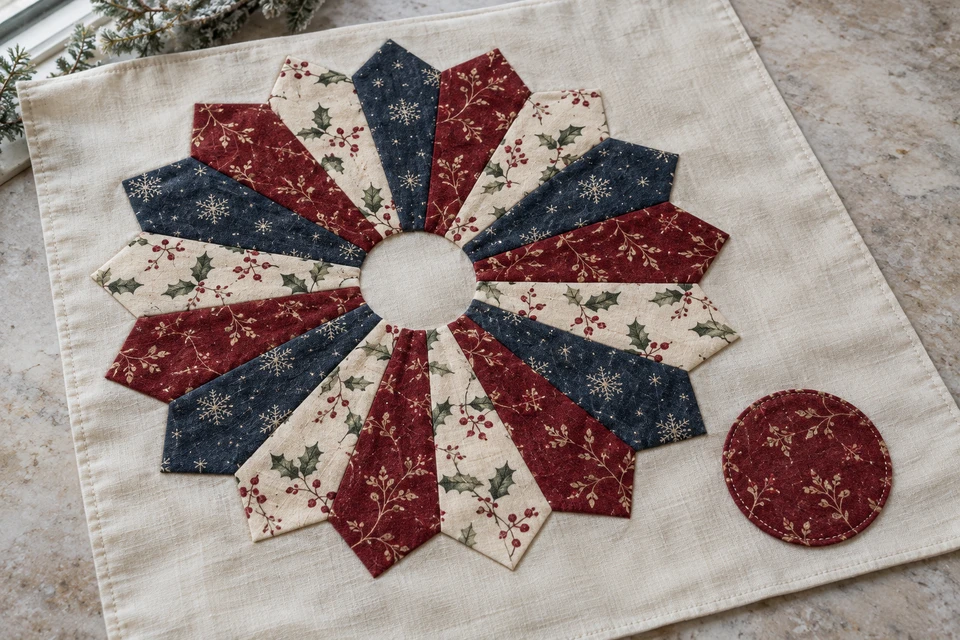
A Dresden-plate table topper can look convincing while its radial pieces are arranged loosely, yet lift or buckle after the last join closes the ring. Covering the centre with an applique circle may hide the inner edges without resolving that problem. Buyers should therefore see the complete joined ring before the centre is covered, then inspect it again on the finished table linen. The important decision is whether the accepted radial construction lies as intended without being stretched, pinned down or disguised by presentation.
Specify the joined ring as a review stage
A laid-out collection of wedges is not the same sample
The Quilters' Guild's Dresden Plate technique article describes a circular arrangement of fabric blades combining piecing and applique. That construction principle supports this procurement question; its pattern dimensions and sewing instructions are not the specification for your product. Request an original project drawing showing the intended number of blades, their outline and the finished ring size. Rounded and pointed interpretations should be identified as different proposals where their appearance differs.
Ask whether the blades are actually joined pieces or whether the effect is printed on one cloth. If the proposal is pieced, define the stage at which all radial joins are complete but the centre patch has not yet concealed their inner ends. This is an inspection opportunity, not an instruction to leave the delivered product unfinished. Agree how the maker will retain or photograph a representative intermediate sample without disrupting the production route.
Examine closure around the whole circle
The last join should not be treated as a hidden correction
Place the joined ring on the agreed flat support and let it rest without forcing it into a shape. Compare the overall silhouette with the drawing. Look for a section that rises, a persistent fold between neighbouring blades or a local area that has been pulled taut to close the circle. Record the location of an observation using blade references in the inspection sheet. Do not assume a particular cutting or sewing cause from a photograph alone.
Compare the last joined area with the rest of the ring. A sample maker may have corrected a local mismatch by changing that seam or trimming one blade; if so, ask whether the correction is a deliberate repeatable construction or an individual repair. Approving an attractive one-off sample is not enough if the production instructions still describe an earlier geometry. The supplier's technical team should resolve the method and present a revised representative ring for review.
Keep decorative sequence and geometric acceptance separate
Christmas colours can distract from a lifted section
Mark the order of burgundy, ivory and other seasonal fabrics around the ring, including any repeated print direction that matters. A colour swap may be visually obvious while a slight lift is easier to miss under a high-contrast design. Review the sequence first and the resting shape separately, using a side view and gentle raking light in addition to the overhead image. Do not combine both decisions into a single comment that the colours look correct.
Agree whether minor natural texture is part of the chosen appearance. A handmade-looking piece need not be unnaturally rigid or perfectly machine-flat, but any accepted variation should be represented by the actual sample rather than a vague allowance for rustic character. Show an unacceptable example when the boundary is difficult to explain. Keep these references specific to the proposed topper instead of borrowing a tolerance from an unrelated quilt or folded fabric ornament.
Approve the centre patch after the ring itself
Coverage and concealment are different decisions
Position the proposed centre patch without using it to pull an uneven ring flat. Check its diameter, centring and relationship to the blade tips. Confirm that it covers the intended inner edges with the chosen attachment route. Ask the maker to explain any change in coverage required by the actual sample. An enlarged centre can materially alter the design, especially if it reduces the visible length of the contrasting blades.
Inspect the completed centre from the face and reverse where accessible. Identify unwanted ridges, visible raw edges or a centre that sits differently from the accepted intermediate sample. Keep the observation separate from claims about durability: visual coverage does not prove attachment strength or laundering performance. Those questions belong in the agreed finished-product evaluation, using the actual materials and construction, not assumptions based on the familiar name of the pattern.
Review the topper as it will be used and packed
A flat ring does not approve the entire table textile
After the applique and final edge treatment are complete, place the topper on a representative table surface. Check the relationship between the radial motif and the outside edge. A well-centred drawing can become off-centre during assembly, and a flat ring can sit on a ground panel that has developed unwanted distortion. Record the whole textile as well as the close details so that the approval covers their relationship.
Repeat the appearance review after the intended care and packing trial. Use only the preparation that the receiving retailer or customer is expected to perform. If a particular press is necessary to achieve the displayed result, disclose and evaluate that requirement instead of using exceptional styling to conceal a recurring issue. Keep care suitability, decorative-object placement and any heat-related use outside the scope of an unsupported photograph. This is table decoration, not automatically a protective trivet.
For a seasonal enquiry to FY Bedding, send the radial drawing, blade fabrics, intended sizes, centre treatment and quantities. Request a joined-ring review and a completed topper sample as separately identified stages. Ask for the associated development timing before committing to a holiday launch. Release the construction only when the supplier's instructions, intermediate evidence and finished reference all describe the same accepted ring and centre arrangement.
Has the complete joined blade ring been reviewed without forced flattening before centre coverage, and does the finished topper retain that accepted shape after ordinary preparation?
Method references: The Quilters’ Guild: Dresden Plate pieced-circle construction.