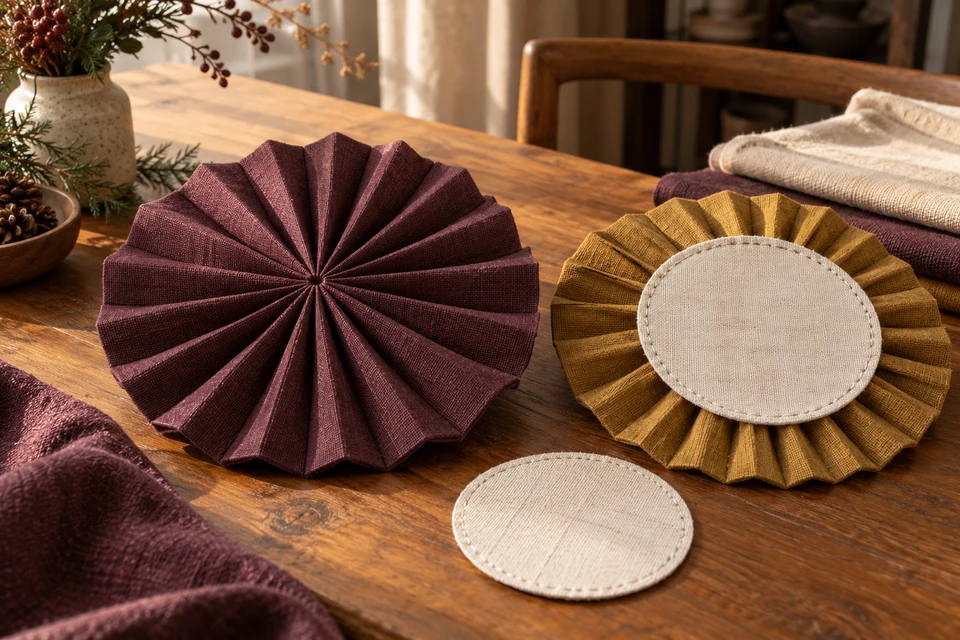
A Christmas fabric rosette combines a radial pleated face with a less visible backing disc. Purchasing teams need both views before approving the decoration. Define the relaxed profile, attachment scope and packed presentation so the finished seasonal assortment can be inspected against something more useful than a flat fabric swatch.
Define the decoration before choosing its finish
Keep the mounting system within the quotation
A Christmas fabric rosette can be a loose decorative component, a hanging ornament or an attachment supplied for a larger textile assembly. These are different offers. Start the enquiry with the intended use, finished diameter and a clear list of supplied parts. State whether a hanging loop, backing disc, central cover and mounting hardware are included. A photograph showing the rosette attached to a display does not establish that the attachment is part of the order.
For a retail collection, distinguish decorative objects from toys and wearable accessories in the development brief. Do not assume that a seasonal motif determines the applicable product category. If a buyer changes the use after sample approval, reopen the construction and evidence review. Keep unsupported claims about suitability, strength or safety out of the product description. The technical pack should retain those supplied-part boundaries.
- Identify the sold unit and every included attachment.
- Show the front, reverse and intended mounted position.
- Record excluded uses before developing retail copy.
Approve the radial fold pattern
Measure the face without flattening its character
Nominal diameter alone cannot describe a pleated face. Record the outer diameter, central covered area, raised profile and the visible width of the folds. Agree on measurement conditions so that one sample is not pressed flat while another is measured in its relaxed state. A deep fold can change the apparent colour through shadow; assess the face under the lighting intended for the retail presentation, not only under a bright sample-table lamp.
Use a complete sample to inspect how the last fold meets the first. The joining area should be deliberately positioned and included in approval photographs. Decide which irregularities are acceptable characteristics of the construction and which are rejection points. Do not create an arbitrary universal tolerance: agree measurable limits with the supplier using representative samples and the intended production method. Use the measurement and tolerance framework to document this agreed relaxed state.
- Retain the approved relaxed profile and measurement method.
- Inspect the closing join rather than hiding it in photographs.
- Approve an acceptable reference and a clearly unacceptable example where useful.
Review the backing as a separate component
Check coverage and the attachment route
The backing disc should be specified separately from the pleated face. Identify its material, finished size, edge treatment and connection to the folds. Too little coverage may expose loose construction on the reverse; excessive coverage may change the outer silhouette or make the decoration feel rigid. Ask for an unobstructed reverse photograph and a physical sample that can be handled from both sides.
Where an adhesive, stitch line or additional reinforcement is proposed, record the actual assembly rather than substituting a generic description such as premium finish. Define a relevant handling review for the intended use and retain its observations. Neither an attractive reverse nor a tidy seam is proof of an unmeasured attachment capacity. Keep any performance statement tied to evidence for the complete supplied assembly. The seam specification guide helps identify the proposed sewn assembly.
- Confirm that the reverse is consistent with the sales presentation.
- Map attachment points to the actual backing construction.
- Record observations without turning a sample review into a certification claim.
Compare the colourways as complete rosettes
Approve face, centre and reverse together
A forest-green face, natural-linen centre and plain reverse may be supplied from different material lots. Define each component in the bill of materials and compare assembled samples. A flat swatch cannot show how pile direction, gathering and shadow affect the finished object. Keep the accepted combination attached to its colourway reference, including any substitutions agreed during development.
For Christmas assortments, state the number of each colourway in the pack and whether variation within one pack is intentional. Confirm minimum quantities by material, colourway and packed set rather than treating them as a single interchangeable minimum. A shared fabric does not automatically mean that every assembly or pack configuration has the same production requirement. Retain the combination in the bill of materials.
- Approve complete colourway samples, not only fabric chips.
- Keep material changes visible in the revision record.
- Separate component minimums from finished-pack quantities.
Evaluate the packed and unpacked presentation
Release the actual shipping configuration
Choose the intended pack before final approval. Review how adjacent rosettes contact each other, whether folds are compressed and whether the centre leaves a mark on the next item. Unpack a representative sample and assess its appearance using the agreed recovery procedure. Do not claim that every fold will recover after shipment unless that statement has been supported for the actual material and packing route.
The purchase specification should retain the approved face, reverse, component list, pack count and handling instructions together. Record sample, material and packaging milestones separately, and obtain confirmed delivery assumptions before making a seasonal commitment. Send FY Bedding the decoration dimensions, intended attachment, colourway split and pack concept to discuss the development scope; no stock or holiday-arrival promise should be inferred from a design image. The sample packing record should connect the pack to its unpacking observations.
- Keep a packed sample as well as the display sample.
- Approve recovery expectations against observed samples.
- Resolve component and artwork changes before order release.
Approve the face, reverse, attachment scope and packed recovery as one identifiable rosette assembly.