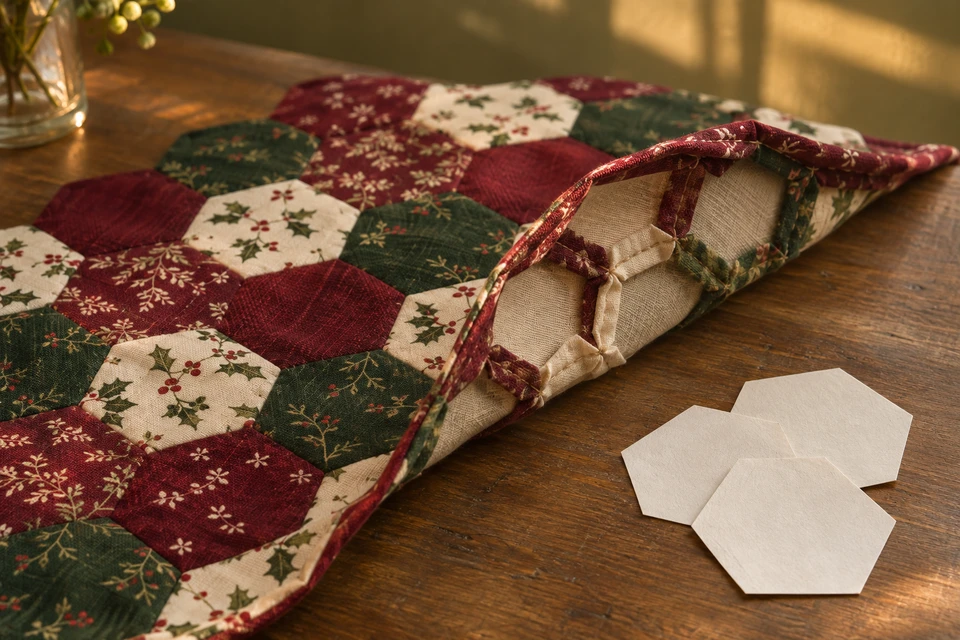
A Christmas runner assembled over English paper-piecing templates can look remarkably precise while those templates are still inside it. For a buyer ordering a finished textile rather than a sewing kit, that is an intermediate state. The approval needs to show what remains after the temporary paper has been removed and before the reverse is concealed by another layer. Otherwise, a crisp development photograph may describe a structure that is not intended to be present in the delivered product.
- 1. State which production stage the order buys
- 2. Request a sample after template removal
- 3. Identify temporary stitches separately from permanent joins
- 4. Review difficult locations before backing closes access
- 5. Approve the completed runner after the intermediate check
- 6. Make the removal checkpoint part of the agreed supply scope
State which production stage the order buys
A prepared top is not a finished runner
Distinguish a kit of fabric and papers, a partly joined panel, a complete unbacked top and a finished lined or quilted runner. Identify the specific stage in the quotation. If the range includes more than one supplied stage, give each its own description and contents list. Do not rely on a styled photograph of a Christmas star or hexagon arrangement to explain whether the customer is expected to complete sewing or remove temporary materials.
For a finished runner, ask the maker to identify every temporary support used during assembly and the proposed point at which it is removed. Keep any intentionally retained interlining or stabilising component separate in the construction record. The presence of the word paper in the technique name does not define the complete bill of materials. A retained foundation or a different construction route needs its own explanation, rather than being silently treated as an equivalent finished item.
Request a sample after template removal
Inspect the textile in the state that will remain
Sew & Quilt's English paper-piecing guidance describes removing the paper once adjoining shapes support the assembled unit. That explains why a paper-supported panel and a released top are different development references. It is not a production method approval for a new supplier. Ask the actual maker to show the proposed sequence and the resulting top, including how the perimeter is handled before the runner is finished.
View the released panel flat without forcing it back into the outline of the original templates. Compare the seasonal layout with the agreed drawing, then examine the joins from the reverse. Record where paper was removed and where any support legitimately remains at the sampled stage. If the demonstration stops before an outside row can be released, request a later-stage sample. Do not record complete removal merely because the middle of the panel has been shown.
Identify temporary stitches separately from permanent joins
A loose thread is not always the same finding
Ask the maker which stitches join adjacent shapes and which, if any, served only to hold fabric around the papers. Record the agreed finished condition of the latter. The buyer should not direct a reviewer to cut every visible thread on the reverse: that could damage a permanent join. Use an annotated sample or close photographs to explain the distinction, and have the maker resolve anything that is unclear before the construction is covered.
Where adhesive basting is proposed, ask what material is used and what finished condition is expected after the declared process. An invisible residue cannot be assessed from a photograph alone. Request the relevant product and process information for the intended use, and agree any further evaluation with the technical owner. Do not promise that glue, paper or thread will disappear during customer washing unless that exact construction and instruction have appropriate supporting evidence.
Review difficult locations before backing closes access
Small corners can hide unfinished work
Include representative narrow points, multi-piece intersections and perimeter shapes in the review sample. A large central hexagon is not sufficient evidence for every location in a star-shaped Christmas arrangement. Ask the maker to expose the reverse at the selected locations while access is still possible. Compare the condition against the agreed removal and finishing criteria, recording an observation rather than accepting a general statement that all preparation materials have been dealt with.
Define a practical verification route for production. This might combine an identified pre-backing inspection stage with retained samples and documented findings, as agreed with the supplier. It should not depend solely on opening completed saleable runners after every delivery. A final external inspection has limited visibility into enclosed layers. Decide in advance how a later concern about retained material will be investigated and which production records can identify the affected work.
Approve the completed runner after the intermediate check
Removing paper does not finish the product
The reverse-stage review is one approval point, not permission to release an untested finished assembly. Request the complete runner with its actual backing, any filling, edge finish and proposed care information. Compare its relaxed outline and table presentation with the released top. If additional quilting or finishing changes the seasonal layout, record that change on the complete sample rather than treating the earlier paper-supported panel as the final visual standard.
Inspect the finished piece after the agreed preparation or care review where required by the project. Keep observations of shape, surface and internal material concerns distinct. Do not assume that any new stiffness, noise or unevenness proves a paper-removal failure without examining the actual cause. Retain the identified intermediate and completed references so the technical team can compare the stages. This supports investigation without turning a purchasing checklist into an unsupported diagnosis.
Make the removal checkpoint part of the agreed supply scope
Quote the work that cannot be seen in a room photograph
Send FY Bedding the authorised seasonal layout, the required supplied stage and the expected finished construction. Ask whether the proposed development route can be evaluated and which samples will demonstrate temporary-material removal. Confirm minimum quantities, sample stages and delivery planning for the complete offer. Neither a craft technique nor a successful prototype establishes confirmed production capacity, stock or arrival before Christmas.
At release, identify the final drawing, the accepted post-removal top and the complete runner by revision. Include the agreed reverse-stage check in the inspection plan and name the party responsible for recording it. This makes a hidden production step visible in the purchase agreement without prescribing an unverified factory method. The commercial object is a defined finished textile; an attractive panel still carrying its assembly supports is evidence of progress, not evidence of completion.
For finished English-paper-pieced runners, approve a released top with the reverse accessible, then a complete runner; record temporary paper and basting separately from intentionally retained components.
Method references: Sew & Quilt: temporary papers in English paper piecing.