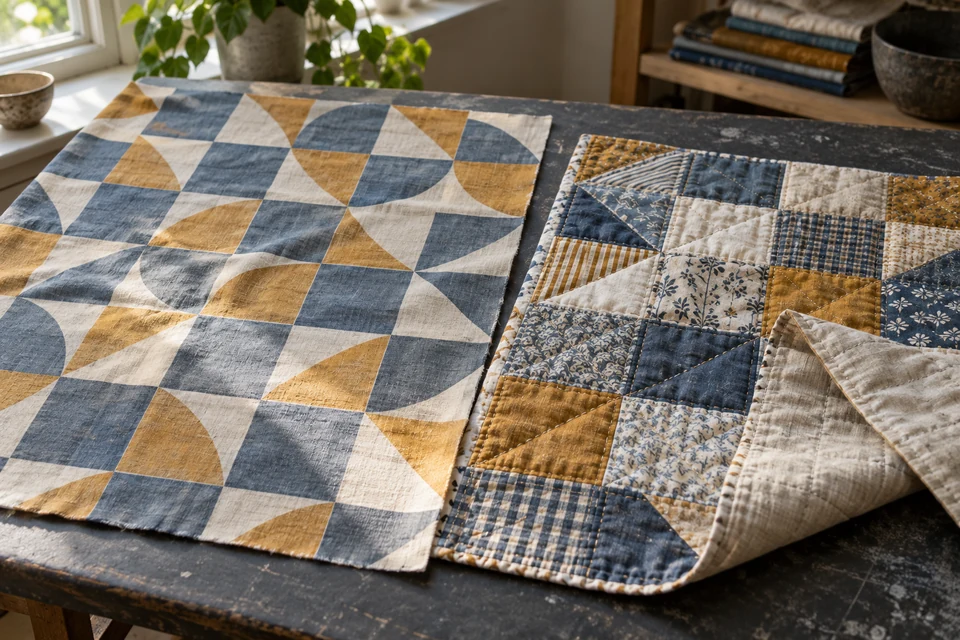
A quilt can display a patchwork-style design without its face being assembled from individual fabric pieces. That distinction matters when a buyer compares quotations, approves workmanship and describes the product to a customer. Printed motifs and pieced faces can both be deliberate design choices; neither route is inherently the right purchase for every collection. The useful decision is to identify what is actually made, which parts create the appearance and what the retail offer promises. This guide addresses that construction choice, not a sewing pattern, historical provenance, handmade certification or a claim that one route is automatically more durable or sustainable.
- 1. Separate the face technique from quilting
- 2. For a printed face approve the artwork map
- 3. For a pieced face control the block inventory
- 4. Specify the reverse and intermediate layers
- 5. Compare the finished appearance after care
- 6. Read quotations as construction proposals
- 7. Publish the chosen route without an invented origin story
Separate the face technique from quilting
Printed blocks are not sewn block joints
The V&A distinguishes patchwork, which joins pieces of fabric, from quilting, which stitches layered material together. For procurement, ask whether the proposed face is pieced, printed on a continuous textile or combines those techniques. Identify appliqué or embroidery separately where present. Do not let decorative stitch lines on a printed face become evidence that individual blocks were joined. The construction brief should name the actual offered route so the buyer, maker and retail copywriter can distinguish a patchwork design from a pieced assembly.
Request an opened sample and construction views that show the relevant joins or continuous face. Ask how the presented sample relates to the intended bulk route. A design development sample may legitimately use a different method for discussion, but that difference should be disclosed before approval. Keep reference photographs separate from the maker's own proposed design and confirm permissions through the appropriate brand owner. A familiar visual style does not authorize copying another quilt's artwork, layout or named maker story.
- Name pieced, printed or combined construction.
- Separate layering stitches from face assembly.
- Identify development samples that use another route.
For a printed face approve the artwork map
The pattern relationship remains a measurable decision
Review the complete printed layout, not only a small square that suggests a convincing patchwork texture. Identify borders, apparent block lines, repeat scale and the position of significant motifs on each offered size. The print approval guide supports color and substrate review, but the complete quilt face still needs its own layout decision. Determine whether sizes share a cropped repeat or require distinct artwork; neither arrangement should be assumed from one photographed sample.
Compare printed line positions with the proposed quilting and edge finish. Decide whether stitches deliberately follow the apparent blocks, cross them or create an unrelated pattern. Inspect the full finished quilt to see that relationship rather than approving printing and quilting independently. If an artwork change moves the apparent joins, review affected stitch placement and borders again. A print that reproduces seam shadows is still a printed appearance; customer language should not turn that detail into an unsupported sewn-construction statement.
- Approve layout by offered size.
- Connect print positions to quilting.
- Keep printed seam effects described honestly.
For a pieced face control the block inventory
Each joined material belongs to the approved version
List the fabrics and positions used in the proposed blocks, including repeated colors, borders and any contrasting strips. Record actual fiber and construction identities rather than treating every printed or solid block as interchangeable. The bill-of-materials record should connect the face map with the offered component references. Do not assume the material is reclaimed, leftover or locally made because the design looks like traditional patchwork. Such a story needs its own traceable evidence and approved wording.
Examine block joins and intersections on the completed sample, with agreed workmanship criteria supplied by the responsible technical owner. Note whether corners, strips and pattern direction meet the accepted design, and check visible seam bulk as well as alignment. Use the seam identity guide for construction fields without prescribing a universal allowance or tolerance. A controlled variation in layout should be explicitly identified; an omitted block or substituted fabric should not be hidden inside a general handcrafted disclaimer.
- Map each face fabric to its position.
- Review intersections and visible seam bulk.
- Keep sourcing stories separate from visual style.
Specify the reverse and intermediate layers
A face technique does not define the complete quilt
Document the backing, intervening fill or layer arrangement, binding and any finishing components offered. Determine how the front and reverse are intended to relate visually, and inspect both rather than letting a strong face design conceal an unfinished back. The quilting and layer-control guide offers related evidence questions. It does not prove that either a printed or pieced version has a particular warmth, fill retention or lifespan without an assessment matched to the actual assembly.
Review the complete edge and border at all corners. Confirm whether any coordinating shams or accessories are included in the sold unit and whether their face technique matches the quilt's description. A set photograph can show a continuous printed quilt beside a pieced cushion without making them one uniform construction. Record those distinctions clearly. If the buyer accepts such a combination, the packaging and product data should explain it rather than using one blanket phrase that inaccurately describes every item.
- Identify backing, fill and binding.
- Review the entire reverse and edge.
- Describe each included article accurately.
Compare the finished appearance after care
Different components need one agreed review state
Have the responsible owner define the appropriate care and technical assessment for the proposed assembled product. Review the identified completed sample in the resulting condition, observing block relationships, seam appearance, print and quilted surface. The post-care seam review is a related input for a pieced face, but it is not a universal acceptance rule for every patchwork-style quilt. Keep any assessment findings connected to the actual component version and documented process.
Do not compare an unprocessed printed sample with a washed pieced sample as if the conditions were equivalent. Disclose preparation, settling and any exceptional shaping used for each. If one face contains multiple materials, obtain the required evidence for that actual combination instead of borrowing results from only its dominant fabric. A buyer may choose a route because its reviewed appearance better serves the collection, but should not publish an invented performance advantage to justify that choice.
- Compare identified and equivalent sample conditions.
- Review the whole component combination.
- Do not infer comparative performance from appearance.
Read quotations as construction proposals
A similar image does not make two offers equivalent
Separate artwork development, component sourcing, assembly work, quilting, packaging and any required evidence in the offered scope. Confirm actual minima by size, material combination and color layout, rather than assuming a printed option is always easier to order or a pieced option always costs more. The quotation comparison guide can keep those included tasks visible. Ask the maker to explain proposed alternatives and treat a change in face technique as a material specification decision, not an invisible cost saving.
When comparing suppliers, keep the design reference, finished dimensions, included articles and relevant evidence basis consistent. Record exclusions, outstanding development and the promised production route. Do not place a pieced-description order against a printed-sample quotation because the mood board appears sufficiently close. That creates a conflict which production or receiving staff cannot resolve by looking at a marketing image. Have the authorized buyer accept the actual route explicitly before quantities and artwork are released.
- Compare the same construction and sold unit.
- Identify development and evidence exclusions.
- Authorize any face-technique change explicitly.
Publish the chosen route without an invented origin story
Truthful construction can still support a strong design story
Write product copy around verified construction and the collection's actual design intent. If the quilt has a patchwork-style print, call it that rather than implying hand joining. If it is pieced, do not add handmade, heritage or reclaimed-material claims unless the supporting records exist for the offered product. The claim matrix can align pack, website and sales material with those boundaries. Show useful detail photographs that let customers understand the chosen route.
Buyers can share a patchwork-style quilt brief identifying whether the required face is printed, pieced or combined, with the layout and sold contents attached. That supports a sourcing discussion, not a promise of a particular FY Bedding construction, craft tradition or production site. Retain the agreed design and assembled sample for repeats, and reopen approval if block fabrics or the manufacturing technique change. The lasting value is a clear product identity, not the most elaborate description of how the quilt might have been made.
- Match retail words to verified technique.
- Substantiate any craft or material-origin story.
- Retain layout and assembly references for repeats.
Choose printed, pieced or combined patchwork-style construction deliberately. Align the face map, complete layers, equivalent care review, quotation and customer language so similar imagery does not conceal a different purchased product.
Method references: V&A: Distinction between patchwork and quilting techniques.