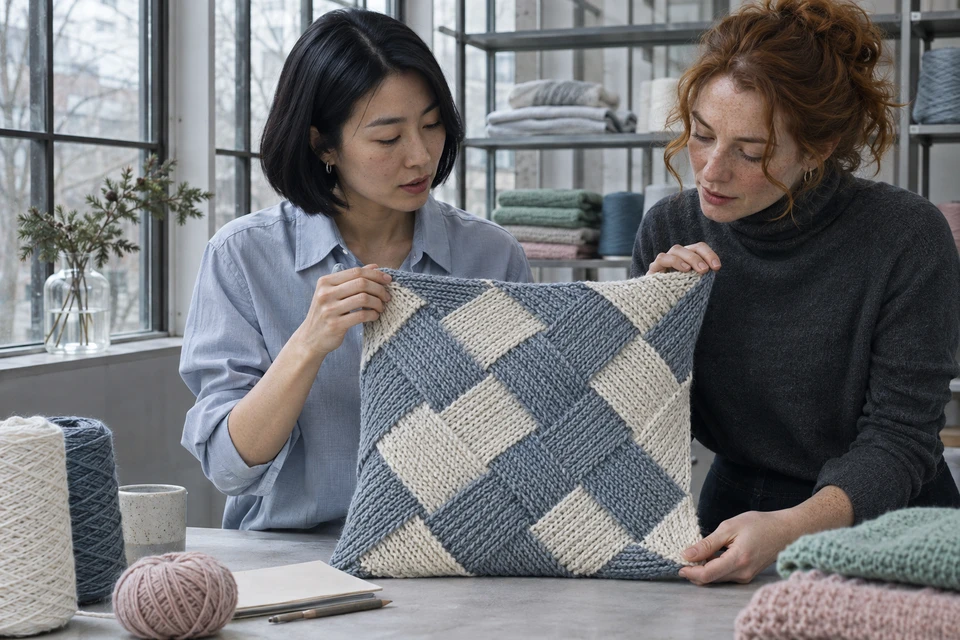
A diagonal block pattern can look like patchwork while being made as connected knitting. For a Christmas cushion collection, that difference belongs in the purchasing brief before a sample is priced. Entrelac should describe the proposed construction, not merely a photograph with contrasting diamond shapes. The buyer's task is to establish how the blocks connect, how the patterned field ends at the cover edges and which complete sample represents the order.
- 1. Follow the knitting across a block boundary
- 2. Approve the edge units as part of the design
- 3. Compare the joins under ordinary handling
- 4. Put the complete cover around the intended insert
- 5. Connect seasonal colour choices to the actual yarns
- 6. Release the connection method and the finished layout together
Follow the knitting across a block boundary
A colour boundary is not necessarily a sewn seam
Garnstudio describes entrelac as knitting squares in different directions, beginning with triangles and picking up stitches along existing sides. This explains why a buyer should examine the connections rather than assume that separate fabric pieces have been sewn together. Ask the supplier to identify the actual technique used in the proposed panel. A printed imitation, assembled knitted patchwork and connected entrelac can all produce a block effect, but they are different offers.
Request a sample that includes several adjacent blocks and their reverse. Have the maker show where one unit ends and the next develops from its side. The buyer does not need to dictate a knitting pattern or machine setting. The required outcome is an unambiguous construction description attached to a physical reference. If a commercial name is being used loosely, resolve that wording before it reaches the quotation or the retailer's product page.
Approve the edge units as part of the design
Do not crop the sample to its easiest central area
The centre of a repeating panel may be attractive while its boundary remains unresolved. Lay out the entire proposed cushion face and identify the triangles or other finishing units at each side. Mark the intended top, bottom and closure position on a separate drawing. Decide whether the visible perimeter should complete the block rhythm, deliberately interrupt it or be contained by a plain border. These are design choices to approve, not defects to discover after sewing.
For a Christmas pair in two sizes, review each face independently. Enlarging the cushion does not automatically preserve the same number or proportion of blocks. Ask the supplier to propose a layout for both sizes with the actual edge treatment shown. Keep the overall dimensions and the visible patterned area separate, because seam allowances or a border can change how much of the last unit remains in view on the finished cover.
Compare the joins under ordinary handling
Identify openings and ridges without inventing a strength grade
Place the panel flat, then curve it gently over the intended cushion form. Look at the picked-up boundaries from the front and reverse. Record any unintended gaps, abrupt ridges or local distortion with a location on the layout. Compare them against an approved reference under consistent conditions. Do not turn a casual stretch by hand into a quantified seam-strength result or assume every visible connection should resemble a smooth woven seam.
Where the product requires a specific durability assessment, agree the method and acceptance criteria with the responsible technical provider. Keep the tested construction identifiable, including yarn, finishing and connection method. An isolated strong-looking join does not approve the complete face. If the supplier changes the knitting route to simplify manufacture, review a new panel rather than accepting a similar colour arrangement as evidence that the original construction has been preserved.
Put the complete cover around the intended insert
The patterned face and the back need a workable relationship
Specify whether the back is also entrelac, plain knitted fabric or a different textile. Ask how the two faces will be joined and how the closure is incorporated. Inspect the completed cover with the intended insert dimensions and filling arrangement. A panel can look balanced flat but become unevenly expanded on a fuller insert. Conversely, an underfilled sample may conceal the shape that the customer will actually see when using the specified cushion.
Review corners, the closure line and the transition between a textured face and any plain border. Separate a deliberate raised block character from twisting or an unintended pull towards one seam. Keep the insert used for approval identified even when the commercial offer is cover-only. The purpose is not to impose one preferred silhouette on all entrelac products; it is to make the chosen silhouette repeatable and prevent a change in sample filling from disguising a cover difference.
Connect seasonal colour choices to the actual yarns
A winter palette must remain a production description
List the selected colours by yarn reference and their positions in the block arrangement. If the design alternates two colours, show where each sequence starts at the edge and whether the reverse presentation matters. A styled photograph in warm Christmas lighting should not replace the physical colour approval. Review proposed yarn substitutions for both appearance and construction, since a similar shade may arrive in a yarn that changes the block definition or finished shape.
Ask what quantity commitment applies to each yarn colour and to each complete cover variant. Keep a small seasonal accent colour distinct from the total collection quantity when discussing minimums. Record the sample stages still required and the dates the supplier has actually confirmed. The Christmas label does not establish available yarn, production capacity or arrival before a particular event. A purchasing decision should identify unresolved dependencies instead of treating a festive photograph as a delivery plan.
Release the connection method and the finished layout together
Give the receiving team a usable comparison
Retain the accepted complete cover, the full-face layout and close views of representative block connections. After any agreed care evaluation, compare the same boundaries, edge units and overall shape with the original reference. Record the procedure and observations without claiming a universal result for entrelac knitting. If the approved appearance changes, decide whether to revise the construction, the care proposal or the intended product description before release.
Send FY Bedding the desired block arrangement, cushion sizes, back construction, insert scope and quantities for a project-specific discussion. Request confirmation of the proposed knitting and sample route rather than assuming a displayed seasonal style has this construction. The final order should distinguish knitted connections from separately sewn assembly and identify the accepted edge layout for each size. That gives later sample or receiving checks a concrete starting point beyond the phrase patchwork Christmas cushion.
Can the supplier show the actual knitted connections, every perimeter unit and the assembled cover represented by the quotation, with changes in yarn or construction routed back for approval?
Method references: Garnstudio: entrelac blocks and picked-up side stitches.