A motif throw is purchased as an arrangement of connected units, so an approved isolated block leaves much of the finished article undecided. The buyer needs to know where each unit belongs, how neighboring units meet and what outline the complete throw presents. This is a furnishing-throw purchasing guide for an offered crochet construction, not permission to reproduce a designer's pattern or a claim of handmade production. It also differs from a fabric-piece patchwork quilt and a continuous cable-knit surface. Treat the proposed yarn work, connection route and final arrangement as one named candidate, with construction and supply conditions still requiring confirmation from the maker.
Turn the motif board into a unit map
A palette becomes orderable only when every unit has a place
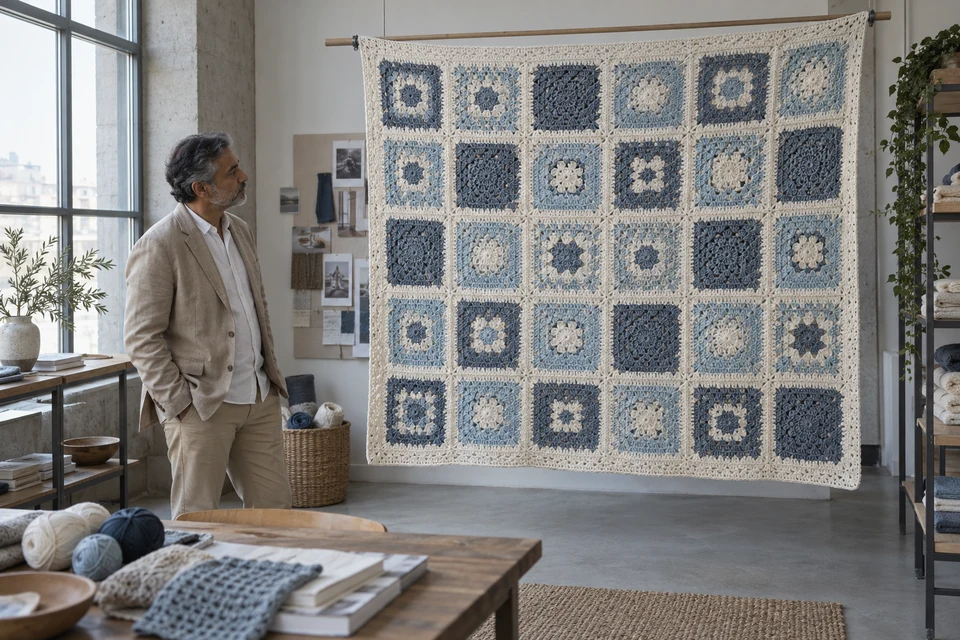
Create a layout drawing that identifies rows or other useful positions, unit families and the intended orientation of each motif. If the throw does not use a regular grid, show its actual arrangement rather than forcing it into a square template. Assign references to repeated designs and color combinations so the supplier can count what is required for one completed article. A mood board of several attractive blocks cannot establish the purchased layout. Put the proposed map in the development brief and keep any later substitution visibly marked until the design owner decides on it.
Identify the outer boundary, any separate border and the areas where units change size or shape. Ask which parts of the reference the maker proposes to reproduce and which it proposes to reinterpret. Keep the source of the design and permission to use it clear before development begins. Do not use an online pattern as a production instruction merely because its photograph suits the range. A revised number of units or a different corner can alter the entire layout; review the complete new map rather than approving another attractive individual motif in isolation.
- Count units by their actual design and color identities.
- Show orientation, boundary and border on one map.
- Resolve design permissions before using a reference commercially.
Confirm the unit and assembly description
Similar-looking blocks are not a manufacturing specification
Ask the supplier to explain the construction offered for the units and the way the final assembly will be produced. Obtain a clear yarn and component description for the particular sample. Do not label an offer genuine crochet, hand finished or cotton solely from the visible loops or a sales name. Where the proposal differs from the requested route, record the difference and let the product owner decide whether to consider it. The cable-knit guide addresses another furnishing texture; its approved sample cannot stand in for this unit construction.
Request a representative unit together with an assembly sample large enough to show its surrounding connections, or ask for those locations to be visible on the complete throw. Record whether the sample uses the intended materials and assembly arrangement. An early design interpretation can be useful without being a bulk reference, provided its status is explicit. Do not infer production capacity or repeat-order consistency from one finished piece. The useful supplier response distinguishes the proposed product, any unresolved development step and the commercial offer against which a production-intent sample will be assessed.
- Identify the offered yarn and actual construction.
- Keep design interpretations separate from production references.
- Do not infer hand work or capacity from appearance.
Approve connections as visible design lines
Joining is part of the pattern rather than a hidden afterthought
Mark connection routes on the layout drawing and ask the maker to show the corresponding finished junctions. Decide whether joining lines should remain visible, blend with a unit color or form a contrasting grid. Inspect long connections, motif intersections and the transitions into the border on both faces. The seam record can hold a proposed sewn joining component where one is used, but it should not replace a description of another connection method. Write the finished appearance requirement in terms the buyer and maker can recognize.
Lay the throw normally and note raised junctions, unexpected gaps, exposed ends or uneven alignment requiring review. Distinguish a deliberate openwork space within a motif from an unexplained opening at a connection. Ask the technical owner to resolve an observation instead of demanding that every visible space be closed. Do not pull units apart with improvised force and call the result a passed attachment test. Keep workmanship observations, the accepted connection appearance and any required technical evidence separate. A correction at an intersection should be checked in the surrounding layout, because the neighboring unit relationships may also change.
- Define whether connection lines blend or contrast.
- Review long joins, intersections and border transitions.
- Separate designed openwork from an unresolved connection gap.
Review the complete outline without restyling
The accepted shape should be visible in ordinary handling
Agree how the completed throw will be laid out for dimensional and appearance review. Show the measurement landmarks on the layout and use a condition that does not depend on stretching individual blocks into position just before inspection. Observe opposite edges, corners and any intentionally shaped boundary. Record local findings against unit references so the maker can locate them. The measurement preparation guide helps keep the sample state identifiable; it does not supply a universal allowance or a shaping procedure for the proposed motif throw.
If the manufacturer uses a particular final preparation to produce the offered shape, ask for that dependency to be described. Then decide how the retail customer or store would obtain the intended presentation after unpacking and the approved care route. Compare the same layout landmarks on the processed sample rather than judging only whether the center remains attractive. The dimensional evidence guide supports a scoped assessment when needed. Do not claim a shrinkage value or recovery property from visual similarity, and do not hide a changed outline by pinning the article for photography.
- Measure the complete arrangement in an agreed relaxed state.
- Record corner and edge findings by unit position.
- Disclose final preparation needed for the accepted outline.
Check color placement in open and folded states
A complete palette can look different when most units are concealed
Review the entire throw with its unit map beside it. Confirm that the intended combinations occupy the intended locations, including edge units and the border, rather than approving a general multicolor impression. Where the design deliberately permits a variable arrangement, define what must remain controlled: included color families, excluded combinations or the relationship between an accent region and the boundary. Do not invent a precise placement requirement after quotation. Explain the intended visual rule early enough for the supplier to confirm whether the offered arrangement can meet it.
Next fold the actual throw in the proposed retail manner and compare the visible crop with the full item. A fold that shows one dominant color can imply a different collection direction from the complete layout. Approve both the open reference and the sold-unit view, keeping straps, labels and props separate from the supplied article. Avoid digitally repeating one ideal motif across a product photograph to simulate the entire purchased assembly. The blanket and throw collection can frame the retail range discussion, but this motif construction still needs its own accepted map and sample.
- Compare physical unit placement with the approved map.
- Define variable-layout rules before quotation.
- Show a folded view consistent with the complete color story.
Compare the same complete motif throw
Unit making, assembly and finishing must be included or excluded clearly
Ask each proposed supplier to state which work is included in the quoted finished article: the named units, connecting work, border, end finishing, final preparation and packing. Resolve whether a development offer covers a single unit, a partial assembly or the complete throw. State the required size and color arrangements without assuming that related designs share the same minimum. If a simpler unit or connection is offered, compare it as a revised candidate. A lower price for a different unit count or unfinished assembly is not the same commercial scope as the accepted complete layout.
Retain the finished reference with its unit map, inside or reverse views where relevant and a description of the final presentation. Keep any accepted care wording tied to that assembly using the care information review. On replenishment, ask the maker to disclose changes to yarn, units, connections or border before repeating the old reference by name. Buyers can share an original motif-throw layout with the assembly questions and retail fold for a supply discussion, or discuss a representative connected sample. Actual availability, permissions and suitability must be confirmed for the proposed project.
- Distinguish a unit quote from a completed-throw quote.
- Name included connections, borders and final preparation.
- Retain the layout map with the physical assembly.
Buy a crochet motif throw against its counted arrangement and connected sample. The unit identities, visible joining lines, complete outline and folded color view must agree; none alone establishes the manufacturing route or a performance claim.