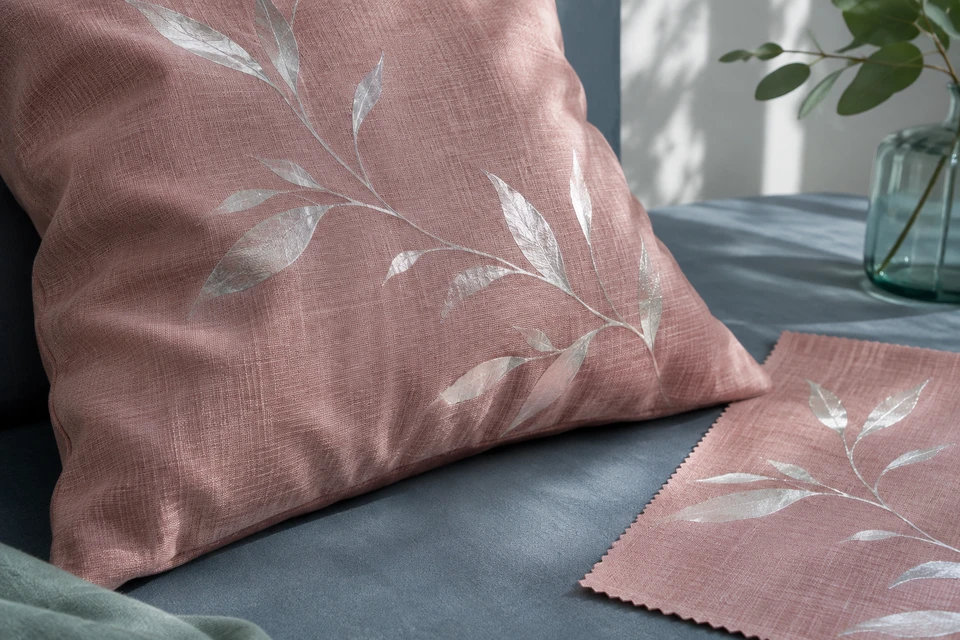
A metallic leaf on a cushion can come from a woven yarn, a printed ink or a transferred foil layer. Those routes may look similar in one photograph but should not share an undefined metallic floral specification. For a foil-printed proposal, the buyer should identify the transferred finish and the adhesive relationship to the cloth, then approve the actual botanical coverage in the complete cushion.
- 1. Distinguish the transferred layer from the temporary carrier
- 2. Approve the botanical coverage as a deliberate design
- 3. Observe reflectance on a moving cushion surface
- 4. Inspect the points where the finish meets construction
- 5. Request evidence for the actual foil and adhesive combination
- 6. Quote a defined decorated article
Distinguish the transferred layer from the temporary carrier
What remains on the fabric is the purchasing concern
Fujifilm's technical description of textile foil transfer explains a foil carried on film and transferred to an adhesive-printed design, leaving the metallic effect on the textile when the carrier is removed. This is a process example, not a universal application recipe or evidence for a current FY product. Ask the supplier to identify the actual foil, adhesive and fabric references used in the proposal and to describe the finished layer that remains.
Do not use metallic print as a catch-all in the purchase record. If a supplier proposes metallic ink, metallic yarn or a separate decorative film construction instead, compare it under its own description. The buyer needs to know which sample the quotation represents. Avoid copying old technical-sheet temperatures, chemical approvals or wash claims onto another material combination; product instructions and evidence must be current and specific to the offered system.
Approve the botanical coverage as a deliberate design
Full metallic leaves and broken effects need different references
Mark which parts of the floral artwork are intended to receive foil and which areas should show the underlying cloth. Identify whether leaves should be continuous, lightly distressed or deliberately interrupted. A distressed concept needs an accepted range represented by physical samples, not an open-ended excuse for any missing coverage. For a continuous concept, make unwanted voids and incomplete edges visible in the review rather than hiding them behind bright lighting.
Request the actual-size motif on the proposed fabric. Fine stems, leaf tips and small spaces between petals can read differently from the same artwork enlarged on paper. Compare the foil version with the approved botanical drawing and identify any process-led simplification. If the artwork changes, retain the revision with the sample. The decorative direction can remain consistent while the production shape changes, but that change still needs a clear buyer decision.
Observe reflectance on a moving cushion surface
One silver flash is not the whole appearance
Place the completed cover around the intended insert and examine the motif from several ordinary room positions. Turn the cushion and move the light relationship rather than judging only a flat swatch. Record how the metallic areas appear at folds and curves, including positions where the reflection is subdued. The target should be an honest appearance range for the chosen material, not a promise that every leaf remains equally bright from every angle.
For photography, retain a view that shows both the overall design and the textile texture. Avoid exposure or editing that turns a thin reflective layer into an opaque chrome-like object or conceals the ground weave. The product description should distinguish a metallic visual effect from actual metal-content or precious-metal claims. If a silver-coloured foil is selected, that colour description alone does not establish the composition of the transferred layer.
Inspect the points where the finish meets construction
Seams and folds can expose an unresolved placement choice
Review the motif's distance from seams, closure areas and any flange or piping. Decide whether the foil is intended to cross a seam or remain within a clear face panel. Ask for the proposed assembly sequence and a representative finished sample without prescribing unverified processing settings. If a flat decorated panel is approved before sewing, return to the assembled cover to confirm that the visible result still matches the intended placement.
Examine any fold lines introduced by packaging and observe the article after normal unpacking. Record unwanted changes with the exact sample state and location. A photograph of a fresh, perfectly flat strike-off cannot establish the appearance after the actual packing sequence. If a softer folding arrangement or revised motif placement is chosen, approve the resulting unit and pack together rather than assuming packaging is unrelated to the selected decorative surface.
Request evidence for the actual foil and adhesive combination
General process literature cannot approve the finished cushion
Ask which care and performance statements the supplier proposes and what supports them for the material stack in the offer. Reports should identify the relevant fabric, applied system and tested state. A document for the base cloth alone does not establish the transferred finish's behaviour, and a technical brochure for a foil product does not confirm that the same system was used on the sample. Keep unknowns explicit in the approval record.
Where a care trial or surface assessment is required, agree the procedure and acceptance criteria with a qualified provider or responsible technical team. Retain the original and assessed samples to compare coverage, appearance and attachment observations. Do not convert an informal rub or a single wash observation into a standardized rating. Any revised adhesive, foil reference or fabric finish should be assessed for its effect on the approved construction before it is treated as an equivalent substitution.
Quote a defined decorated article
Keep the sample stages visible in the order
Compare offers using the same fabric, cushion dimensions, foil reference, motif area, colour, assembly and packaging scope. Ask whether development includes an artwork proof, an actual-material transfer sample and a completed cover. Clarify minimums by the relevant material or colour commitment, rather than assuming that the total cushion quantity automatically satisfies every component requirement. Availability and delivery milestones need confirmation for the chosen project. The FR-01 collection reference does not establish foil printing, adhesive identity or material performance.
Send FY Bedding the floral direction, artwork rights, intended reflective character, target product size and quantity split to discuss development. Collection photographs can guide the botanical composition but do not establish that a listed style uses foil or any specific adhesive. Release the identified transferred layer, actual-size motif and assembled sample together. That makes a metallic floral effect a traceable buying choice instead of a photograph that permits several materially different interpretations.
Does the quotation identify the transferred layer and retained adhesive, the intended foil coverage and the completed packed cushion, with evidence specific to that same material combination?
Method references: Fujifilm: textile foil transfer and carrier removal.