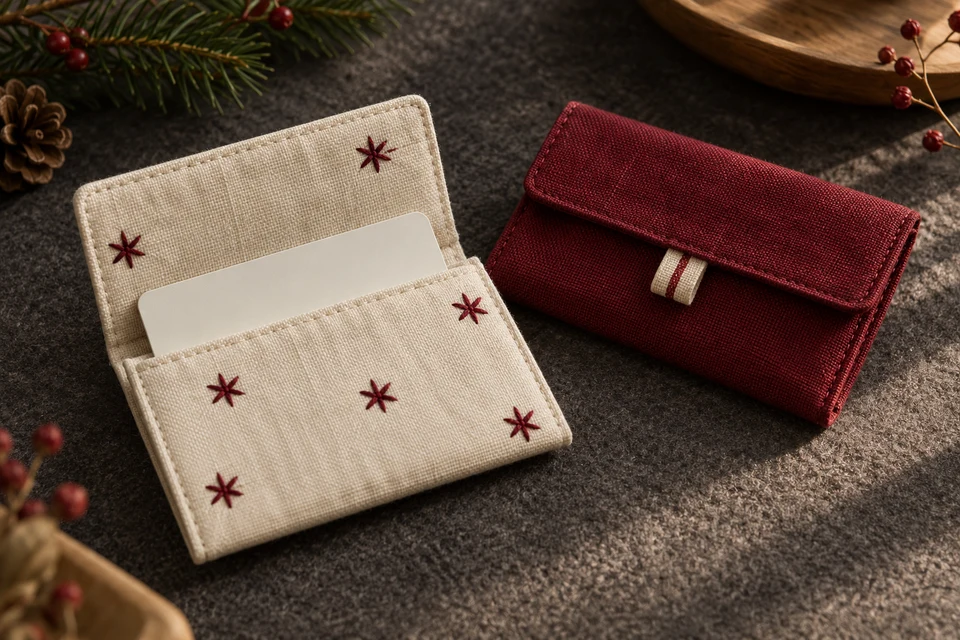
A small fabric gift-card wallet can look complete in a photograph while failing the simplest customer action: inserting the card and closing the flap. The buying decision should start with the actual insert, not the finished wallet's outer dimensions. For a Christmas retail programme, define how the pocket holds the card, how the fold clears it and what the customer receives before approving embroidery, trims or multipack artwork.
Approve the insert envelope
Use the actual card and any carrier together
Ask the retail team whether the wallet holds a bare card, a card attached to a paper carrier, a note or a combination. Measure that complete insert and record its thickness and corner shape. A blank sample with the same dimensions is useful for fit review, but a thin paper substitute may not represent the final card-and-carrier combination. Keep the insert reference number beside the wallet specification.
Define the amount of card that should remain visible above the pocket and the clearance needed to remove it without pulling the fabric out of shape. Do not assume one pocket works for every promotional insert. The tech-pack checklist can capture the insert outline, pocket mouth and insertion depth as separate dimensions. This prevents an external-size approval from concealing a smaller usable pocket.
- List every item intended to sit inside the pocket.
- Record usable opening width after sewing, not only the cut-panel width.
Balance easy insertion with retention
Observe ordinary handling in the agreed orientation
Place the representative insert into the finished wallet and follow the intended opening, closing and presentation sequence. Look for catching at the seam, a pocket that turns outward with the card or a mouth so loose that the insert moves unexpectedly. Agree the handling observations that matter for the retail use, and document the conditions. Do not invent a universal retention force or declare a sample secure from a single photograph.
Compare samples with the same insert and identify which construction change produced the difference. A deeper pocket, different seam allowance or altered lining can change the usable space even when the outside dimensions remain unchanged. Review seam allowance and edge-trim inspection for recording the sewn geometry. Keep the accepted pocket reference separate from any earlier decorative prototype that was never checked with a card.
- Check insertion and removal without stretching the mouth.
- Photograph the card position in the closed and open wallet.
Give the fold and closure their own clearance
Review the filled wallet rather than the empty flap
Close the wallet with the full intended insert inside. Check whether the fold lands naturally or bends the card, whether the flap covers the intended area and whether the closure can be operated without twisting the pocket. State which closure is supplied: a fabric loop, snap, tie or another approved detail. Each choice needs its own construction and usability review; a drawing of a flap does not establish interchangeability.
If a snap is proposed, ask the technical reviewer to define the appropriate attachment and use checks rather than borrowing a pass result from a different textile. For ties or loops, review their length and attachment in the intended retail use. The snap attachment guide helps frame the evidence request where applicable. Keep any intended user restrictions and product assessment with the project; do not add child-safety claims to seasonal copy.
- Check the filled thickness at the fold.
- Approve the closure material and attachment, not merely its colour.
Position Christmas details around the working pocket
Keep dense decoration out of the insertion route
Review embroidery or appliqué on both sides of the panel. Ask whether backing, knots or seam bulk can contact the insert and whether a lining is included to cover them. Make the motif placement relative to the finished pocket and fold explicit. The small area means that a modest placement shift can change the visible design, so approve the real sewn wallet instead of only a large embroidery swatch.
Keep the decorative colour reference and the fit sample tied to the same construction revision. If the buyer selects several motifs, identify any that add substantially different bulk or trims and decide whether they need an additional sample. The component minimum-order guide can help separate shared fabrics from design-specific trims when discussing quantities. Do not silently average different motif constructions into a single unspecified product.
- Inspect inside surfaces where the insert touches the decoration.
- Check motif position with the wallet closed and filled.
Make retail contents and ordering units clear
A wallet, a card and a multipack are different units
State whether the gift card is included, shown only for illustration or supplied separately by the retailer. Confirm whether the purchase unit is one wallet, a matched pair or an assorted set. An assortment specification should name each design and its quantity, not simply say mixed Christmas colours. Check the actual pack so the customer can understand the product without opening it or confusing a styling card with included value.
Approve pack dimensions with the finished wallet and any insert already in place. Retain the sample, artwork and assortment record together, and confirm the current commercial schedule separately. The pack and ecommerce claim matrix supports consistent descriptions. FY Bedding can review the insert dimensions, desired wallet construction and assortment brief with you; sample availability, component minimums and timing remain subject to project confirmation.
- Use a clear unit definition on the quotation and order.
- Keep gift-card value or retailer branding out unless explicitly supplied and authorized.
The approved reference is the wallet with its intended insert inside. Confirm pocket access, retained card position, filled fold and closure before treating the embroidered appearance or empty retail pack as final.