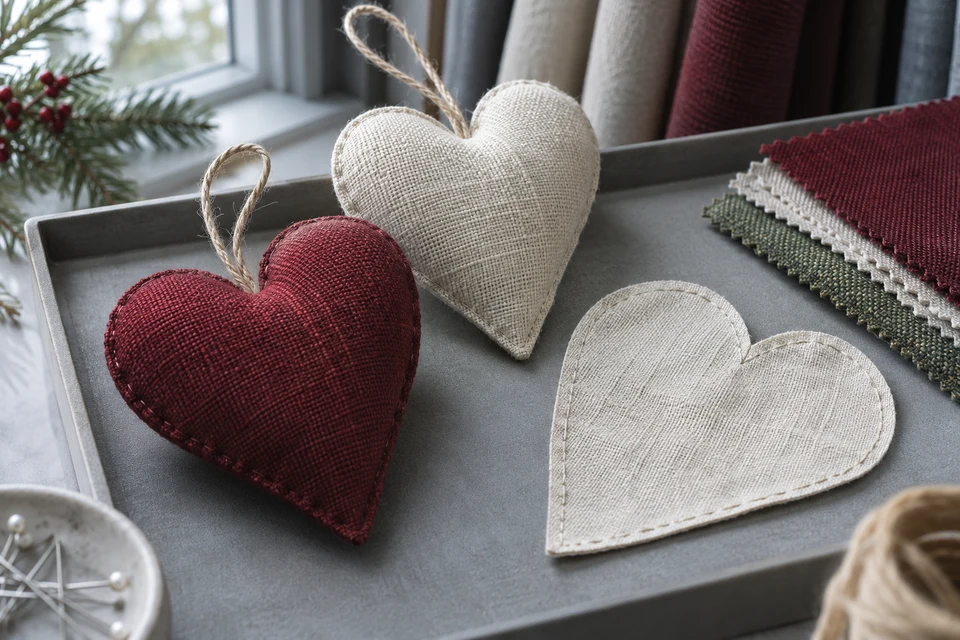
A heart-shaped fabric ornament is easy to recognise and surprisingly easy to distort. A rounded bottom, uneven upper lobes or a deep central crease can change its character even when the flat cutting pattern appears correct. For a Christmas decoration programme, approve the filled silhouette as a separate deliverable from the paper outline. The aim is a repeatable decorative shape, not a universal filling recipe. Fabric, seam construction and the chosen filling all need to be identified before the sample becomes an ordering reference.
Describe the heart you actually want
Separate flat dimensions from filled appearance
Start with a drawing that marks the two upper lobes, the central cleft and the lower point. Record the finished height and widest part, but also show the intended proportion between them. Two hearts with the same overall dimensions can look quite different if one has broad shoulders and the other a long narrow tip. Include a front photograph or authorised design reference that makes the preferred character visible.
Keep the cutting pattern and the filled reference separately named. Seam allowance, turning and filling mean the two outlines need not coincide. Ask the sample maker to identify which dimensions describe the empty shell and which describe the finished ornament. Do not instruct production to force a filled item onto a flat template by pressing it down. That can conceal the very loss of shape the review is intended to detect.
Compare a small controlled fill trial
Change one variable at a time
Request a few clearly identified fill alternatives using the same shell material and construction. Compare the lower point, fullness of each lobe and depth of the cleft while the ornaments are resting without pressure. A fuller sample may look substantial but push the outline towards a rounded cushion. A lighter sample may preserve the point while leaving one shoulder hollow. Choose the balance deliberately instead of approving whichever item photographs best.
Record the agreed fill identity and quantity with the sample, without treating weight alone as the shape specification. Distribution matters too. Check whether the same appearance can be restored by the normal handling allowed for the product. If the sample needs persistent hand sculpting, ask whether the pattern or filling approach should change. A retail customer should not have to reproduce an undocumented studio preparation routine to obtain the advertised silhouette.
Inspect the lower point and upper cleft
Look at the seam without stretching it
Examine the point in front, side and reverse views. Note a trapped fold, an unexpectedly blunt end or a visible lump beside the seam. At the cleft, look for puckering and uneven transitions into the lobes. Ask the technical team to explain any construction change proposed to improve turning. The buyer should approve the resulting finish rather than prescribe an improvised cutting or seam operation from a photograph.
Agree what natural softness is acceptable. A textile heart is not a rigid geometric object, and an excessively sharp visual expectation may be inconsistent with the chosen cloth and filling. Keep examples of acceptable and unacceptable outline variation beside the approved sample. That gives inspectors a more useful reference than a comment such as make every heart perfect. Separate cosmetic observations from any attachment or material performance requirements that need their own evidence.
Check the hanging view
The suspension point changes the presentation
View the finished heart suspended from its intended loop using a suitable controlled display arrangement. Observe whether the lower point hangs beneath the cleft or the ornament tilts to one side. Record loop placement, visible loop length and the normal viewing face. A loop captured off-centre can make an otherwise symmetrical heart appear unbalanced, while a bulky join can pull one lobe inward.
Do not convert this visual exercise into an unsupported strength or safety claim. The project owner must define the relevant requirements for the intended decorative use and market. Keep this programme distinct from a toy brief, and avoid implying suitability for children or placement near heat. If a heavier trim, different loop or new filling is proposed later, repeat the affected balance and attachment review instead of relying on the original appearance photograph.
Approve the packed selling unit
Preserve the outline beyond the sample table
Trial the actual quantity and orientation in the proposed retail pack. Reopen it after the agreed handling sequence and inspect the tips, loops and shoulder areas before reshaping. Record any permitted recovery step and the time of review. A pack that folds the lower point under the body may change the first impression, even if the ornament was acceptable before packing. Compare packed and unpacked references under the same viewing setup.
Send FY Bedding the outline drawing, selected fill trial, hanging photograph and proposed pack quantity when requesting development review. Ask for confirmation of feasibility, material availability, minimum quantities and sample timing; none is established by the illustration accompanying this guide. Release the order only when the supplier and buyer share the same filled reference and understand which changes require another sample. Keep rejected variants identified so they cannot reappear as an apparently equivalent substitute.
Approve the heart resting, hanging and recovered from its actual pack, with the shell, fill and loop linked to one reference.