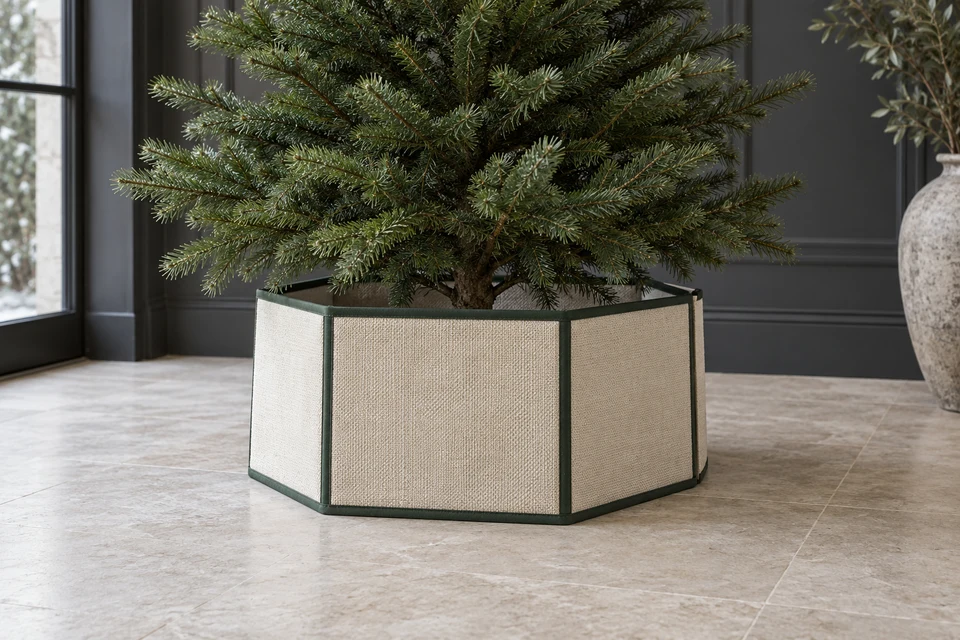
A fabric-covered tree collar is an upright surround, not a flat skirt spread across the floor. Its appearance depends on the panels underneath the textile, the way those panels meet and how the surround opens around an existing tree base. Buyers need to specify that complete assembly before comparing decorative fabrics. This guide concerns a non-load-bearing decorative surround. It does not establish support for the tree, fire performance, electrical protection, water resistance or the safety of an installation. Those responsibilities remain separate from approving a textile-covered shape.
Map the real tree-base envelope
Outer appearance and inner clearance are different dimensions
Ask the installation owner for the footprint and height of the actual stand or base, including any elements requiring access. Record the usable interior of the proposed collar separately from its external width. A tapered or polygonal surround can have less clearance at one level than another. Show the base envelope and collar outline together in the technical brief rather than quoting one nominal diameter.
Confirm whether the surround is assembled before or after the tree is positioned. Identify the direction from which it can be opened and removed. Do not assume it may touch equipment or obstruct maintenance access; have the relevant site owner review the arrangement. A collar that looks balanced in a photograph may be impractical around a stand with a broad foot or an offset access point.
- Record internal clearance at relevant heights.
- Confirm the opening route with the installation owner.
Identify what keeps the textile upright
The face fabric is only one component
Ask the supplier to declare the panel core, outer fabric, lining, edge finish and connections. Distinguish a rigid panel assembly from a soft collapsible sleeve. Both may be described as fabric collars in a catalog, but they require different sample and packing reviews. Keep each component in the bill of materials, including anything removable before cleaning or storage.
Inspect corners and upper edges where the supporting structure may show through the cover. Review whether the exterior reads as smooth panels, softly padded faces or an intentionally flexible surface. Do not infer long-term shape stability or moisture resistance from the sample standing upright for a photograph. Ask the technical owner to define evidence appropriate to the offered materials and expected indoor use.
- Name the supporting core and connections.
- Separate desired surface softness from structural performance claims.
Approve the polygon and seam rhythm
Repeated panels make small differences visible
Assemble the complete collar without pulling one panel into position solely for the camera. Compare panel widths, upper-edge alignment and the way adjacent faces meet. For a bordered fabric design, inspect how the borders turn at each junction. Record the acceptable appearance in several viewing directions, including the seam most likely to face the room entrance.
The seam brief helps document textile joins, while the full assembly establishes the geometric reference. Mark the intended order of panels if they are not interchangeable. If the product ships in separate sections, verify that a second person can reproduce the accepted shape using the supplied instructions. A neat factory mock-up does not establish that the packed product is straightforward to assemble.
- Inspect every junction on the complete surround.
- Verify panel order and repeatable assembly.
Keep the access join usable
A hidden closure should not make maintenance impractical
Open and close the designated join around the representative base using the ordinary intended route. Observe whether fabric catches, a panel twists or the closure becomes inaccessible once the tree is in position. Ask the site owner to assess any requirements around equipment, watering or inspection. Do not improvise a fixing to the tree stand merely to prevent the decorative collar from shifting.
Use the closure-contact review if hook-and-loop material is offered, or document the specific alternative in the component specification. Keep potentially exposed fasteners away from the approved visible fabric surfaces according to the tested arrangement. Record whether the surround can be removed without lifting the tree. Describe it as decoration, not as a protective enclosure or stabilizing device.
- Trial the actual access join around the base.
- Do not turn a decorative surround into an improvised tree support.
Approve storage as part of the product
Folded panel packs need a clear reopening sequence
Trial the proposed folded or separated pack and inspect panel faces, corners and bindings after reopening. Record which parts stay connected and which parts need reassembly. If cleaning requires the cover to be removed from a core, make that process explicit and review refitting. Do not apply a fabric-only care assumption to an assembly containing supporting boards, adhesives or other components.
The repacking guide can support a reusable seasonal storage brief. Quote the complete panel count, connections, cover and any supplied bag as separate line details. Share the base envelope, desired silhouette, material direction and pack requirements with FY Bedding before discussing development feasibility. Confirm the intended production route and current schedule only after the assembled sample and relevant evidence requirements are clear.
- Inspect panel edges after real pack reopening.
- Quote the complete assembly rather than only its face fabric.
Approve an upright collar as a removable panel assembly around a defined base. Internal clearance, access and packed reassembly matter as much as the exterior textile.