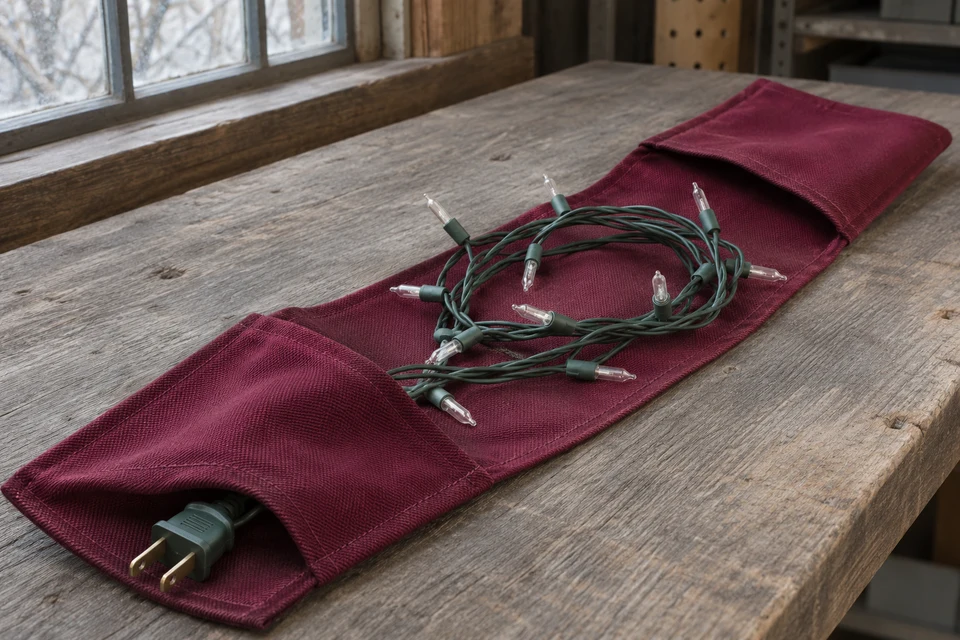
The useful measure of a light wrap is not how tidy it looks empty. It is whether the person dismantling a Christmas display can put the last lamp away and find the starting end next year. Send the sample room a representative disconnected strand, or a nonworking dummy with the same plugs, lamp spacing and cable bulk. Specify that the accessory is for storage only. The cloth is not an electrical component, and the sample should never be assessed by operating lights inside it.
Start with the strand, not the rectangle
Map the bulky ends separately
Lay the strand on a clear bench. Identify the plug, any inline controller, the final connector and the sections carrying lamps. Photograph each end beside a ruler on the same plane. Two strands of similar overall length can need different pockets: a broad controller and a narrow plug should not be treated as interchangeable lumps. Decide whether each component needs its own recess or simply a clear space next to the coil. Draw the intended contents on the sample sheet; otherwise a quote for a plain roll can look deceptively similar to one for a wrap with shaped pockets.
Make the reference coil without pulling the cable tight or overriding the handling instructions that accompany the lights. Record its relaxed outside width, thickness and the position of both ends. If it springs open as soon as a hand is removed, capture that too. A wrap designed around the compressed dimension may need continual tension to close. A larger format may use more cloth but avoid asking store staff to force the final turn.
Decide which end comes out first
Rehearse next season's setup
Work backwards from the first step in the next installation. A window dresser might want the plug immediately visible; a warehouse team issuing a complete kit might prefer both ends inside. Put a removable paper marker where the user begins. Ask someone who did not wind the sample to open it and lay the strand out without instructions. Note when they have to pull a component through an enclosed loop. Move the pocket opening or reverse the winding direction and repeat before changing the overall dimensions.
A single photograph of a perfect coil conceals much of this information. Keep three views: open and empty, partly loaded with the ends visible, and closed. Mark the side that faces the storage carton. If the plug is only accessible when the whole parcel is inverted, check whether loose turns fall out during that movement. A shallow open pocket is easy to reach, while a deeper pocket can isolate the plug better but hide the cable exit. Choose between those outcomes deliberately.
Inspect the loaded wrap
Locate hard contact before choosing a fastening
Set the closed sample down in the posture in which it will actually be stored. Open it again and look for points where a hard plug overlaps a lamp or where a seam traps the flexible lead. Do not infer impact protection from the presence of padding. If the display owner needs protective transport packaging, ask for a separate packaging brief and an agreed assessment of the packed system. The sewing sample answers a narrower question: can the intended pieces be arranged without forced contact?
Try the closure with the smallest and largest relevant coils. A long tie can fit both but needs somewhere to sit when packed; a short fixed tab can be easier to operate but may only suit one bundle. Mark the range that was physically tried, not every light set in the retailer's catalog. When the range is too wide, request two priced sizes instead of asking one operator-dependent fold to do all the work.
Buy the packing operation as well as the cloth
Identify the supplied unit
Ask for separate quotation lines for an empty wrap and any packing service. State whether the buyer supplies electrical goods, whether the wrap is sold separately and who confirms the storage instructions. A seasonal illustration showing lights in place is not evidence that lights are included. For mixed colors, ask whether the minimum applies per fabric color or across a combined cutting run. For an in-store date, request the dates for reference-strand receipt, first sample and packing approval before making any promise.
Send FY Bedding the strand profile, three packing views and the expected units per format when requesting a custom quote. Hold approval if the close-up of the plug pocket does not agree with the closed sample, even if the outside looks right. The useful approval record lets another person repeat the winding sequence without borrowing the original sample-room operator.
Keep one loaded reference and one empty reference together; record which strand was used and what remains outside the scope of the storage accessory.