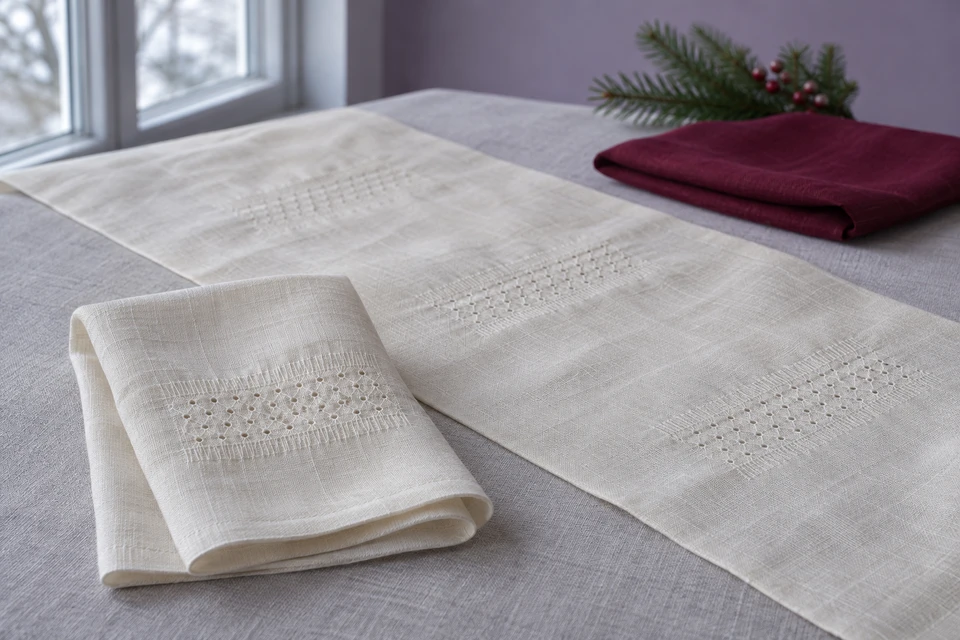
White-on-white Christmas table linen can contain delicate openings without fabric being cut away. For a pulled-thread proposal, that construction distinction should be explicit. Buyers need to know whether the supplier is moving the ground threads, removing them or offering another route to a similar openwork appearance.
Name how the openings are formed
Pulled and drawn are not interchangeable instructions
The Royal School of Needlework distinguishes pulled work, where stitching distorts the ground threads, from drawn work, where threads are removed. This is a useful identification boundary for procurement, not a requirement to use the materials or dimensions of a teaching exercise. Ask the supplier to describe the actual proposed construction. If a table-linen design combines techniques, identify the locations separately rather than applying one label to the entire item.
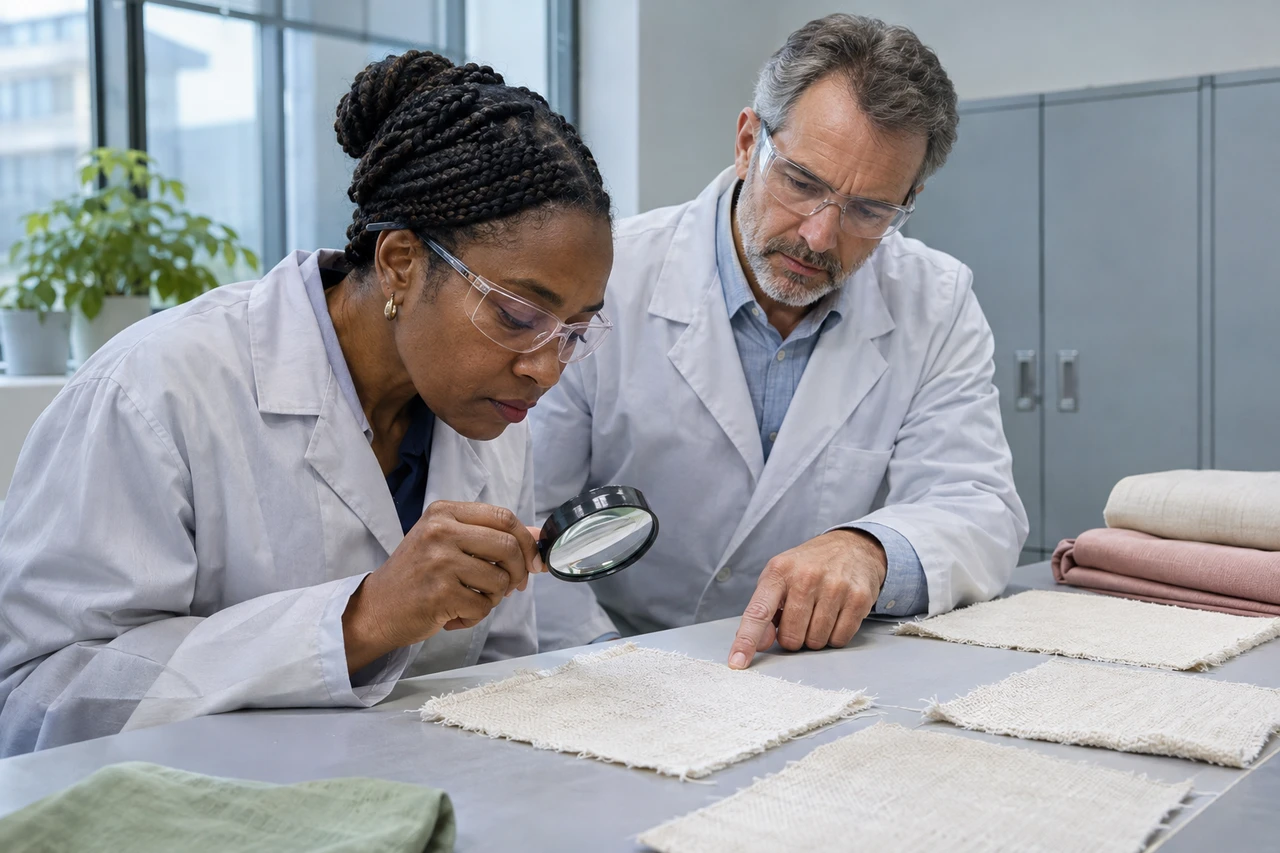
Request a worked sample with some undecorated ground still visible. The technical reviewer should be able to compare the base weave with the altered area and ask the maker to explain any unclear detail. Do not instruct staff to cut a sample apart or pull out threads to prove the method. A supported construction declaration and an appropriate physical examination should resolve the question without turning a buying review into an improvised destructive test.
Select the ground and stitch reference together
The same drawing can produce a different openwork field
Keep the ground fabric identity, declared composition and relevant yarn arrangement with the proposed stitch reference. Ask the maker which base cloth it recommends for the intended design and why. A holiday star sketch or a photograph of a white runner does not specify the textile that can produce the desired openings. Record any development alternatives separately so the buyer can see what changes when the ground or stitching thread changes.
Compare the actual worked fields instead of ranking samples only by how open they look. A more visible hole is not automatically a better result. Consider the intended balance between intact cloth and openwork, the clarity of the arrangement and the surrounding fabric's appearance. If the design is meant to be subtle, an enlarged photograph can misrepresent that goal. Retain both a close detail and an ordinary table-distance view as parts of the same approval.
Inspect displaced threads and surrounding distortion
Separate the intended opening from an unintended break
Look at how the threads gather around the worked areas and how the surrounding ground lies. Record broken-looking threads, isolated oversized gaps, irregular gathering or a section that differs noticeably from the accepted reference. Ask a competent reviewer to determine the cause and appropriate action. The buyer should not assume that every visible opening is a defect, but should also not allow a damaged ground to be excused as part of the openwork style.
Examine representative locations, including the first and last parts of a decorative band and any place where the arrangement changes direction. A selected centre swatch may hide difficulties near the edge of the worked field. Keep photographs linked to exact positions so a correction can be checked. If the supplier proposes a different ground or stitch route to resolve the issue, request the affected design again rather than approving an isolated patch whose relationship to the complete runner is unclear.
Place the openwork in the actual table setting
Background contrast changes what the customer sees
Review the linen on the intended table colour or undercloth. Pale openings over a white surface can read very differently from the same cloth over dark timber. Decide which presentation the product photography and retail description will show. For a Christmas programme, confirm how the openwork relates to the centrepiece area, place settings and the part that hangs over the table edge. Keep decoration clear of assumptions about protective or heat-resistant performance.
Use the proposed finished dimensions, including hems and any adjoining plain areas. If a napkin or runner is part of a coordinated set, show how the worked fields relate without assuming that they must be identical in scale. A large runner arrangement may overwhelm a small folded napkin. Request separate layout approvals where the product form changes. The buyer should be able to describe the deliberate relationship between pieces rather than relying on the word matching.
Assess the delivered finishing and care state
Openings should not be judged only while held under tension
Ask how the sample was prepared for presentation and which preparation will be used for production. Compare the cloth relaxed in its intended state rather than pulled taut between two hands. Record any pressing, shaping or finishing used to achieve the approved appearance. A sample shown under tension may conceal puckering or exaggerate open areas, while a heavily styled photograph may suggest a result that ordinary unpacking will not reproduce.
Agree the appropriate care assessment for the complete construction and document the actual procedure and observations. Review the openings, surrounding ground and hems together afterward. Do not infer a wash temperature, service life or universal shrinkage result from the technique's name. If the supplier revises the ground, stitching thread or finish, decide which evidence needs repeating. Keep the original sample and revision record so a changed texture is not mistaken for the previously approved material.
Release a construction-specific order reference
Preserve the distinction through quotation and receiving
The order should identify the method at each openwork area, the selected ground and thread, finished layout, accepted appearance and preparation state. Ask whether the quotation includes full finished pieces or decorated panels awaiting conversion. Confirm minimum quantities, sample revisions and packing requirements for the actual assortment. A table-linen offer described only as white embroidery can conceal significant differences in scope, even when two suppliers show similarly delicate Christmas photographs.
Send FY Bedding the intended table setting, authorised motif direction, product sizes and the worked-construction questions that remain open. Request a feasible sampling proposal and evidence for the stated use. Confirm production and delivery arrangements against that proposal rather than presuming seasonal stock or arrival. At receiving, the team should compare the named construction and finished reference, escalating unexpected thread removal or breakage instead of silently accepting another technique because its outline looks close.
Confirm whether each open area is pulled, drawn, cut or otherwise formed. Approve the worked ground in a relaxed finished state, its placement on the table and its supported care condition before buying the Christmas assortment.
Method references: Royal School of Needlework: pulled and drawn whitework distinction.