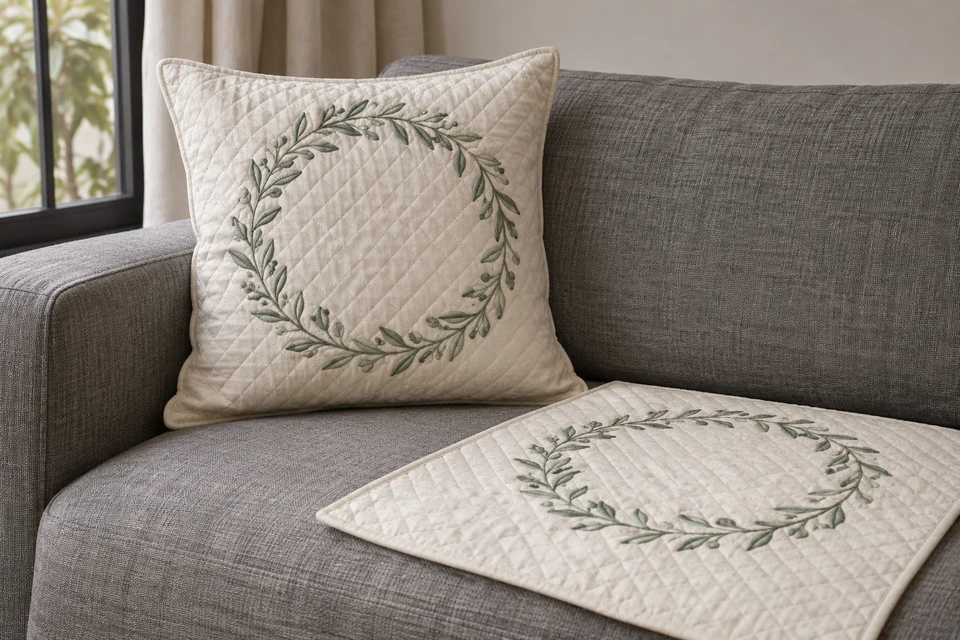
A circular wreath can look balanced on a flat cushion panel and appear narrow or displaced once that panel curves around an insert. The relevant purchasing decision is not simply whether the artwork is a perfect circle. It is whether the intended wreath reads correctly in the finished display position. Review the decorated, quilted face as part of a complete cover-and-insert combination, while keeping decorative stitching distinct from any performance role assigned to the quilting. A seasonal picture alone cannot establish the construction or fill specification.
Separate the wreath from the quilting field
Identify which stitches create each feature
Ask the sample maker to identify whether the wreath is embroidered onto a quilted panel, formed by quilting lines or made through another proposed combination. Mark the decoration and quilting separately in the drawing. This avoids a quotation for an embroidered wreath on plain cloth being compared with a layered quilted cover. Record the proposed face, backing and intermediate layer where one is used, without inferring them from the illustration.
Decide which visual relationship matters most: the apparent ring, the spacing of leaves or the quiet field surrounding it. A circle can remain mathematically correct while crowded leaves make one side appear heavier. Review a full-size drawing and then the actual stitched panel. If the construction changes the apparent width of the ring, approve the physical interpretation explicitly rather than leaving the inspector to choose between the drawing and the sample.
Locate the centre against finished boundaries
Do not use the cut edge as the final reference
Mark the wreath centre relative to the finished cover seams and the intended top. Note the clearance between the outer leaves and each finished edge. The cut panel may include allowances that disappear during assembly, so a measurement from its raw edge can be misleading. Keep the placement drawing linked to the cover pattern and identify any later seam or size change that requires a placement review.
Compare the opposite sides after sewing. If one side of the cover is pulled more strongly around the insert, an apparently off-centre wreath may result from the complete fit rather than the decoration position alone. Record the observation before assigning a cause. Inspect the empty cover and the filled cover under the same orientation so the designer and technical team can distinguish a placement issue from a curvature or assembly issue.
Choose the display insert deliberately
Fullness changes the visible ring
Use clearly identified inserts when comparing the finished face. Keep the cover fixed while reviewing the proposed alternatives, and photograph them from the same height and distance. Observe the visible circle, the parts of the ring approaching the side curves and the relationship between the wreath and the upper corners. A fuller insert may make the central area prominent while rolling the outer leaves away from the viewer.
Agree which combination represents the intended selling image. For a cover-only offer, record the styling insert separately and ensure the listing does not imply it is included. For an insert-included programme, the accepted complete combination belongs in the product specification. Do not approve an attractive photograph using an unidentified studio insert and then ask the supplier to reproduce that appearance with an unspecified filling. The reference must be something another reviewer can reconstruct.
View the wreath in its normal position
A front-on photograph is only one check
Place the cushion on the intended sofa, chair or bed arrangement and review the main viewing angle. Compare the head-on view with a modest side view and the normal seated-height perspective. Note whether the wreath still reads as one continuous composition or whether a seam, fold or sharply curving edge interrupts it. Keep any surrounding accessories from concealing the areas that need approval during this review.
Natural softness should be described, not eliminated through excessive styling. If the cushion has to be propped from behind or manipulated into a rigid shape to keep the wreath circular, decide whether that arrangement is realistic for the intended customer. A gently elliptical appearance may be acceptable when viewed obliquely, but record that judgement against actual images. Avoid using digital retouching to repair a layout problem that remains present in the physical product.
Retain the assembled reference after care
Control revisions across decoration and construction
Run the agreed care and handling review on the complete construction, then compare the ring, surrounding quilting and panel outline. Record the process and finishing state before judging any change. A new backing, thread or quilting arrangement can affect the finished appearance even when the wreath artwork is unchanged. Keep those components in the change-control record so a supplier does not treat them as invisible substitutions.
For development with FY Bedding, share the full-size wreath layout, desired cushion dimensions, proposed selling configuration and photographs of acceptable curvature. Request confirmation of the construction, sample scope, quantities and timing before committing the seasonal range. Release the artwork and complete physical reference together. Keep close details of the leaves for workmanship review and wider views for composition; neither set of photographs should be used to replace the other when the order is inspected.
Approve the wreath on the assembled, identified cushion configuration, with separate flat-panel placement and normal display-view references.