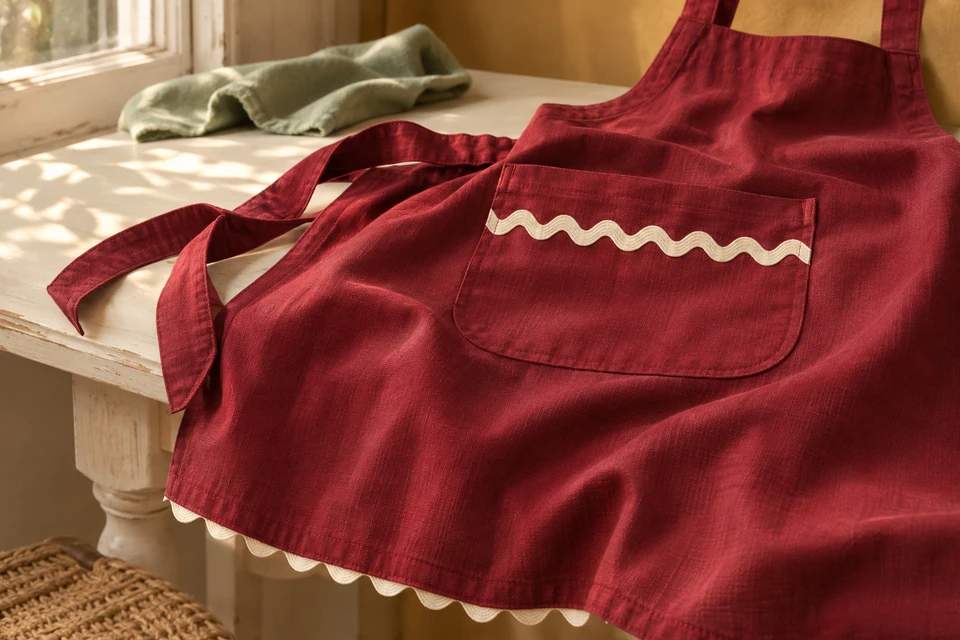
The same rickrack braid can produce two very different Christmas apron details. Applied flat, its whole wave is visible; inserted into a seam, only part of each point may emerge. A purchase description that names the trim but omits its placement leaves that decision to the sample maker. Decide which appearance belongs to each part of the apron before comparing quotations or approving the finished garment.
Name the application at each position
One trim reference does not define the visible edge
Mark the pocket, bib, lower edge and any other decorated area on a simple apron drawing. For each location, state whether the braid is fully applied to the surface, enclosed at a join or partly exposed beyond an edge. Sewing and Craft Alliance guidance illustrates flat application and insertion as different ways to use rickrack. Use those distinctions to describe the desired result, not as a production instruction copied from a general sewing handout.
A cranberry apron with an ivory pocket wave might use only the points of that braid at its lower edge. Those details should have separate approval views even if the material reference is identical. Do not use one photograph of a loose length to approve both. Confirm whether the project is an adult decorative apron or another clearly defined item; a festive appearance does not establish protective properties or suitability for food-service work.
Measure the braid and the visible portion separately
Catalogue width can hide a different presentation
Ask the supplier how its trim width is defined and obtain a physical sample. Record the overall wave envelope and an agreed way to identify the repeat along the length. Then identify the visible exposure required in the finished seam. A nominal braid width alone cannot tell production how much should project from beneath the fabric. Use a marked sample rather than an unqualified instruction to expose half.
Compare a short straight section of each proposed application. For the flat band, check the complete wave and the position of its securing stitches. For an inserted edge, inspect whether the visible points emerge consistently while the retained part remains captured as intended. Keep any tolerance project-specific and agreed with the maker. The buyer's role is to approve a reproducible appearance, not to assume that one universal seam position will suit every braid size and fabric thickness.
Follow the trim around the actual shape
Corners and curves deserve their own sample
Review the lower apron corners, the pocket corners and any curved bib area separately. A trim that sits evenly along a straight cutting may turn differently on a curve. Ask the maker to propose the turn and show its result in the selected material. Examine the outside of the bend as well as the inner side, noting whether a wave is crowded, flattened or lifted. Record the intended treatment at a sharp corner rather than leaving it to individual operators.
Do not judge the corner only while someone holds the apron stretched over a table. Let it hang and rest naturally, then view it in a representative wearing arrangement. This is a presentation review, not a claim about fit or protective performance. If the braid needs a revised path to lie acceptably, update the decoration drawing and recheck the visible relationship with the pocket or hem. A neat corner in the wrong position is still a different design.
Decide how starts and joins should read
A hidden overlap may become a visible thick spot
Show where each trim run begins and ends. Ask whether a run is continuous, interrupted at a seam or joined in an exposed area. Inspect the proposed join from the face and reverse. A bulky overlap can change the outline even when its colour matches, while an abrupt end can leave the last wave looking cut off. The approval should distinguish a deliberately concealed termination from an exposed join that needs its own workmanship reference.
For a pocket band, check the relationship between the braid ends and the pocket's side construction. At the hem, follow the trim through the full perimeter rather than checking only the central photograph. Do not assume that a supplier can always provide uninterrupted lengths in every colour or size. Confirm the actual component format and how any permitted join is handled. Keep that commercial question separate from the visible design acceptance.
Evaluate the braid with the apron cloth
Contrasting colours and different constructions need combined evidence
Confirm the declared fibre composition and finish of both materials. Ivory braid and red cloth can look suitable together without establishing how they behave during the proposed care process. Agree the relevant evaluation for the complete apron, including the trim's attachment and exposed portions. Retain the initial reference and compare it after the stated procedure. Describe observed waviness, local pulling or colour change without converting a development trial into a broad durability guarantee.
Review the resulting edge in the ordinary packed and unpacked state too. A fold across protruding points may change their first presentation to the customer. Ask whether any preparation is expected before sale and whether that is realistic for the channel. Do not rely on a perfectly arranged sample that requires undocumented handling. If the braid is substituted, revisit the application trial even when the new supplier uses the same width name.
Release the trim decision with the seasonal assortment
Keep appearance changes visible in the quotation
The final brief should identify the braid, its colour, the locations where each application is used, the exposure reference, corner treatment and allowed join positions. Ask which quantities or minimums apply to each colour and trim variant. Avoid combining a flat-applied version and an inserted-edge version under one indistinct purchase line if their construction or pricing differs. The sample revision should tell the packing and inspection teams exactly which version they are receiving.
Share the Christmas apron direction, intended use and marked trim locations with FY Bedding when requesting feasibility and sampling. Ask for the proposed material and assembled detail before treating the illustration as an available product. Confirm the actual sample and production schedule independently of the holiday name. A clear waved-braid brief makes the comparison useful: buyers can see whether the offer supplies the full decorative wave, the intended row of points or a different finish altogether.
Identify full-wave and inserted-point applications separately. Approve the actual braid, exposed portion, turns and joins on the finished apron before freezing the seasonal trim reference.
Method references: Sewing.org: flat-applied and seam-inserted rickrack.