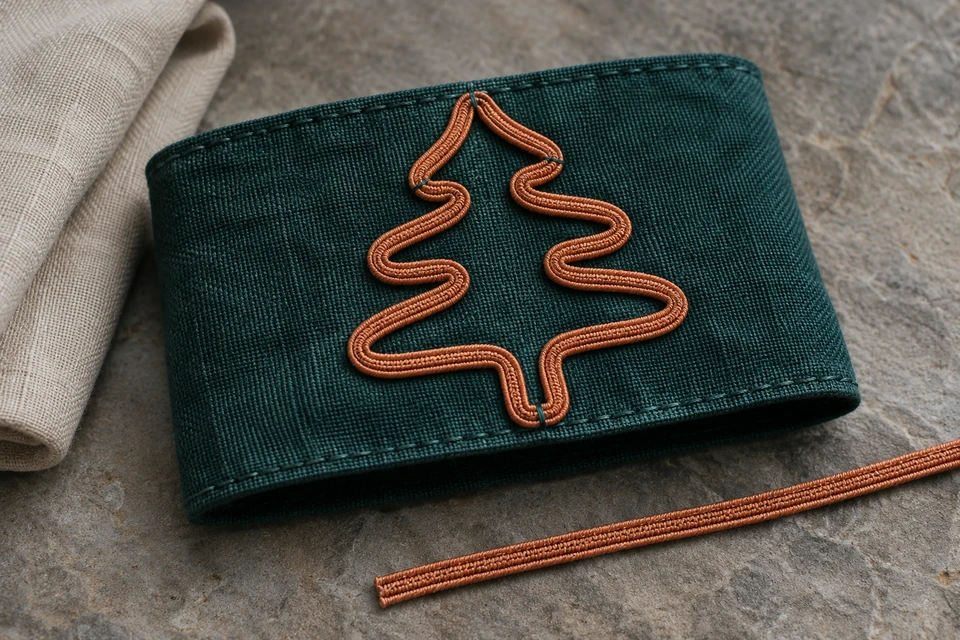
A curled Christmas tree can be easy to draw and difficult to express with a narrow flat braid. For a soutache-trimmed napkin band, the purchasing decision lies at the turns: whether the chosen braid follows the approved shape while keeping the face, channel and securing work controlled.
Name the trim before comparing quotations
A narrow braid is not automatically soutache
The Textile Research Centre describes soutache as a particular narrow braid with a V-shaped appearance, laid along a design and stitched down its middle. Ask the supplier to identify the braid actually proposed, including its width, composition information and colour reference. A round cord, a waved rickrack trim and a flat braid may all be described casually as decorative trim. They should not be placed in the same quotation line unless the buyer has explicitly accepted them as alternatives with their own sample approvals.
Request a loose length of the proposed braid alongside the applied sample. Seeing both makes it easier to distinguish the material's own shape from distortion introduced during application. It also helps establish which face is intended to be visible. If the supplier cannot yet identify the braid's source or specification, classify the sample as a concept. Do not turn a successful-looking trial into a firm production specification by writing only the word soutache on the purchase order.
Choose the tightest curve early
Test the difficult part before approving the full tree
Start development with the smallest inside turn in the Christmas design, a wider curve and a straight section on the intended ground. A tiny spiral on a digital artwork may be unsuitable for the proposed braid without a visible change in shape. Let the maker propose a revised curve or a different braid where necessary, then compare those options against the desired appearance. The buyer should approve the compromise before the entire motif and its costing are frozen.
View the sample directly from above and from a low angle. The overhead view establishes the outline; the low view reveals lifting, twisting or a bulky overlap at the bend. Neither view alone answers both questions. Mark the specific curve under review and keep the same orientation in comparison photographs. Avoid a vague instruction to make the motif 'more premium' when the actual concern is a raised inside edge or a tree branch that has lost its recognisable shape.
Follow the channel through junctions
Decide how an intentional crossing should look
A braid can look flat along most of its route yet become visually confused at the trunk or where two lines meet. Ask the maker to show the proposed crossing, overlap or termination in a sample. Decide which line should appear continuous and whether a small local thickness is part of the design. If the drawing has no true crossing, a production shortcut that creates one should return for approval. It is not merely an invisible assembly choice when it changes the visible tree.
Examine the securing work in relation to the central channel and the braid colour. The aim is an agreed appearance and attachment, not a buyer-invented rule for stitch length or machinery. A contrasting securing thread may interrupt a fine copper line; a closely matched thread may be less noticeable but still needs adequate attachment for the intended use. Ask the supplier to explain the proposed method and show its result. Do not infer attachment quality from a photograph that conceals the work with shallow focus.
Evaluate the band around its napkin
Flat-table approval does not establish the finished curve
Assemble the band with the intended napkin presentation or an agreed dimensional equivalent. Its bend around folded cloth may change how the tree's side branches sit. Record the fold, band position and fastening arrangement used for approval. If the napkin size, thickness or folding method changes later, review the presentation again. A band approved around one compact fold should not silently become the reference for a much larger hospitality napkin display.
Inspect the inside as well as the decorated face. The fastening, seam allowance and braid ends can meet in the same small area, creating a local bulk that affects appearance or handling. Agree how these elements are arranged rather than hiding the back in every product photograph. Where the item is intended for repeated use, determine the relevant care and handling checks with the supplier. No decorative braid name, fibre claim or successful styling session establishes a care guarantee for the completed band.
Freeze design options before splitting quantities
Small changes can require separate development
Copper on teal, ivory on plum and a larger tree may look like three easy colourways in a retail plan. In production terms, each may require different materials, matching securing thread or a revised route. Ask which attributes can remain common and which require their own sample. Keep the supplier's quantity assumptions attached to the quotation, including any separate trim minimums. Do not assume that all colourways share one minimum order simply because their finished bands are listed under a single collection name.
Build the timing discussion around the decisions still open. A braid-source change, a tighter curve or a new ground fabric can invalidate an earlier appearance approval. Identify the person authorised to approve such changes and the evidence they need. Confirm production and transport timing for the actual purchase order rather than suggesting that seasonal decoration can be added at the last minute. An agreed Christmas theme is not a confirmed Christmas delivery commitment, and a small sample does not establish bulk availability.
Write a receiving reference that identifies the turn
Make the decision reproducible without overengineering it
The retained reference should show the full band, its approved presentation and close views of the most demanding turns. Include the loose braid identification and the agreed treatment of crossings and ends. Use clear observations such as 'inside edge remains seated as in sample A' where they describe an actual accepted condition. If numerical tolerances are needed, agree the measurement method with the supplier; do not invent limits from a photograph or borrow them from an unrelated ribbon product.
At inspection, compare like-for-like band configurations under consistent lighting. Record whether a discrepancy concerns braid material, application, motif placement or assembly, since each calls for a different response. Keep a changed sample under a new revision rather than overwriting the original approval. A useful FY Bedding enquiry includes the Christmas motif direction, band dimensions, intended napkin presentation and quantity split. The discussion can then address feasible development options and evidence required, without implying that a displayed collection image already uses this particular trim.
Resolve the narrowest turn, the central-channel appearance, junction treatment and assembled band before approving quantities. Retain a loose braid reference and photographs of the exact accepted bends with the final physical sample.
Method references: Textile Research Centre: applied soutache braid and middle attachment.