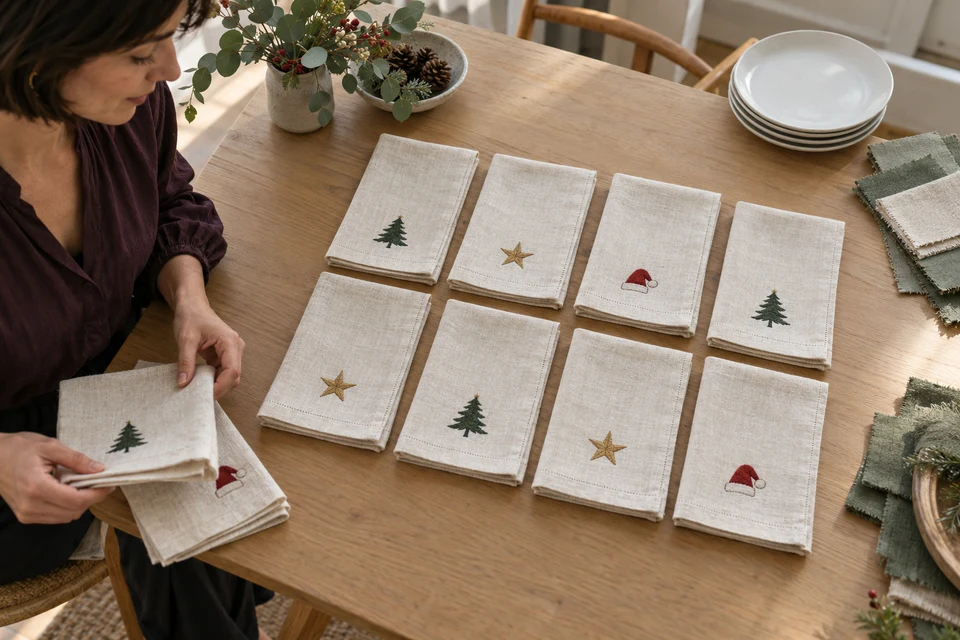
A three-motif napkin sequence divides neatly across six seats but needs an explicit decision for eight or ten. Ordering an equal quantity of tree, star and Santa-hat designs does not guarantee that every service kit contains the intended mix. Hospitality and retail buyers need to decide how incomplete repeats should look, how spares are selected and whether mixed table sizes can share one stock pool. This is an allocation problem for a specific festive design sequence, not a recommendation to buy equal quantities of every motif.
Choose what an incomplete repeat should look like
Uneven counts are not automatically packing mistakes
Lay out the three motifs around each intended table size and let the design owner choose the result. An eight-seat arrangement might use three trees, three stars and two hats; another concept might repeat two motifs deliberately at the ends. Neither is an implied standard. Record the chosen seat map and the count of each design. Keep the viewing convention clear if opposite seats should match or alternate.
Use the collection brief to connect each approved table layout with a kit code. Do not leave the missing part of a repeat for service staff to improvise on the day. A six-seat kit and an eight-seat kit can use the same towel or napkin construction while remaining different assortments. Their photographs and packing references should make that difference visible.
- Approve a layout for every offered table count.
- Record counts by motif, not just total napkins.
Calculate quantities from the kit mix
Multiply each motif through the actual deployment plan
List the number of tables or retail kits of each approved size. Multiply those quantities by the motif counts in each kit, then total each motif separately. Keep service spares on a separate line until their allocation rule is agreed. This avoids a common error: multiplying all seats by one total and dividing by three even though several table sizes do not contain complete three-part repeats.
The quantity planning framework can hold this arithmetic while the specific Christmas kit map remains the decision source. Have a second reviewer reconcile the motif totals back to the planned kits. The sum of all motifs should equal the intended textile-piece count, but that total alone cannot prove that enough of the less common design is available for every planned arrangement.
- Reconcile motif totals to each table-size plan.
- Keep spare quantities visible instead of hiding them in rounding.
Define the spare rule before buying extra pieces
A spare can preserve or change the visual sequence
Decide whether a missing napkin must be replaced with the same motif or whether the operator may use a designated neutral or alternate design. For a same-motif rule, spares need separate tree, star and hat identities. For a flexible rule, show the permitted replacement arrangements so staff are not forced to choose between an incomplete table and an unapproved visual mix. Do not describe flexibility that the stock and service instructions cannot support.
Link the rule to the component replacement record. Preserve the embroidery or print revision and base textile reference. A later tree design may not match the original kit even when its color is similar. Decide when an entire kit should be refreshed rather than silently combining old and new artwork in a guest-facing setting.
- State same-motif or approved alternate replacement.
- Keep spare identity tied to the original artwork revision.
Pack by the approved motif vector
An eight-piece kit can still contain the wrong eight pieces
Prepare a packing reference with a photograph and explicit counts for the particular kit. Verify the pieces before the fold or sleeve hides the decoration. For the example eight-seat mix, three trees, three stars and two hats is different from three trees, two stars and three hats, even though both packs total eight. If the operator accepts both, define them as approved alternatives rather than treating the distinction as irrelevant.
Use the packout completeness process to connect the check to the selling or service unit. Separate kits awaiting review from accepted kits, especially when several table sizes are packed in the same area. Carton-level equality of motif totals cannot establish the contents of each individual kit. Keep the size and motif combination legible in the internal packing instruction.
- Verify each kit before motifs become hidden.
- Do not use a correct carton total as proof of individual assortment.
Order, reset and replenish the same defined kit
The operational handover should preserve the design decision
Provide the operator with the accepted table layout, kit count and spare rule together. Review how pieces are sorted after use and care so the next service can rebuild the correct mix. Keep the care specification tied to the actual fabric and decoration rather than assuming every festive napkin can follow one process. A kit code should describe a reproducible assortment, not just a seasonal marketing name.
The receiving and laundry handover record helps connect purchasing with service preparation. Ask the supplier to confirm minimums by motif and construction, including any separately ordered spares. Resolve an inconvenient minimum through an explicit assortment or quantity decision; do not let excess components quietly change the table design. Agree the feasible delivery plan without assuming Christmas availability from a catalogue image.
- Hand over the layout and spare rule with the kit.
- Resolve minimum-order differences without silent motif substitution.
Share the number of six-, eight- and ten-seat arrangements, the three motif references and the desired spare policy with FY Bedding. Request a motif-level quantity proposal and checked trial kits. Approve the actual mix for each table size before the Christmas linen order is released.