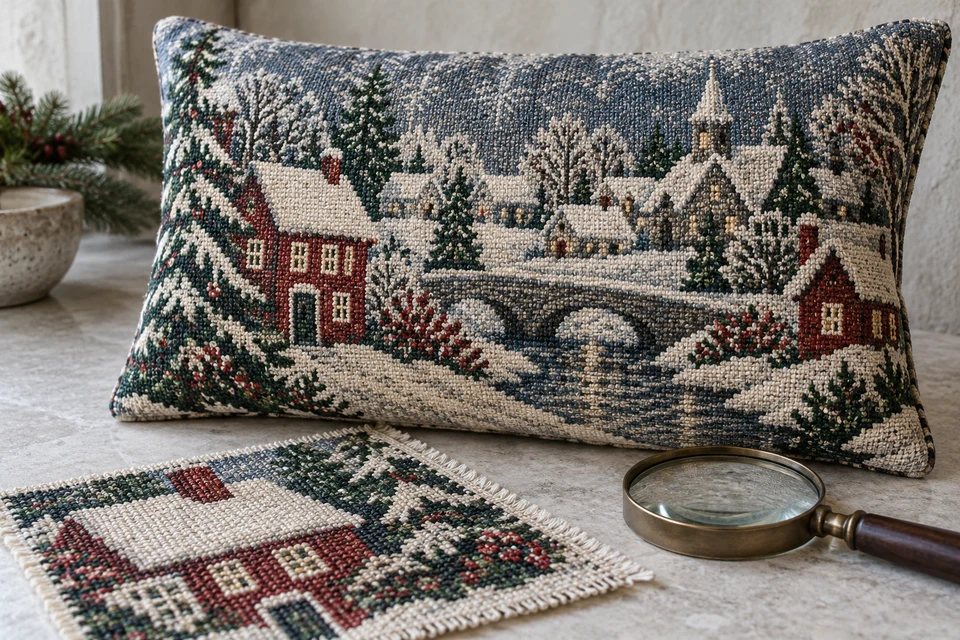
A small village scene can carry the appeal of a Christmas cushion: roofs, windows, fir trees and a snow-covered path all contribute to recognition. Those details must be interpreted in the offered woven fabric, not simply copied from a high-resolution drawing. The buying decision is whether that interpretation works at the intended cushion size. Confirm the actual construction before using tapestry language, and do not turn a woven appearance into a handmade or heritage claim.
Confirm how the picture is formed
A woven scene and a printed imitation are different proposals
Ask the supplier to describe the face construction and provide physical front and reverse references. Identify the actual yarn materials, back panel and closure in the brief. If the image is printed to resemble woven texture, describe it as that alternative rather than approving it under a woven specification. Do not infer a particular loom, production site or craft method from a photograph.
Use the specification pack to connect the construction statement with the scene artwork. Keep an offered alternative in a separate revision, including its own sample and quotation. This makes commercial comparison possible without suggesting that every technique producing a similar village picture is the same purchased product.
- Request both fabric faces and a construction description.
- Separate printed alternatives from the proposed woven version.
Choose the details that must survive
A miniature window is not as important as every roof outline
Rank the essential features in the design before sampling. The tree silhouette and house spacing may matter more than a tiny window cross or individual snowflake. Ask for a woven interpretation at the proposed finished scale, including both detailed and plain regions. Compare the whole scene at normal room distance before inspecting local yarn relationships with magnification.
Keep the original artwork and accepted woven interpretation in the buyer's approval records. If a feature is simplified, document the accepted change instead of treating it as an undocumented production defect later. Avoid forcing more tiny detail into the image without reviewing how that changes the clarity of the village as a whole.
- Rank essential scene landmarks before the first sample.
- Approve deliberate simplifications in the physical woven reference.
Map the crop for every offered size
The village needs a finished-face boundary
Show the visible cushion face, seam area and scene placement on each size drawing. Check whether a roof peak, tree or path is lost at an edge when the cover is assembled. Decide whether different sizes use a newly arranged scene or a controlled crop of one layout. Neither approach should be assumed from one rectangular catalog image.
Use the size-set review to compare the finished covers on their nominated inserts. A woven panel can appear correctly centered while the filled cushion pulls its scene around the side. Review front and oblique views, and record the insert used so the next sample is not compared under a different shape.
- Draw visible-face and seam boundaries for each offered size.
- Confirm the crop on a filled cover, not only a flat panel.
Review yarn colors as a complete scene
Matching one red does not approve the village
Keep physical yarn or fabric references for the accepted color combination. Review neighboring shades together, including snow, roofs, sky and tree areas. Ask what substitutions are proposed and whether they alter the scene's contrast. A similar color name is not enough to authorize a replacement if windows or tree branches become difficult to distinguish.
Coordinate the retail photography review with the retained finished cover. Do not sharpen the photograph until it suggests details that are not visible in the textile. For care or durability statements, request assessment of the actual assembly, including backing and closure; a visually clear scene is not evidence of snag resistance or long service life.
- Approve neighboring colors and the complete scene together.
- Keep retail detail photographs faithful to the physical weave.
Make repeat-order identity recoverable
Store more than the original artwork file
Retain the accepted fabric, finished cover, construction description, color references and size-specific crop maps under one revision. Ask the supplier which quantities and minimums apply to yarn colors, woven design and finished cover sizes. Use the quotation driver checklist to separate scene development, sample weaving, assembly and insert scope.
Agree which changes require a new panel or finished cover. A new yarn combination, altered scene scale or revised backing may need more than a quick photograph. Confirm the available development route before planning a seasonal order, and keep stock and delivery statements tied to an actual confirmed offer. The aim is a repeatable product identity, not an unsupported story about a traditional workshop.
- Retain a finished cover together with its woven panel reference.
- Confirm design, yarn and size minimums separately where applicable.
Send FY Bedding the village artwork, priority details, intended sizes and desired construction. Request a woven interpretation and filled-cover review before selecting quantities or preparing customer-facing collection copy.