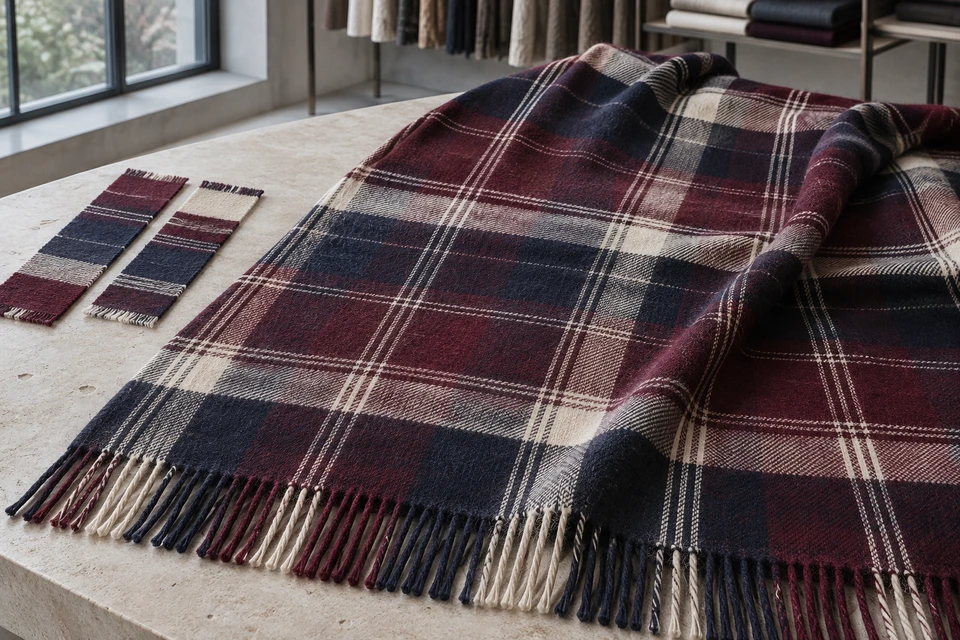
A Christmas tartan throw can contain the right colours and still be the wrong design. A narrow ivory stripe may sit on the wrong side of a broad red band, or a sequence intended to reflect may simply repeat. Neither error is resolved by approving individual yarn colours. The buying reference needs to describe how those colours progress across a complete sett: the repeating pattern that gives this particular tartan its identity. Approve that sequence before discussing the finished throw's border or retail fold.
Decide what the word tartan means in this proposal
A colour mood is not a weaving instruction
The Scottish Register of Tartans explains that a threadcount records coloured threads in sequence and distinguishes reflective setts from repeating ones. Use that distinction to ask the supplier how the proposed pattern is constructed. It does not establish that your seasonal design is registered, associated with a clan or authorised for a particular commercial use. Keep design permissions and any naming claims separate from the technical pattern record.
Begin with an original or appropriately authorised design and identify whether the offered throw is woven with coloured yarns or printed with a tartan appearance. Both can be evaluated, but a drawing expressed as a weaving sequence should not silently become a printed imitation. If printing is proposed, require a separate production interpretation. This brief concerns the ordered stripe structure of a woven proposal; the appearance of a plaid at a bedspread corner is a different layout decision.
Read through a complete repeat in both directions
Find the point where the sequence starts again
Ask for a diagram that shows every band in order, including fine overchecks that are easy to miss in a small catalogue image. Identify the reference start and the progression along warp and weft. If the sequence reflects, show the turning points explicitly. If it repeats without reflection, show where its end connects back to its beginning. Avoid a cropped image whose boundaries happen to conceal the transition the buyer most needs to approve.
Work through the diagram with the supplier using one consistent set of colour identifiers. A code should refer to the agreed physical yarn reference, not merely a colour name that different teams interpret differently. Confirm whether the warp and weft arrangements are identical or intentionally different. When they differ, the drawing should show both. A single handwritten row of colour names is inadequate if the maker must guess which direction it represents or whether a narrow line is part of the repeat.
Separate thread sequence from finished physical scale
The same ordering can look different on the shelf
Record the proposed finished repeat dimensions alongside the thread sequence. Ask the maker how the selected yarn and construction relate to that scale, and assess a woven trial rather than calculating a product promise from a screen image. Do not copy a registration example's thread numbers into the purchase specification. Those numbers describe another design and purpose; the supplier must quote the actual construction being developed for your throw.
Compare the complete repeat at its intended size, not just enlarged details of attractive intersections. Look at how much visual weight the broad burgundy area carries against the fine ivory overcheck. If one colour dominates unexpectedly, establish whether the cause is a changed stripe width, yarn shade, crossing effect or sample presentation before altering the design. Keep a reference that includes sufficient surrounding repeats to reveal the rhythm. One isolated square can look balanced even when the full field does not.
Resolve seasonal colour substitutions as design changes
A missing yarn cannot be replaced by name alone
A supplier may propose a nearby red because the preferred yarn requires a different minimum quantity or procurement route. Ask for the proposed substitute as an identified option with its quantity and timing implications. Do not treat a commercial constraint as approval to change the sett. The buyer can choose to retain the target, revise the palette or reduce the range, but the selected route needs a new, visible decision.
Place substitute yarns into the actual woven relationship. Two reds that appear close as loose strands may produce different intersections beside blue and ivory. Conversely, a small isolated shade difference may be acceptable in the completed proposal. Retain the accepted woven comparison and state which earlier reference it replaces. If several holiday colourways share a stripe sequence, check each palette against that sequence rather than assuming one accepted colourway approves all of them.
Release the sequence before converting the throw
Preserve a recognisable reference after folding
Request a whole-width or otherwise representative trial that exposes the full agreed pattern in both directions. Mark its orientation in the development record and compare it with the diagram without stretching the textile to make bands align. Agree any intentional irregularity and the boundary beyond which a sequence or stripe-width difference needs review. These are project decisions, not universal tartan tolerances supplied by a register or by this article.
Once the woven field is accepted, review the finished throw and its proposed retail fold. The visible folded face should not suggest a different dominant colour from the opened product. Keep the approved sett, physical repeat size, yarn references, finished sample and pack view together so a later purchasing team can recognise the same offer. A new yarn or construction should reopen the affected comparisons even when the collection name remains unchanged.
Send FY Bedding the complete seasonal repeat, intended throw dimensions, colourway quantities and available physical references through the project enquiry route. Ask for confirmation of the proposed construction and sample scope before planning a launch. Approval of a drawing does not establish inventory, manufacturing capacity or Christmas delivery. A useful quotation identifies the pattern version it covers and lists any unresolved material or development choices.
Can the buyer and maker follow the same complete stripe sequence, including its reflection or repeat boundary, and match it to one identified woven sample at the approved physical scale?
Method references: Scottish Register of Tartans: threadcount and sett sequence.