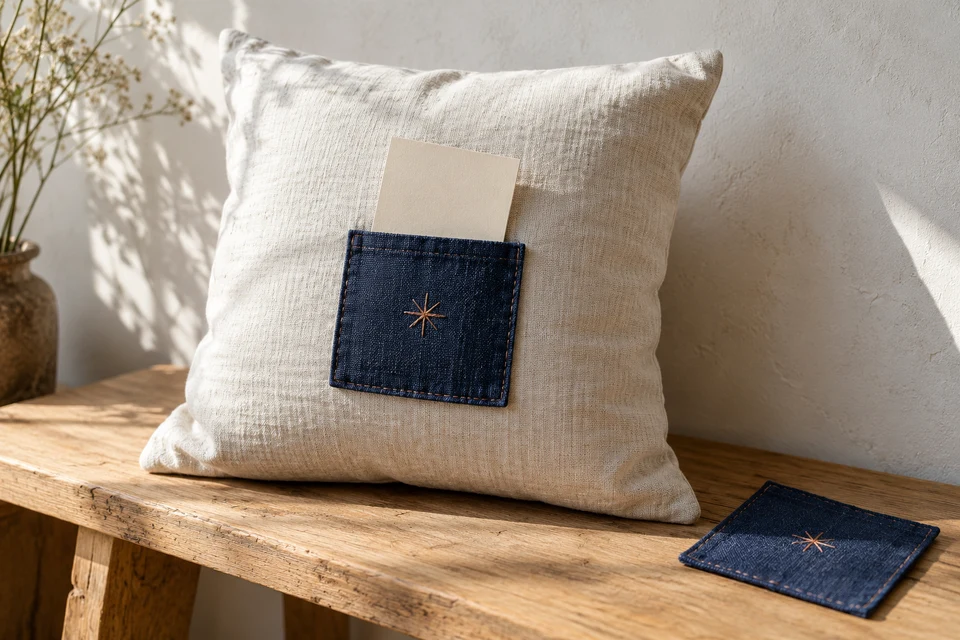
A Christmas cushion with a small external gift pocket can hold a defined flat card or message insert. The pocket is part of a curved, filled textile surface rather than a separate envelope. Its usable space, attachment and visible shape therefore need approval on the actual cushion assembly. Keep the demonstration card, cushion cover and insert clearly distinguished in the selling-unit description, and do not imply that the pocket is suitable for arbitrary gifts or valuables.
Define the flat insert reference
Pocket fit begins with the intended contents
Identify the card or envelope used for development, including its relevant finished dimensions and thickness. State how much should remain visible above the pocket and whether any protective sleeve is part of the reference. Add it to the technical pack. A nominal pocket width does not establish usable space once side seams, a shaped cushion face and the insert's thickness are involved.
Ask for a physical fit trial on the filled cushion rather than only on a loose flat patch. Observe insertion and removal using the agreed reference without forcing the card or flattening the cushion. If several insert sizes are intended, list them and review each combination. Keep the retail statement limited to the defined use; a decorative card pocket should not automatically become a general storage compartment or secure-value holder.
- Identify the actual card and intended visible height.
- Review insertion on the filled assembly without forcing the shape.
Locate the pocket on the filled face
A centered flat panel can sit differently after filling
Mark the pocket's finished position relative to the cover seams and intended cushion orientation. Record the cover-and-insert combination used for the review. A fuller insert may change how the patch lies or how the top opening presents, even when the cover dimensions are unchanged. Approve the empty pocket and the occupied pocket in the same natural cushion position so those conditions can be compared directly.
Place the Christmas star or other motif relative to the finished pocket, using the artwork version record. Check whether the card conceals any design detail intentionally or unintentionally. If the pocket is moved or resized to solve a fitting issue, recheck the complete face composition rather than treating the artwork proof as unaffected by the construction change.
- Compare empty and occupied pockets on the same filled cushion.
- Review motif visibility with the intended card inserted.
Inspect the opening and attachment joins
The upper corners are part of the usable construction
Identify the proposed pocket material, lining if any, upper-edge finish and attachment method. Show the usable opening rather than relying only on the outside patch dimensions. Review the upper corners and side joins where the insert passes into the pocket. Use the seam specification method to document the real construction and any local reinforcement the maker proposes.
Check the reverse of the cover panel to understand the attachment and any exposed backing or seam allowances. A decorative front photograph cannot establish how the pocket is joined. Ask the responsible product owner to define any required handling or attachment evaluation in a product evidence plan. Do not translate a brief insertion trial into a strength, security or long-term durability claim.
- Measure the usable opening after the edge finish is complete.
- Inspect the panel reverse and upper attachment corners.
Preserve the intended cushion shape
The pocket should not require flattening for a good photograph
Observe the face with and without the reference card, looking for changes in the pocket outline and surrounding fabric. Record any accepted gathering or shaping as part of the design. Do not hide distortion by compressing the insert or arranging the cushion in a position that the customer cannot reproduce. If a larger card is proposed, revisit the pocket and base combination instead of assuming extra visible width is enough.
Keep the pocket use separate from the cushion's care instructions. A paper insert may need to be removed, while the textile assembly requires its own supported care guidance. The buyer resource checklist can organize material and care decisions. Avoid claims about retaining valuables, accommodating hot objects or suitability for children unless the complete intended use has been separately assessed.
- Review the natural face shape in both pocket states.
- Keep insert removal and textile care instructions unambiguous.
Confirm the complete selling unit
Styled inserts are not automatically included
State whether the pack contains a cover only, a filled cushion, a card or another defined combination. Make those contents clear in photography and retail wording. For multiple motifs or card sizes, reconcile the exact combinations with the assortment verification checklist. A correctly counted cushion assortment can still disappoint if its expected card or filling is not supplied.
Align base cover, insert scope, pocket construction, decoration and packaging before comparing prices. Ask which variants create separate minimums or sampling work. Request a packed sample and repeat the occupied-pocket review after unpacking. Confirm actual production and delivery milestones before committing a Christmas promotion; a finished design proposal does not prove stock or a particular arrival date.
- Declare cover, filling and card inclusion separately.
- Review the packed selling unit with the same card-fit reference.
Share the intended flat card, cushion base and Christmas motif with FY Bedding. Request empty and occupied pocket samples on the filled cushion so usable space, face shape and selling-unit contents can be approved together.