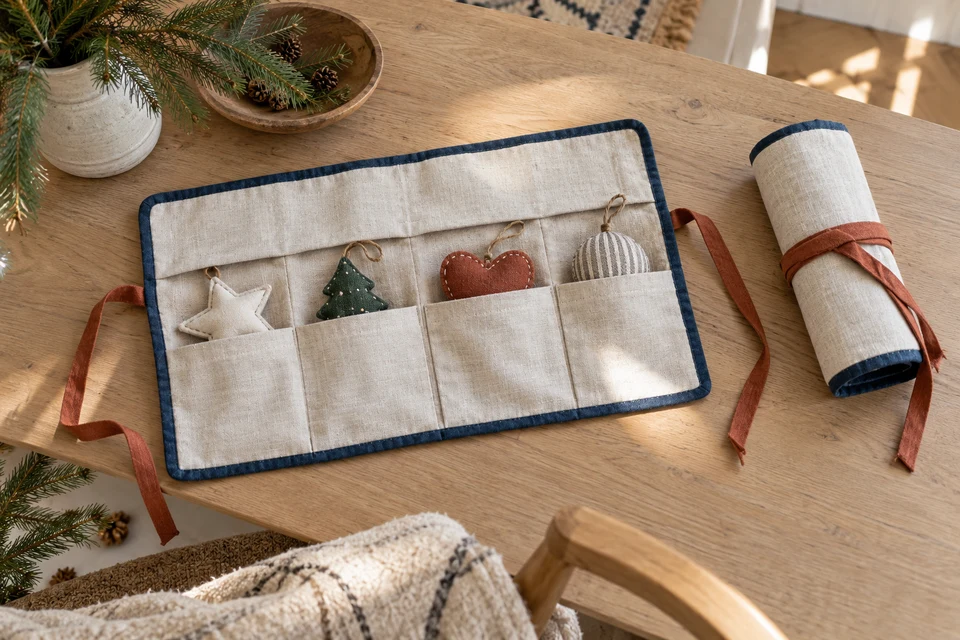
A textile ornament roll combines individual pockets with a flexible outer panel and ties. It is not a rigid divided box, and it is not a single long cloth wrapped around a tube. The buyer must define the ornaments used for development, how they sit in the pockets and how the loaded panel rolls without an unintended tie crossing the contents. A photographic storage concept does not establish protection for fragile ornaments or any universal capacity.
Define the ornament set used for development
Pocket count is not the same as usable capacity
Identify the actual sample ornaments, including their relevant dimensions, thickness and projecting features. State whether those items are supplied with the organizer or used only for a fitting demonstration. Add the reference set to the technical pack. Four pockets do not establish that four arbitrary decorations will fit or remain suitably separated when the panel is rolled.
Review any proposed alternative contents as separate fitting combinations. A flat fabric star and a rounded ornament can affect the rolled shape differently even if they have similar front dimensions. Keep the intended storage scope explicit and do not infer protection for glass, delicate finishes or breakable components from a trial using soft textile samples. The responsible product owner should decide what evidence the final claim requires.
- Record the actual reference ornaments and protruding features.
- Distinguish pocket count from an approved contents combination.
Map pocket openings and separations
Each item needs a defined entry and resting position
Show the finished pocket widths, depths and opening positions on the flat panel. Identify any flap, closure or internal divider that is genuinely included. Review how the reference ornaments enter and sit without forcing them into shape. Keep usable pocket dimensions separate from outside patch dimensions because seams and binding can reduce the available space, particularly around a thicker item.
Inspect the panel reverse and pocket joins using the seam specification method. Ask the maker to describe the actual construction rather than assuming the pockets share one continuous cavity. If a hanging loop from an ornament remains exposed, document its intended placement. An attractive open-panel photograph does not prove that neighboring contents remain separated through the rolling process.
- Identify each usable opening and actual separation.
- Review ornament loops and other exposed parts before rolling.
Approve the rolling order with contents installed
An empty roll can conceal a loaded-fit problem
Define the intended rolling direction and demonstrate it with the agreed reference set in place. Observe the sequence in which pockets overlap and whether an item shifts toward an opening. Do not compress the assembly to make it match an empty-roll photograph. Record the loaded dimensions in a defined condition and retain a practical demonstration that another person can reproduce without hidden rearrangement steps.
If the panel is meant to fold before rolling, show that intermediate step and the resulting pocket orientation. Keep the layout connected to the design version record so decorative panels or direction-sensitive motifs remain correctly positioned. A change in pocket depth or contents thickness should trigger another loaded rolling review rather than approval from the flat panel alone.
- Review the complete rolling sequence with the reference contents.
- Record any intermediate fold and the loaded final dimensions.
Keep the tie route outside the contents
Closure should not depend on an undisclosed path through pockets
Mark where each tie attaches and the intended route around the rolled outer panel. Show the final closure without threading ties through pocket contents unless that is an explicitly designed and assessed arrangement. Review the tie length using the loaded roll, not the empty sample. If the maker proposes elastic or another fastening instead, identify it as a revised closure and repeat the practical sequence.
Put any requested attachment, care or handling evaluation into a product evidence plan. A successful tying demonstration is not evidence of impact protection, secure transport or long-term storage performance. Keep the instructions aligned with the intended contents and use. The buyer resource checklist can separate the cosmetic sample approval from claims or evidence still requiring review.
- Review the exterior tie path on the loaded roll.
- Keep closure usability separate from protective-performance claims.
Release the storage selling unit
Demonstration ornaments must not confuse the pack contents
State whether the selling pack contains only the textile organizer or also the identified ornaments. Make that distinction clear in retail copy and images. If several pocket layouts or colors are offered, reconcile the actual combinations using the assortment verification approach. Count complete organizers with their closure components rather than treating a loose outer panel as a finished unit.
Compare quotations only after panel materials, pocket layout, binding, ties and packaging match. Ask which variants require separate sampling or minimums and confirm the actual development milestones. Inspect a packed organizer after opening and repeat the loaded roll demonstration. Plan the Christmas storage offer around the confirmed production and delivery sequence, without promising inventory or arrival timing from a design reference.
- Declare whether ornaments are included or only shown for demonstration.
- Repeat the loaded closure review after ordinary unpacking.
Share the intended ornament set and storage format with FY Bedding. Request an open-pocket sample, a loaded rolling demonstration and an exterior-tie view before approving the complete organizer and retail contents.