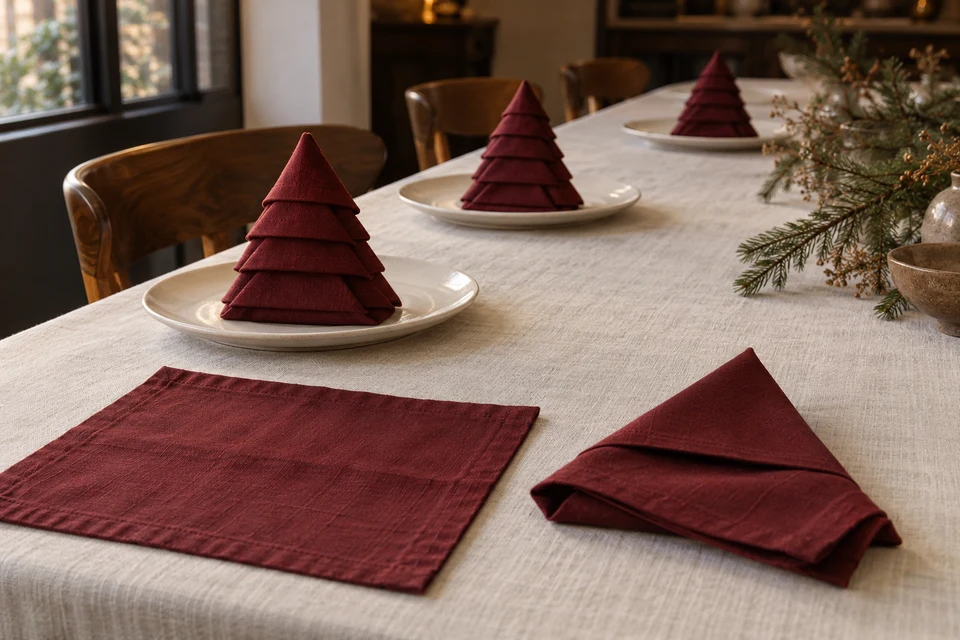
A Christmas tree made from folded cloth can be a seasonal service presentation rather than a separately manufactured tree-shaped product. That distinction changes the order: the buyer purchases a flat napkin and approves a preparation method. Define the cloth format, the desired fold and who performs the work. Do not confuse this program with a sewn cutlery sleeve or assume that every square napkin will reproduce the same layered silhouette.
Name the flat product being purchased
The fold is a preparation state, not the cut shape
Specify the finished square dimensions, material construction, edge finish and color before discussing the tree silhouette. Ask whether the napkin is supplied flat, conventionally folded or pre-folded into the seasonal shape. If a pre-folded service is proposed, record how the shape is held during transport and what the receiver must do to restore it. The invoice should not leave the buyer guessing whether the quoted unit includes preparation.
The table-linen procurement guide can hold the flat product specification. Keep a separate page for the seasonal arrangement. A tree-shaped sewn pocket has a different construction and should remain a different product, even if both appear beside a plate in the same Christmas catalogue.
- Record the flat square and its finished edge construction.
- State who performs the tree fold and when.
Trial the layered fold with the proposed cloth
Thickness and edge bulk affect the outline
Use the actual sample to make the intended fold, noting the sequence and the visible layers. Observe the tip, lower branches and base from the seated position. If the cloth springs open or becomes bulky where several edges meet, record the result rather than trimming or hiding part of the napkin for the photograph. Compare alternate materials using the same folding sequence and plate arrangement.
Review the edge through the napkin corner and hem inspection. The goal is not to prescribe a universal fabric weight; it is to select a construction that the operator can prepare consistently. Any starch, pressing or other preparation must be agreed and compatible with the actual care and service system, not silently added only for approval photography.
- Keep the folding sequence consistent between candidates.
- Record every preparation step used to hold the shape.
Check the guest-facing setting
A decorative fold must still become a usable napkin
Place the folded tree on the intended plate or setting position, then ask someone unfamiliar with the design to pick it up and unfold it. Look at whether the guest can understand the object without disturbing adjacent items. Keep the table trial free of unsupported food-contact or hygiene claims; those depend on the actual product, preparation and service arrangements rather than the shape of the fold.
The restaurant folded-napkin trial offers a useful operational comparison, but a tree fold does not need to function as a cutlery pocket. Decide whether the design is purely decorative and make that scope clear. Avoid inserting extra pins, clips or ornaments solely to make the sample stand upright unless they are separately specified and assessed.
- Trial picking up and unfolding the napkin.
- Do not hide unapproved supports inside the display.
Measure preparation and reset in the actual operation
Seasonal labour is part of the buying decision
Ask the team that will prepare the service to repeat the fold across a representative set. Record the time and corrections observed without presenting that small trial as a universal productivity result. Include the space needed to hold prepared napkins and how they are transferred to the table. A presentation that works for a small display may need a different preparation plan for a full banquet.
Link the selected cloth to the laundry and operating trial. Review the fold after the proposed care process as well as on a new sample. If the operator chooses a simpler fold during busy service, retain it as an approved alternate rather than treating every difference from the Christmas photograph as a manufacturing defect.
- Record the observed preparation sequence and correction points.
- Approve a practical alternate if the service team needs one.
Keep counts and claims tied to flat napkins
Avoid a misleading seasonal selling unit
State the number of flat napkins in the selling pack and identify whether plates, props or folding instructions are included. If the photo shows a complex tree form, make the supplied condition clear to retailers and online buyers. A bulk carton of flat cloths should not arrive where the customer expected ready-to-place shaped pieces. Resolve this before calculating store allocation or service quantities.
Use the pack-out checklist to preserve that unit definition. Ask for actual minimum quantities, sampling and confirmed timing for the chosen cloth. The seasonal value comes from a reproducible presentation on a suitable product, not from renaming an ordinary napkin without explaining the preparation required.
- Confirm flat-piece count and supplied folding condition.
- Align retail images and copy with the actual delivered unit.
Approve the flat napkin, the documented fold and the service preparation plan together. FY Bedding can review the cloth specification and sample requirements; the operator should confirm that the selected presentation is practical for the intended Christmas service.